Auditions

There’s a trite saying about writing that unimaginative professors like to trot out when they’ve run out of original thoughts: “Writers write,” is what they say, generally with a smug, knowing look.

Although this is a meaningless phrase disguised as something profound, we can actually make use of something like it when we think about acting: “Actors act.”

But here’s the thing: while this is self-evidently true, the fact is it’s not only actors who act–we all act, every day, even those of us who have never set foot on stage.

Every job interview, every time you order a coffee, every time you say hi to your neighbors or even talk to your mom on the phone, there is an aspect of performance involved: we are presenting a certain version of ourselves to the outside world in the hopes of garnering a certain response.

That’s not to say that everything everyone does is fake, just that it’s important to keep in mind that we’re all “on stage” all the time–especially when it comes to auditions.

So you’ve done all the prep work, you’ve learned your sides and done your research on the character’s arc and the piece you’re auditioning for, and of course that’s the core of the audition. But there is so much more! Here are a few non-acting aspects of auditioning to keep in mind.

1. You Are On Stage

In keeping with the idea that we’re all acting all the time, it’s important to keep in mind that you are being evaluated from the moment you walk into the audition waiting room. Especially at an audition–which is of course all about evaluating actors–people are watching you as soon as you enter. I have seen far too many actors behave abysmally toward the person taking names and headshots outside the audition room, not realizing that that person is often much more than a secretary; they might be a production assistant, or even an assistant director if you’re auditioning for a low-budget play production. Then there are the other actors in the room, actors you might end up working with should you land the role. So be on your best, most professional behavior the entire time you’re there. Treat the pre-audition part of it for just what it is: a job interview. Sure, if you know other actors there, say hello and chat briefly, but this isn’t a time to share vacation photos and laugh uproariously at your drunken antics in Cancun. Get yourself mentally focused on your job, maintaining a professional, friendly, and confident demeanor.

2. Hit Enter 

Speaking of having a confident, professional demeanor, they say first impressions are the most important ones. And while we’d all like to think that given a chance to convince someone, we could get them on our side even after a bad first impression, there’s still some truth to the notion that you are stuck with whatever reputation you cemented when you first met someone. Malcolm Gladwell’s eye-opening book “Blink” strives to demonstrate through an exhaustive list of scientific studies that the human mind makes evaluations and judgments long before we are conscious of it–and they are often more correct than those we make with more time and research. For instance, according to Gladwell, this “thin-slicing” or using a very narrow window from which to evaluate something or someone is what allows us to instantly know how a person is feeling based on their facial expression and body language. So if you scuttle into the audition room like a terrified mouse who is fearful of being stepped on, that sends a signal to the casting team, and it’s not the kind of signal you want to give off. Yes, entering the room subjects you to an array of new stimuli, and it’s a lot to take in while your brain is already working overtime to remember your sides. But just remember, you are a professional. This is what you do, after all. You got this. Enter the room with your head held high, with a bright smile and greet the casting team. One useful tip is to not focus on relaxing yourself or forcing down your own nerves, but rather focus on getting the people behind the table to relax and be comfortable with you. Even a calm, direct gaze and a smile along with a hello can reassure casting directors that you know what you’re doing.

3. Don’t Bend the Knee

Speaking again of confidence (funny how that keeps coming up, huh?) a big mistake rookie actors make at auditions is they treat the casting director and their team as if they were gods seated on Mount Olympus passing judgment on the unworthy. But unless you happen to run into a pathological CD, craven servants is not what they’re looking for. These folks are just like you: professionals looking to work with a team of creative people to make something unique and valuable. They don’t need empty vessels to fill, or pawns to manipulate; they need collaborators who will bring their own autonomy and agency to the role and to the production and put their unique stamp on it. They are people too; treat them as such and you’ll make them very happy and avoid awkwardness.

4. Pleased to Meet Me

The way you slate is important for all the same reasons outlined above: that’s the very first thing the client, director or producer is going to see of you. There are people who suggest slating in character for this reason, and certainly that’s an option. But most CDs agree that a simple, open, friendly slate as yourself, then taking a beat to shift into character is the way to go. This way you not only show them who you are: a pro who is confident and on point, but also you show them your ability to shift gears into character.

5. Exit Stage Left

The exit from the audition room is just as important as the entrance. After your read, take a beat to let the piece breathe, then make eye contact and say thank you. It’s okay to hold for just a half beat to see if they have any questions or if they want you to go again and make an adjustment, but don’t linger. The only thing worse than an actor silently begging for approval with big blinking doe eyes aimed at the casting team is one who apologizes profusely right after they read. It’s done, the moment has passed, and it’s time to move on with your life and let them move on with theirs. Say thanks and head toward the door with a calm, confident, deliberate stride. Remember, you’re still performing until you hit the street. Most of all, break legs and have fun!

6. Get More Auditions

Don’t forget, sites like this one are invaluable tools for getting your foot in the door and getting seen by casting directors! Post your resume and sign up for email alerts today!


Shakespeare App

A Conversation With Actor and App Developer Ron Severdia 


If anyone might have legit reasons to get frustrated with the modern world’s total enchantment with cell phones, it’s actors.

For starters, how about when someone’s phone rings in the theater while you’re in the middle of your big monologue? Or the annoying glow of people texting in the movie theater while you’re waiting for your scene to come up? Or even just clueless people clogging up the sidewalk with their faces glued to the screen when you’re running late for an audition?

But don’t smash your phone with a hammer and go full Luddite just yet, fellow actors. Although there are reasons why modern technology is annoying, the good news is there are plenty of people out there who sympathize with the plight of the performer. Some of them are even trying to make our lives easier using apps.

One such developer is Ron Severdia, the brains behind the Shakespeare Pro app, along with a whole suite of apps designed to assist busy performers, directors and stage managers. Severdia is also an actor, naturally, and he is currently winding down a world-premiere run of a stage version of “Sideways” based on the 2004 Paul Giamatti film in his home stomping grounds of Northern California.

“I’m in Marin County and so just north of me is Sonoma County and Napa,” Severdia said via Skype, “and that’s where the theater is, so it’s a good fit.”

But between performances–and one assumes generous wine-tastings after every show and perhaps even during–Severdia is hard at work tweaking his flagship app, Shakespeare Pro. It’s a tremendously useful app that offers an array of tools for helping the busy actor work on plays and sonnets written by the Bard of Avon.

And while Severdia clearly takes great joy in easing the way for other actors to bring Shakespeare’s works to life for modern audiences, the app originally came about not via any great streak of altruism, but strictly in self-defense. To be more specific, Severdia created it in order to save on chiropractor bills.

“So I was in a production of ‘King Lear,’ and I had this big, massive tome like many actors have of his Complete Works, and you end up breaking your back with that,” Severdia said. “The cell phone at the time, the most advanced one was probably the Treo made by Palm. And they were terrible, like all cell phones before the iPhone. But I had actually created a website that my cell phone could access with the Complete Works on it, and that was PlayShakespeare.com. So that was version one of the app, even though it wasn’t really an app, just a way I could access the Complete Works without carrying this big book around with me.”

But all that changed–much like the world itself did–with the advent of the iPhone.

“With the first iPhone you couldn’t install apps, you could just use the ones it came with,” Severdia continued. “I could still access my website with the Complete Works on it. But once they launched the App Store, within about a week and a half I had an app up there. So it’s been almost ten years now, almost since the beginning [of both the iPhone and the App Store] that I’ve had an app available there.”

But longevity is just one aspect of the Shakespeare Pro story. For the working actor who faces the daunting task of preparing for a Shakespeare audition or production, the depth and breadth of the array of features available are truly a godsend.

Not only are all 41 plays, 154 sonnets and six poems including the “doubtful works”  preloaded, there is also a Study section that includes articles on Shakespeare’s bio, the chronology of the plays, a section on Elizabethan theaters, and best of all, an in-depth section on scansion, so you can brush up before that big audition.

But one particularly exciting addition with the paid version of the app is the ability to use “notebooks,” materials you create yourself or pre-prepared ones that you can access in conjunction with the play you’re reading.

“Your notes are collected into notebooks, and you can share those,” Severdia said. “And there’s some free notebooks that come with the Pro version, so for instance, with ‘As You Like It,’ you can just import that notebook and there are notes and commentary running throughout the play. Teachers for example can share their notes with a class.”

As an actor who loves really digging into the plays he performs in, Severdia has come at the problem of creating a user-friendly approach to Shakespeare that fellow actors are sure to love. The Pro version for instance comes with an advanced search feature, which allows you to search not only the scene you’re reading, not only the play you’re currently reading, but also across all the plays if you want.

“We’re putting a lot more focus on the power of search,” Severdia related. “You can say only search the comedies, or only search ‘Coriolanus,’ or search everything. So you can get a lot more granular and specific like that.”

What’s more, theater nerds unite: the latest iteration of the Pro version also includes the First Folio in the original spelling, with a great bundle of ways you can use it. You’re able to not only include the First Folio in your searches, but in the next big update, due out in a few weeks, the search engine Severdia has created will allow you to search for a word in the modern spelling, and also bring up instances of the word in the First Folio in every alternate spelling that exists there.

Even better for those who truly like to go on a deep dive when it comes to learning Shakespeare, you can read the First Folio and the modern text together.

“One of the scenarios we implemented was a First Folio comparison,” Severdia said. “Say if I was doing ‘Hamlet’ and I wanted to see what the First Folio text looked like in comparison with the modern text. You can read those side by side. Some people believe the way the text was laid out in the First Folio gives you clues and insight into the way the characters should speak, or certain other things about the character, and also where you could take a breath and where you shouldn’t, things like that.”

Severdia has also written a clever graphic analysis tool that actors and readers can use to view the arc of each individual character, not only counting the lines they have, but charting the scenes they’re in and with whom. But perhaps best of all for both the seasoned Shakespearean actor and the layman is the inclusion of a Shakespeare glossary. Based on the book “Shakespeare’s Words” by David and Ben Crystal, the fully integrated glossary allows you to tap on a word in the text and see its definition in the context of the line, not just a general definition.

As if that weren’t enough, another app that is perhaps even more ambitious Severdia is working on is called Scriptigo. The app seeks to completely replace paper scripts for actors, directors and stage managers. Stemming from a staged reading Severdia produced that took place at the Apple Store in San Francisco some years back in which the actors performed Macbeth reading their sides only from iPhones, Scriptigo launched a couple months ago, but is already turning heads in the professional theater community.

“Basically it’s geared toward being used as the script in the rehearsal room or in a film production,” Severdia said. “I’m working with the Oregon Shakespeare Festival on a pilot. I’ve been talking with them about this for about a year and a half, about their needs and what would work best for them, as they are one of the largest Shakespeare festivals in the world. So you can import your scripts, but Ashland [Oregon Shakes Fest] is using all my scripts for their productions as a starting point, and then of course the director edits them.”

The digital nature of the script implies several innovations: people with editing permissions like the director and dramaturg can edit the play on everyone’s script all at once; the stage manager can take all the notes and push them to the appropriate actor or the entire cast and crew as needed; actors can still take their own notes, as well as include audio clips or even photos if they want; and the entire production can be archived and accessed later; if the show goes on tour, for instance, it’s easy to bring new cast members up to speed.

“We used it in this production of ‘Sideways,’ Severdia added, “so that was sort of our real world beta test, if you will, and it worked really well. We got some good feedback to improve things. I think it’s really where the future is as far as script and production work is happening. There’s a big green initiative at the Oregon Shakespeare Festival. Plus they can save thousands of dollars every month just by not printing scripts. So the price of Scriptigo is just a fraction of what they can save, even if they just cut down on their printing rather than entirely eliminate it.”

A third app Severdia has authored is Soliloquy, a monologue manager that comes preloaded with over 1100 classical monologues for male and female actors of all ages. Users are also able to upload and store monologues as well, sorting them by run time, comedy or drama, and a variety of other criteria.

The bottom line is that it’s worth it for actors to take a moment to visit to Severdia’s section of the App Store. Even if you stick with the free version of Shakespeare Pro you’re doing well for yourself. But at a mere $9.99 for the full pro edition, as Severdia says, you’d be hard-pressed to find a better deal.

“If you add up all the costs, and you look at what a Complete Works costs, I mean I’m sure you could find one at a garage sale or something for ten or fifteen bucks,” he said.

But certainly not one with all the additional features to make life easier for the actor or student studying Shakespeare.

And let’s face it, these days we need all the help we can get–might as well make our cell phones work for us for a change!

Go to playshakespeare.com for more information on all the apps mentioned above.

Shakespeare Pro: available on App Store/Google Play – free/$9.99

Scriptigo: available on App Store – free/$4.99 – Pro-Sharing version: $5/mo subscription

Soliloquy: available on App Store – free/$1.99

Shakespeare Pro (Apple): http://bit.ly/shakesproapp

Shakespeare Pro (Android): http://bit.ly/shakesandroid

Scriptigo (Apple): http://appstore.com/Scriptigo

Soliloquy Pro (Apple): http://bit.ly/soliloquypro


Make your own work

Actors probably more than any other profession go through peaks and valleys when it comes to working. That’s just the nature of the business. Even the most bankable Hollywood stars have fallow periods where there just aren’t so many jobs lined up.

First and foremost of course, is to make sure you’re wired in to the latest, most up-to-date listings of auditions in your area, and that you’re receiving audition notices as soon as they come out.

Even then, it’s not unusual for actors to find themselves with no particular gig to prepare for. What to do?

Well, if you’re serious about developing your craft and being a professional actor who regularly books work, sitting around in your pajamas eating Cheetos while binging on Netflix shows for days at a time is not an option. Even if there’s no audition, show or film to prepare for, there are ways to get yourself seen, and in the process keep your acting chops in tip-tip shape for when that perfect audition notice does slide into your inbox. Here are a few ideas.

1. Have You Heard of This YooToob Thing?

Yes, believe it or not there is a platform out there on which you can post virtually any type of video you want! Not only that, you’re probably carrying around a tiny computer in your pocket right now that not only has the processing capacity that a full-sized desktop computer had just a few short years ago, it also comes with a video camera that can shoot in high definition. It’s kind of astounding how many actors–who are generally creative, outgoing, fun people–fail to take advantage of modern technology and film themselves and their friends doing scenes, monologues, or even improv. You’re not even constrained if you don’t feel ready to write a whole screenplay; perform a monologue or read a scene with a friend and film it. There are limitless lessons to be learned from watching yourself perform, even in a format like this one. What’s more, if you like the way it turns out, you never know who might run across your vid if you post it with the proper tags. And when it comes to writing something original, remember two things: one, every great film or play started with a scene, which started with a single line which started with a single word spoken by a single character. Just start! Open a blank word document and see where your imagination takes you. There are a million resources out there on screen and playwriting–read up on the craft and have a go! The second thing to remember is that as you create, so too can you destroy. Anything that you don’t like need not make it into the public eye. The beauty of creating work this way is that as writer, director and editor, you have control over what goes into the final product. This is also a helpful mindset when it comes to feeling embarrassed or uncomfortable when filming: if it sucks, cut it and try again! Extra bonus: working in front of the camera on your own or with your friends can help you to be more relaxed next time you’re in front of the camera for an audition.

2. The Play’s the Thing

No matter where you live, there are live theater performances happening somewhere nearby–and there’s nothing like the joy of producing something from start to finish and presenting it to the public. A quick search on how to produce a play is a way to start, but it’s likely that there are people in theater groups in your area who would be happy to sit down with you and give you a sense of how to get the ball rolling. The best thing about producing your own theater show is you get to choose what show to produce–and you also have a say in the casting, hint hint. In all seriousness, even a few friends who are eager and excited to perform can make a staged reading or black box show a night to remember for audiences. Another tip: if you agree to donate any proceeds to charity, you can not only create a buzz and attract audience members who might not otherwise go to see a play, you can also get local businesses on board to donate supplies like printing needs and even a space where you can perform.

3. Read Read Read

There are a million book clubs out there–why not start a play-reading club? Gather your actor friends and even those who are aspiring to be actors and get together for weekly scene-readings from your favorite plays. There are a million ways to format this, but one fun way to really explore a piece is to start with reading the entire play aloud the first night and briefly discussing it. Then the following week come back with thoughts and more in-depth discussion, then start going over the play again a scene at a time, perhaps switching up roles and reading the same scene multiple times in a night. And remember, helping others helps yourself too. If there are people in your group who aren’t as advanced when it comes to acting, sharing your experience and insight with them helps you too. In the act of sharing what we know, we often help to clarify it for ourselves and we can even gain new insights.

4. Go to University

Local colleges and universities often have aspiring filmmakers and directors who are hungry to create new work every semester. Look up theater departments and film departments in your area and ask if they’re looking for talent. When working with student creatives you can often find yourself at the heart of the collaborative process and taking a strong hand in crafting something from the ground up. What’s more, you never know where a contact made in this way can lead in the long run!

5. Keep it Classy

Don’t skimp on taking classes in your down time between jobs. You never know who might be attending a particular class, or how networking with classmates might pay off down the road. And when it comes to being seen, ask if a class you’re considering culminates with a performance or showcase at the end. You might be surprised at the number of talent agents and casting directors who attend such events.

6. Submit!

Don’t forget to self-submit! Sign up for sites like nycastings.com and get your resume and reel in front of the largest pool of agents and casting directors you can! And break a leg!

Audition mistakes

“An audition’s an opportunity to have an audience.” — Al Pacino

As actors we spend a lot of time thinking about auditions, and that’s probably okay. After all, the audition is our version of a job interview!

But problems can arise when actors develop bad habits with regard to auditioning; after all, most types of work don’t require the ongoing series of constant “job interviews” that performing does. So with that in mind, here are the top five bad habits to avoid when auditioning.

1. It’s All In Your Head

Yes, it’s true that actors think a lot about auditions: how to get them, where to find the latest notices and how to succeed once they have them. But let’s face facts: most actors don’t follow Al Pacino’s advice. They don’t look on auditioning as an opportunity, they see it as a chore. Indeed some actors get so stressed about auditions that they never really give themselves a chance to let their true talents come out at all, let alone shine and rise above the competition. It’s a tall order, no doubt! But the thing about negative thoughts is that they have a tendency to manifest themselves in our emotions. From there they show up in our actions, whether we intend them to or not. If your general mindset toward auditions is one of stress, tension, and dread, that’s going to be apparent in your read. The first bad habit to break is the negative thought cycle. Take Pacino’s words to heart: don’t look at your audition as an odious, nerve-wracking chore; rather, here’s an opportunity to commiserate with some fellow artists who are also theater or film professionals and show them what you love to do! You get to act for someone–how is that not a great thing for someone who loves to perform? Second, realize that acting in general is stressful. Stepping in front of the camera or onto a stage is not easy, and it’s not for everyone. It takes a lot of courage. Good news: as an actor you possess that courage. Turn it around: view your audition as a chance to rise above the other nervous, stressed-out people at the audition, and demonstrate that you are a fearless, bad-ass actor who is ready for prime time. Banish negativity and let positive thoughts and feelings flow through you.

2. Set Your Damn Alarm

If the number one audition killer for most actors is stress, then the number one cause of said stress would have to be arriving late. You must, must, must find a way to get to the audition on time–and by that we don’t mean RIGHT on time, we mean early. You’re asking yourself–your mind, your body and your emotions–to do something very difficult under stressful circumstances. You have to give yourself 15 minutes to center yourself, settle into the waiting room, and clear your mind. Bashing through the door and lunging up to the sign-in table out of breath one minute before your scheduled time almost guarantees a less-than-ideal read. Get yourself in there with plenty of time to spare, walk in with a smile and a positive attitude, sit yourself down and do what you have to do to relax. If you feel the need to look over your sides, go for it, but realize that at this point frantically peering at the crumpled, sweaty paper in your hand and soundlessly reciting the words over and over again is unlikely to make much difference other than to stress you out more. Which brings us to:

3. The (Professional) Actor Prepares

Look, we all get it: you only got those sides last night. You had a late shift. Your roommate was on the phone all night fighting with a significant other. Your dog had diarrhea. Of course it was hard to get ready for the audition. Guess what? It was hard for everyone. And anyway none of that matters if the other actors in the waiting room are better prepared than you. You have to find a way to get done what you need to do. However, a corollary to this is that being prepared doesn’t necessarily mean being off-book. Casting directors get it too: this is a fast-paced business and actors are constantly being wrangled into auditions at the last minute. The bad habit to break here is two-fold: one piece is cheating yourself by not doing absolutely everything you can do to get ready–be honest: you know when you’ve cheated yourself of your best shot at it. Just remember, when you’re tempted to quit and see what’s new on Netflix or scroll through your Instagram feed “just for a second,” realize there are other actors who are still working on those sides. The second bad habit is to allow yourself to feel flustered and rattled and overstressed if you’re not completely off-book. If you’re relaxed and in the moment, but you glance down occasionally at your sides–while having a solid grasp on the character and the scene–that’s a damn sight better than having that glazed look as you stare at the ceiling and sweat out a word at a time or completely go up. The words aren’t as important as the acting. Better to be in the character and in the moment and comfortable, even if you’re holding the sides.

4. The Nerve of That Guy

The thing about being nervous is that in a way it’s a good thing: the adrenaline rush we get from acting is a big part of the reason we do it, and it’s what lends life to performance. That said, this can go sour if you let it turn negative and shake you out of your confident, prepared, professional zone and mess with your thoughts. Someone once said that worrying is like walking around with an open umbrella in case it rains. Same goes for being nervous in advance of an audition. What are you worried about? You’re not going to die here. They’re not going to shoot you or stab you if you drop a line. They’re not even going to burst out in laughter and mock you. And so what if they did? This is one of a million auditions you will attend in your career; realize that and realize that it’s just not that big a deal. You’re not here to pay homage to some grand poo-bahs behind that table and beg for a job; you’re here to have fun with some other artists, see if there’s a chance you could collaborate, and do what you love to do–so enjoy yourself!

5. Just Go Already

After your read, two things: if they don’t suggest it or ask if you want to try again, don’t ask to do another read. It’s a sign of insecurity, and anyway, if they liked your first read, don’t argue with them! Don’t hang your head or say anything negative about your read; it was what it was, and you never know if what they saw is the same as what you felt. Let it go the moment you finish. Second, there’s a subtle art to exiting the audition room with a bit of hesitation to give them a chance to ask you questions or otherwise converse, but don’t let it get out of hand. Don’t rush off like a frightened rabbit, but dear God, don’t stand there for 15 seconds and beg for approval with your eyes. Say thanks, give it a very small beat, then make a calm, purposeful and professional exit. And head to your next read!

Casting Director watching actors reel

When we talk about the tools actors need in order to secure auditions, the first thing most people think about is headshots. And of course, having a quality headshot is vital–as is getting the latest casting alerts and submitting your resume to places where casting agents are actually going to see that killer headshot.

But one key tool to getting into the audition room is the oft-neglected demo reel. And it’s a shame too, because while a good demo reel may not book you a role on its own any more than a headshot will, your reel can often be the deciding factor that will at least get you in front of a casting director so you can have a legit shot at booking a job.

So how to best maximize your chances of getting the audition using your reel? Here are a few basics to keep in mind.

1. Sell Yourself

If we can think of the headshot as a newspaper ad or billboard pitching your wares as a performer, then the demo reel is your television commercial. This is your moment to shine, your chance to show yourself in action. Not only do you get to let your acting talents come out, the reel is also where you are able to demonstrate your more subtle inner qualities as well. This is where you can let them see what makes you tick, a chance to tell a story about you and your personality much more so than in a static headshot. That’s why it’s so vital to have a good one. This is a commercial for the product that is you–so make it look good! What’s the first thing to cross your mind when you see a commercial? If the spot even managed to somehow make enough of an impact to penetrate your consciousness, the first thing you might think of is how much you might like to have the product or service advertised. Commercials were invented to create desire, and that’s exactly what you want to do with your demo reel: you want them to want you. The second thing we usually think about when we see a commercial is paying for the goods or services advertised: how much is it worth? And is the cost on a par with what I would get out of it? It may seem terribly crass to put it in these terms, but this is exactly the way casting directors and producers think of actors–and it’s the way we have to learn to think of ourselves too. It’s called “marketing yourself” for a reason: you’re asking casting directors and producers to invest in you. You’re asking them to trust you and your talents with their project as well as their money. A film or television show is a massive investment, not only in terms of cold hard cash, but also time, effort and manpower. The people who are looking at your reel are the gatekeepers watching out for their investors, so your marketing materials have to be top-notch in order to make the sale. When you’re considering what to put on your reel, it’s advisable to think about it this way: you’re selling a Lexus, not a broken-down Craigslist fixer-upper. Use only stuff that shows you at your best and your most professional. Older material and amateurishly-shot scenes should remain in the “friends and family” folder on your hard drive.

2. So What About Material?

In keeping with the above, it’s advisable to use only scenes that come from professionally shot pieces, film and television preferably. There was a time when casting directors would advise actors to hold off on even putting a reel together until they had sufficient professional credits to pad out a 90-second to two-minute reel. However, times are changing in this regard. These days not having a reel is tantamount to not having a headshot–no one is even going to look at you without one. So where can you get material to put on your first reel? The good news is that even if you’ve done most of your work on the stage and don’t have a lot of film or television credits yet, you can still find ways to create a reel that can have an impact on casting directors. There are services in New York and L.A. that will shoot you under professional conditions for the purposes of creating a reel. But even if that’s something that’s out of your budget or not in your area, there are other options. Most universities, even if they aren’t big enough to have a dedicated film department will still have students making films–and student filmmakers are always looking for actors. It won’t pay, but for an actor looking for material to put on a reel, the trade-off of time and talent in exchange for a scene or two of cleanly shot, professional quality material is well worth it. Additionally, more and more casting directors and agents are becoming more lenient when it comes to the rule about strictly using professional material for your reel. There are plenty of actors out there who have shot themselves doing a monologue or two or a scene with a friend and used that for their first reel. Just make sure your lighting is adequate and that your performance is the best you’ve got. And once you’ve booked some professional gigs, rotate those self-shot scenes out of your reel.

3. How To Put It Together

When you’re editing your reel and getting it ready to send out, keep in mind the truism that casting directors are some of the busiest people on the planet. Naturally, you’re super proud of the scenes you’re putting on your reel, and so of course you want to present them in the most eye-catching, flashy way possible. But using a long opening sequence is a mistake; if it takes ten or fifteen seconds to even get to your first scene because you’re using a lengthy opening montage or a soaring music track playing under your name presented in flashy graphics, it’s likely the casting director will have moved on before you ever get started. Get your name on there, a link to your email address and/or website, and frontload your reel with your best scenes. You’re looking to catch their eye, not make an award-winning short. Saving your best material for a big reveal at the end probably means no one ever sees it.

The “too long; didn’t read” nutshell for putting together a reel is this: gather three to five of your best, and only your best scenes, even if you have to shoot them yourself. Put the best of the best first, along with your name and contact info, keep it under two minutes, and make sure the focus is on you. Then post it to your website, your YouTube channel, and casting sites like this one and get ready for the offers to roll in!

Upload your Reels now!

Hugh Jackman

A few years ago the brilliant “Key and Peele” sketch comedy show featured a hilarious parody of “Les Mis” that had even fans of the musical rolling in the aisles. To give you some idea, it currently has some 8 million views on YouTube.

But one of the forgotten yet very funny pieces of the episode was the intro to the parody sketch. In it, a girl is trying to convince her boyfriend to go see the film version of the musical with her:

“Your boy Wolverine is in there,” she says to him.

“Nah, no he ain’t. No way…Who else is in there?”

“Gladiator.”

A funny bit, sure, but one that raises a great point for actors: let’s talk about versatility, and the doors it can open for you.

Now, a supremely talented actor/singer/dancer/action star like Hugh Jackman is obviously a rarity–just ask Russell Crowe, right? So of course we can’t all sport adamantium claws one week and then host the Tony Awards the next. Even so, we can take a lesson from Jackman on the importance of being versatile.

Far too many actors find their niche, and over time it turns into their comfort zone, and finally it becomes a trap they find they cannot escape. Sure, it’s nice to have an area in which you know you can hit it out of the park every time. But the danger of never trying new things is that in the process, countless opportunities pass you by. So here are a few things to think about in terms of your versatility as an actor, along with some ways to bust out of that comfort zone!

1. Medium, or well done?

There are a few ways we can talk about versatility as an actor, but the first and most obvious one probably has to do with the medium you work in. Far too many actors find the one thing they’re good at and then avoid everything else like the plague. How many times have you heard a variation on this: “Oh, no, I don’t do musicals. I can’t sing (or dance).” Or, “I don’t really audition for straight plays. Drama’s hard.” What a strange and fearful admission from someone like an actor! Think about it: actors are some of the most courageous people out there when it comes to taking risks that might result in public embarrassment. Without thinking twice an actor at a party might launch into a comic routine about his or her first kiss, or perform at an improv show a scene in which they’re crawling around like a worm with their hands behind their back while reciting the alphabet. (True story; don’t ask.) So why on earth would people who are naturally this way, people for whom public performance is their life and what they live for–despite the inherent risk of failure–why would they shy away from what is basically just another type of performance? Same goes for people who are reluctant to switch from stage to film, or vice versa. We have to remember that we were all newbies at one time or another, in everything that we now do so expertly. It’s vital to keeping our instrument honed and sharp that we continue to place ourselves in positions where we are uncertain and where we have to push ourselves and our limitations. Plus, by declining to even try working in various media, you instantly reduce your opportunities to book jobs, and nobody wants that.

2. Role-playing

The same concept applies to various types of roles. We all fit a certain general type; for instance you probably wouldn’t immediately think to cast Jim Parsons of “Big Bang Theory” as a tough guy enforcer for a crime syndicate. On the other hand, wouldn’t it be interesting to see him play a role that was the polar opposite of the nebbishy, nerdy Sheldon? He’s obviously not a physically big guy, so what tactics might he use to intimidate or threaten? How might he make his power known and get what he wants from the other characters? We have to be wary of boxing ourselves in to roles that are easy for us to play. I was auditioning for a production of “True West” years ago in which I was reading opposite an actor who is much smaller, skinnier and softer-spoken than I naturally am. Thus I was reading the role of Lee, the sketchy, violent, trashy older brother, and he was reading for Austin, the buttoned-down suburban writer. But in a moment of madness or genius, the director had us switch. At first it was strange, forcing the outward, Id-driven Lee down into the restrained Austin. But we went on to create the show with that configuration, and I like to think that both myself and the other actor found new and challenging levels to our acting by doing so, and that it raised the bar for both us and the show. Bodybuilders know that you can’t grow muscle without tearing the muscle you already have. Same goes for pushing our skills outward and upward: you must take risks in order to grow.

3. In the moment

Finally, we can help open ourselves up to new opportunities by being versatile from moment to moment. Far too many actors come to auditions or report to set or rehearsals with only one way of reading the scene they’re tasked with performing. Of course, as we get off-book for whatever we’re doing, we’re going to incorporate some choices within our performance of the text. But in order to be a versatile actor, and to keep your options open as much as possible, it’s also vital that you not have those choices too solidly locked down. It’s a fine line and it’s a tricky one, but it’s vital to find the flexibility to be able to let go of what you’ve already tried and going in a different direction–not only if a casting director asks you to try something new, but also based on what you’re given from a reader or from another actor. Rigidity is the enemy of growth, and when it comes to auditions, it’s often the enemy of getting cast. Think of being versatile as though you were offering a menu of options: yes, you’re going to be off-book and you have thought through the character’s actions and what he or she wants in the scene and how you might try to get it. However, you are going to bring with you a set of options for the casting director–and you are going to be open to letting them order a la carte as well!

At the end of the day, being versatile is about being open, relaxed, brave and ready to experiment with whatever comes your way as an actor. Be like Wolverine: bring your trusty adamantium claws, but also develop your dancing and singing ability, and you are certain to book more jobs!

Biggest problem in getting the audition

You know that old saying ‘I was at the Right Place at the Right Time’?

Well, the right place at the right time in Show Business is the Casting Room for the Audition.

And the #1 reason why Actors or other types of talent don’t get as many auditions as they like is they simply didn’t know about the audition to begin with…

If you didn’t know about the audition, you certainly didn’t submit yourself, so the Casting Director (or Director, Producer or Photographer) overseeing the project never got the chance to consider you for the job.

So, that means you clearly weren’t at the right place at the right time, but the good news is, it’s such an easy fix.

First, here is how the casting process works most of the time for gigs that are not requiring Celebrity Talent: 

When a project starts casting, the Casting Breakdown is sent out to various Casting Services and Casting Websites. Once that happens the Casting Team is expecting submissions to come in right away and they start looking over everyone and making choices.

Additionally they will call Talent that they have worked with in the past that will be a good fit for the project. This is the #1 Best Reason to get called in and probably yields the best change of getting the gig. 

Lastly they may also search the databases of these same services for more options, but usually only if they are not seeing the right people though the incoming submissions. The reason being: searching the databases is far more time consuming. When they reach out to the talent out of the blue, they have to explain the project, then send an email with all the info about the project and themselves, and hope the talent is available and willing to do the project. All to often it ends in a no-go for any number of reasons – not available for casting or shoot dates, not enough pay, wrong skillset, etc.. 

So, the Direct Submission to the Casting Notice is the way they’re seeing most people most of the time for your garden variety jobs. 

Now, Back to Knowing about the Auditions:

I find myself wrapped up in conversations often with people who say they aren’t getting many auditions. So, when I’m in these conversations, I basically start asking the same list of questions to get to the core reason of WHY this person isn’t getting in the Casting Room.

After hearing them out I start my line of questions:

Well, are you looking though all the auditions that come in through NYCastings Every Day?

The Common answers from these people is often: ‘No’ or ‘Sometimes’ or ‘Once’

Anything other than ‘Yes, I look through them every day’ means you’re missing out on knowing about the auditions. (Most projects are only up for a few days, then their gone.) And If you know about them, the next step is making your submission to the Casting Director.

Next I say, ‘Well, why not look for auditions everyday as part of your daily routine?!?

The Common answers are: ‘I don’t have the time for all that’, ‘I don’t think it works’ or ‘I have an agent, I let them do all that.’

1. For the ‘I don’t have time for all that’ people, I say, ‘It doesn’t take more than a few minutes every day to see all that is casting, and make your submissions. So, you could just start with that and things should pick up right away.

If you haven’t already done so already, make it easy for yourself, Join the Mailing List for Casting Notices, Set up Customized Casting Alerts for Your Type and Area, and Make sure your Resume is set up and looks as amazing as possible, so you can submit yourself whenever you see somthing your right for.

2. For the ‘I don’t think it works’, I say ‘Look at our Top Bookers, they work hundreds of days a year from the same Casting Notices that you can be submitting to. Example:

3. For the ‘I have an agent, I let them do all that’ people, I say, most Actors that I know, tell me that they get more work for themselves than what their agents get. Now this situation can vary greatly based on the individual and agent, but there is still far more work out there that an individual agent does’t know about or doesn’t care about. And it’s totally possible the agent isn’t even submitting you much or at all. So if you want more work, you start looking for auditions yourself, AND also look for other agents to work for you.

Now, just knowing about the audition, and submitting to the casting notice is just STEP 1 in solving your ‘lack of auditions’ problem. You still have to WOW the Casting Directors, with great Pictures, Resume & Reels to get the actual audition – pending on the importance of the job of course.

And also of Great importance, is you should only be submitting to Roles, that are a very good fit for your type, and skills. If you are just submitting to anything and everything you see, this will backfire on you in terrible ways! You will look like a time wasting jackass that doesn’t bother to consider what the casting director was actually looking for. You will make a bad name for yourself that may be unrecoverable, so please use good common sense.

We’ll cover more of the complexities of submitting in future stories.

The bottom line is you have to take out all the roadblocks to success 1 thing at a time. Knowing about the auditions is the first and by far the biggest problem by volume that I have seen with actors. Solve this and you can move onto the next roadblock, which is Getting the actual audition.

Headshots

It’s autumn in New York, and naturally a young actor’s fancy turns to thoughts of…new headshots.

Or at least it should. If you have even a vague sense that it might possibly, maybe, perhaps be nearly time for new headshots, that means you’re probably overdue.

This is hard to admit; as actors, very few of us bring home a steady paycheck, and thus of course we’re reluctant to plunk down hundreds of dollars for anything. But when it comes to saving money on headshots, far too many actors stubbornly cling to that ancient headshot taken seven years ago by their college roommate who briefly fancied herself a photographer–before she moved on to being a full-time Etsy crafter and cat blogger.

But the thing to keep in mind about headshots is that they’re not a luxury item. They’re an essential tool that will get you hired–and thus help you earn more money! So with that in mind, here are a few rules to remember about headshots.

1. No *&#%^ selfies!

It’s unfathomable that in this day and age that there are STILL actors out there who think that a phone pic they snapped in their toothpaste-spattered bathroom mirror might be acceptable as a professional headshot. No. Simply, finally, absolutely, NO. Despite the promises of phone manufacturers that the camera on your device is approaching the quality of professional cameras, you STILL cannot use your phone to take your headshot. Even if you look “super cute” in that one pic your friend took of you on wing night at the local bar, a casting director will take one look at that shot blown up into an 8 x 10 glossy and toss it along with your hard-earned resume in the trash without a second thought. A headshot is so much more than a picture; it’s even more than a calling card or a foot in the door. If it’s done right, a headshot is a window into your personality. It’s a captured moment of you acting. In other words, it’s a tiny piece of art, meant to represent the art that you create, and what makes you unique as an artist. You simply cannot replicate that in a selfie or any other camera phone pic. So stop it.

2. Um, who is that?

Another huge complaint casting directors have about headshots is when they don’t look anything like you when you show up in person. This can be due to the fact that you or your photographer went a little crazy in Photoshop and you ended up looking like an airbrushed, plastic doll version of yourself. Or maybe it’s because you’re still using a dated photo. Or perhaps they’re not even that old, but you’ve just changed your look dramatically since you had them taken. Either way, when a casting director you’ve never met calls you in to read, it’s based on what you look like in your headshot. If you’ve recently cut your long, luscious, auburn locks and opted for a bleach-blond pixie cut, that’s all well and good, but if your headshot still reflects that older look, then you’re often going to be wasting the casting director’s time–and yours as well. What’s more, your headshot should look like you actually look on a typical good day, not the way you’d like to look on your wedding day after spending six hours with a hairstylist and four more with a makeup artist. And make sure you look like whatever your current look is: guys, if you’re going for the scruffy, windblown, three-day beard growth vibe in your headshot, show up looking that way at the read. If you look clean-cut and neat in your headshot, well, then that’s what the casting director thinks they’re calling in. Obviously there’s some room for variation here from day to day (who else hates shaving, fellas?) But as a general rule, you should try to match your headshot as closely as possible. Another piece of advice: if you’re changing up your look significantly before your headshot shoot, try and give yourself a couple days to let the new look settle in–and to let you get comfortable with it–before you step in front of the camera.

3. Choosing a photographer

We’ve already ruled out your college roommate, unless he or she is a professional photographer with tons of experience who comes highly recommended. And let’s take that one step further–whoever you hire should not only be a pro photographer, they should be a professional HEADSHOT photographer. The general principles of photography can and do serve good headshot photographers, of course. But there is nothing like having on-the-ground experience for bringing out your inherent look in a headshot. There are camera angles, subtle tilts of the head and shifts in body angles that headshot photographers know how to exploit for your benefit. Don’t trust your luck with a photographer who isn’t well-versed in headshots.

4. Get comfortable

Speaking of the photographer you choose, the chemistry between you and him or her is vital to getting a good result. Try to set up a face-to-face meeting ahead of the shoot, even a brief one, to see if this is going to be a good fit. It’s also a great opportunity to ask about things like their experience, possible reshoots, retouching of photos, and how long it takes them to get the finished product to you. Yes, you’re an actor and you’re going to be “acting” while you’re getting your headshots done, so in theory it shouldn’t matter who’s behind the camera. However, as we all know, there are people we work with who effortlessly bring out our best, and there are times when it’s a bit more like pulling teeth. Do yourself a favor and make sure it’ll be the former with your headshot photographer, and you’ll be rewarded with natural-looking, comfortable shots of you looking at ease, so you can appear in your photos as you really are.

5. Wardrobe

This is a sub-set of the comfort tip above, but it still deserves its own heading. Yes, we all want to look our best on headshot day, but make sure you’re wearing clothes that you’re comfortable in–at least until you get in the groove. One way to approach this is to have your “comfort zone” clothes as a starting point for the shoot. Think casual-nice clothes you might wear to a party where you don’t know that many people. Then, once you get sort of ramped up in to the shoot, you can try on different wardrobe pieces that are perhaps a bit more unfamiliar to you. This way any discomfort you feel won’t be as pronounced. Starting out right off the bat with a brand-new fancy outfit almost always results in awkward, uncomfortable-looking shots. Hold off on that outfit until after you warm up a bit and get comfortable in front of the camera.

There’s plenty of support and recommendations out there for getting quality headshots done. So put away that selfie stick, and get yourself the proper tools for booking jobs!

Mylines

There was a time when the only option for memorizing lines was highlighting your character’s sides in a hard-copy script, then slogging through it a line at a time.

Rinse and repeat.

Eventually, by sheer force of will, you somehow jam that sucker into your skull into a place where it sticks–and hopefully remains accessible on the night of the show or the day of the shoot.

Nowadays however, if you do a search on either the Google Play store or the Apple store, you might be surprised to see what an amazing array of apps are out there designed to help the busy actor accomplish all sorts of tasks: you can track your auditions, appointments and networking contacts, self-tape auditions, convert scripts to audio–heck, there are even apps that can help you write your own screenplay right on your phone, if your thumbs are agile enough.

But of course the work of the actor begins with memorizing lines.

That’s where MyLines app creator Randy Threewits enters stage left.

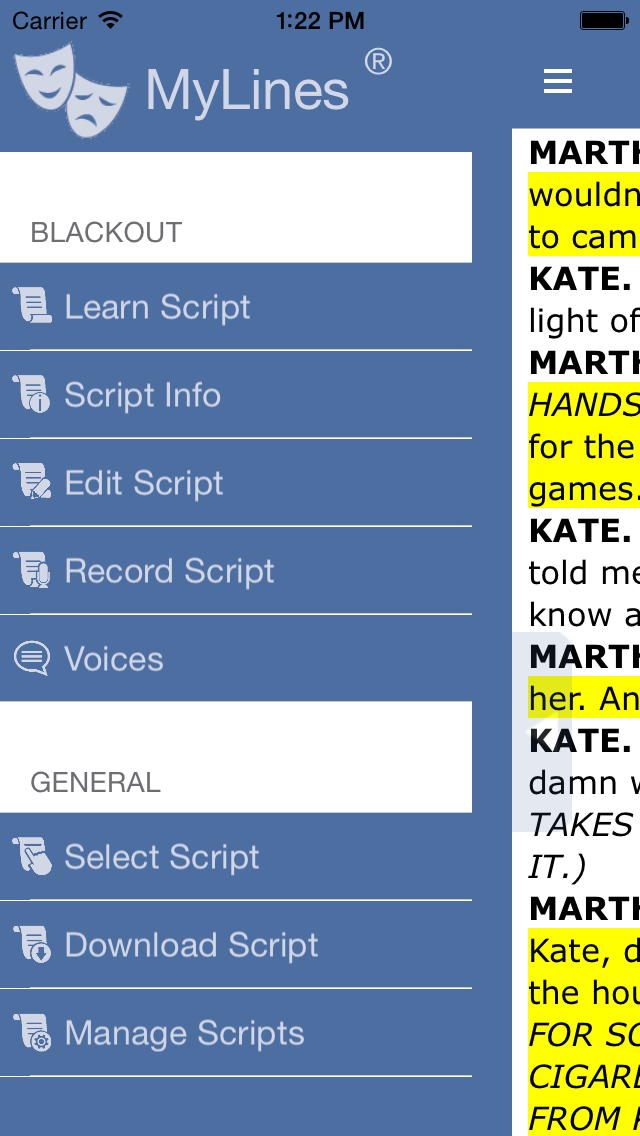
Myline left“By trade I’m a software developer but I do some community theater,” Threewits said via phone from his hurricane-battered but still-intact South Florida home. “And one of the things I’ve always kind of sucked at is memorizing lines. And I thought, hey I wonder if I could write an app that would help me memorize my lines? So that’s kind of where it came from.”

He’s the founder and creator of MyLines, which is an exciting addition to the broader field of actors’ apps. MyLines’ forte and purpose is to help with memorization using a variety of approaches that mimic the ways we use hard-copy scripts–but it goes way beyond that too.

“It [started] when the iPhone was still pretty new,” Threewits says. “I shared it with some other people from the show I was working on, and they liked it, so I decided to try and make it a real thing.”

By soliciting feedback from fellow actors and asking for input every step of the way, Threewits has created a program that has a great user interface, and yet is also solidly functional, with a variety of settings to suit any taste or methodology when it comes to memorization. The user simply uploads a script in standard play format and the program configures it for use on the app.

my lines screen“Once you have a script on there, you can automatically select the roles you’re working on, and automatically highlight your lines,” Threewits explained. “And you can break it up where you can either see the script as a whole, or where you can see your lines highlighted. Or there’s another mode where you can say, well just show me my cues, so that’s kind of nice, so that you don’t see your lines accidentally.”

The various configurations feature a scene mode, a role mode, and even one where you can only see a line at a time. By selecting your character, the app automatically highlights all your lines, and you’re able to scroll up and down through the text, as well as flipping from scene to scene or act to act using direction arrows on either side of the screen.

But one of the most popular features is in the scene mode–for the actor who is already on the way to being off-book.

“If you do like seeing a scene at a time, you can hide all your lines,” Threewits says. “Your lines are still highlighted in yellow, but all the text goes away. So now you can see everything at one time [except your lines.] But if you’re curious or you’re having trouble, you just tap on the yellow space and it will give you the first word. And then if you need another word it’ll show you the next one, and so on.”

An extra bonus of the app is it lets the actor’s friends and relatives off the hook when it comes to helping with memorization.

“I’m trying to kind of simulate like when you have a friend sitting in front of you helping you learn your lines,” Threewits added. “But one of the things about having a friend do that is it kind of ruins the show for them.”

And with MyLines the actor isn’t restricted to simply reading lines on the screen. Once a properly formatted script has been uploaded and converted for use on the app, the text is then available to be converted to audio as well.

“Another way you can approach this, since we’ve now converted everything into text, you can have it read your lines back to you,” Threewits says. “It’s something like Siri speaking to you. So by going into this role/cue mode, it will stop and see if you can figure out your next line. You can also assign a different voice to every different character in the show. So at least now when you hear it read back, it’s not the same voice.”

And far from simply being a digital copy of the script, MyLines gives the user total control over the appearance of the text.

“What we do is we take a script and we break it up into four components,” Threewits says. “One would be a scene or an act change, another would be who is talking, and then the third thing is what they’re saying, and the fourth thing is the stage directions. And you control these four components separately. So if you’re working on your lines and stage directions aren’t important to you right now, you can shrink those down to basically nothing.”

And while a Word or text-based document is easily formatted for use with the app, Threewits acknowledges that PDF versions are trickier and require more work to format correctly. To that end, he has been working with various publishers to arrange deals under which their properties would be available for purchase on MyLines.

“So we’ve been in contact with most of the major publishers to say that ‘Hey, we can convert this for you automatically,’” Threewits says. “So the two or more hours that it would have taken you to convert a script, you can go ahead and buy that online for say ten dollars. That’s like two Starbuck’s coffees.”

And while MyLines recently announced that it has inked a deal with the company that licenses all of Andrew Lloyd Webber’s shows, Threewits says there are even bigger fish on the horizon.

“We’re hoping that by the end of this month we’ll be able to make a major announcement about someone else that’s much larger, so we’re very excited about that,” he added.

And stage managers take heart: Threewits has also put in extensive work on StagePro, an app designed to make running rehearsals and shows much easier.

“It started with ‘12 Angry Men,’” Threewits says. “One of the main difficulties with that is you are trying to coordinate 12 or 13 people who are on the stage nearly 100 percent of the time for like an hour and half. So that ends up being a blocking nightmare. So what I can do, since this script basically has each line separate, within the StagePro app you can basically see the script on one side, and you click online, and it’ll show you a picture of the stage and you can drag all the characters anywhere you want on the stage.

“And of course, if you decide you need to change blocking, it makes it very easy to change blocking that already exists. You don’t have to do the erasing and redrawing,” he added.

And a great innovation Threewits has come up with is syncing up the actor’s app, MyLines with StagePro.

“Another nice thing we do is if you are working with both MyLines and StagePro, all of that blocking can be forced down into the actor’s MyLines apps,” he says. “So you know how I said you can tap on the [highlighted space] and see the line? You can also see the blocking for that line.”

So no more excuses: gone are the days when an actor can say, “Oh I didn’t get that blocking change!”

One refreshing approach Threewits and his team have adopted is to be open to feedback and a willingness to adapt the apps to suit the needs of actual users on the ground.

“What we recognize for both the MyLines and the StagePro app is that this is a different way of doing things,” he says. “Particularly for experienced actors and stage managers who are used to doing it the way they’ve always done it, it is a learning curve. And we’re trying to get feedback and see where it goes from there.”

MyLines is available on the Apple Store and Google Play store for $1.99, StagePro is available only on the Apple Store.

DaisyWinters_InTheatresDec1

Daisy Winters – Dealing with Tragedy on Set
A Tragic Moment Defines the Release of Indie Film Daisy Winters
with Producer JANE BADLER & Actress CARRIE PRESTON

Watch the Daisy Winters Trailer

Daisy Winters stars Carrie Preston (True Blood), Iwan Rheon (Game of Thrones), Brooke Shields and young performer Sterling Jerins (The Conjuring).
Daisy Winters Twitter

As viewers of the large and small screens, we get excited when we get a glimpse of behind-the-scenes action. But sometimes that news is tragic, as was the case with indie film Daisy Winters, which is being released on December 1, 2017.

Writer / director Beth LaMure committed suicide soon after filming ended, but before post-production was finished. What affect and interactions does something like this cause?

Daisy Winters Producer JANE BADLER and actress CARRIE PRESTON weigh in on their time on the film and how the cast and crew were determined to get the film into theaters through new beginnings, a tragic middle and finally a comforting ending.

JANE BADLER

Jane Badler. Photo by Alan Mercer.

Jane Badler, who was born in Brooklyn, NY, is well known as the guinea pig-eating, brilliant scientist, evil Diana in the epic mini-series and series “V”. Jane’s singing and acting career took off moments after she graduated Northwestern University. In most recent years, Jane has released several albums in which she wrote emotional, heart wrenching songs, collaborated with several well-known artists and produced music videos.

Without knowing it at the time, while she was making music videos, Jane got a taste of what it was like to be behind the camera. But it was one of those things that she never really thought about. It was just something she did automatically since the album projects were her own.

Producing a full-fledged film, such as Daisy Winters, was a new beginning for Jane Badler. The reality of not being in front of the camera caught up with her and she went on to produce a second film, not yet released.

You are a successful singer and actress. When and why did you make the decision to start producing films?

As a singer and actress it is often hard to feel empowered as a person and a woman. I like the idea of making the story happen rather than just being part of the story. Also, I find that life is a continual journey… I was curious and interested in what it takes to find a project and make it happen. I had already produced theatre and my own one-woman shows, so it seemed like a natural progression.

How did you become attached to Daisy Winters?

My son Harry introduced me to the writer / director, Beth LaMure, about four years ago. He sent me the script for Daisy Winters as he was being considered for one of the supporting roles. I read it and thought it was a perfect script. Fast forward two years — Harry invited me to an enchanting evening at Beth’s home. After dinner Beth asked if we could meet up the next morning for a coffee. We met up and she told me that Daisy was shooting in a couple of months. At that time Brooke Shields and Sterling Jerins, the young lead actress, had been confirmed. Beth was incredibly charismatic and talented. She wowed me and wooed me and I was terribly excited to work with a woman director on this remarkable script.

When you visited the set for the first time in Savannah, Georgia, what were your initial thoughts? Who was the first person to greet you?

I was quite nervous as I had never produced a feature before. I arrived in Savannah not quite knowing what my job would be. I tried to stay out of Beth’s way while still offering any creative support. A few weeks into the shoot, I realized that part of my job was to work with Deborah Crawford to keep the budget on track and help with any problems that may arise. It was definitely a big learning curve and I’m very grateful to still have opportunities that are way out of my comfort zone.

What was it like for you to be behind the camera instead of in front of the camera? What did you learn being behind the camera that you didn’t necessarily know in front of the camera?

I must say that at first it was very strange to be on a set and not be pampered or part of the action. I was really just trying to stand back and not get in anyone’s way… just be there when needed. I really had to put my ego away and humble myself. I became so much more aware of the big picture and how important everyone is in making a good film – not just the actors. I grew to love the process of film making even more when I was freed from worrying about my performance and was there to get the best out of everyone and the best product on a pretty small budget.

Jane Badler and Beth LaMure.

The writer / director, Beth LaMure, committed suicide soon after filming ended. How did the cast and crew handle this situation?

Our director suffered from Bipolar Disorder. I was unaware of this and it wasn’t until filming and the edit had finished that Beth went into a depressed phase. She was protected by a close group of friends so most of us were unaware of the extent of her illness. I can only speak for myself when I say I was absolutely shocked to hear the news. I think we all kept it quite private for a while out of respect for Beth and the family. Also, we all needed time to register what this meant for us all on a personal and professional level. Beth was an extraordinary person and we were all blessed to have been able to work with her on this beautiful film.

What obstacles did the production have to overcome?

Probably the biggest obstacle was losing our beloved writer and director several months after we finished filming. Luckily Beth had finished the edit so we just needed to do music and sound. We all worked together to finish the film without Beth. But most difficult was not having our head cheerleader to champion her film. We finished the film last December and for six months it was languishing. Deborah Crawford, one of our producers, showed it to Eric Parkinson from Hannover House and he loved it. We were so lucky as it’s so hard to get a theatrical release. We are opening December 1, 2017 in 100 cinemas. Very Exciting!!

Your production company is called Me Jane Productions. What was involved in starting your own company? Who came up with the name?

I actually started my production company about 20 years ago. I called it MeJane because when I was young, I can’t tell you how many men would say, “Ah, you Jane, me Tarzan!” I think they thought it was clever but I find it a bit tiresome. So in honor of my youth and bad jokes I thought I would call my production company MeJane. I produced two plays and my own one-woman shows under MeJane. Anyone can set up their own production company.

What exactly does a Producer do?

A producer can be so many things. A producer can raise the money or put up the money. A producer can help put the film together. A producer can be involved in every aspect of the film from casting to location to putting a crew together or none of the above. A producer can also introduce the team to someone and be called a producer. In my case I was very involved in raising the funds and also worked in post production – helping Beth with the editing and finding the music supervisor and composer. I worked very closely with Beth and then with Deborah Crawford after Beth passed away.

What are the differences between an Indie film such as Daisy Winters vs. a blockbuster film?

An independent film is a movie that is produced and distributed outside of the major film studio system. Often in the big studio films there are a lot more people giving opinions on the film and making demands. The more money spent on a film, the more at stake. With our film, Beth was able to have full autonomy as there were very few investors. Indie films often give the director more room to fulfill their vision.

Anything else you’d like to say?

I am hoping that Daisy Winters finds an audience. It’s message is such a poignant one… a young girl’s search for the idealized love of a father she never knew.

CARRIE PRESTON

Carrie Preston. Photo by Lesley Bryce.

Unless you’ve been living in a forest with no wi-fi, electricity or life sustaining elements such as water, you will immediately recognize actress, comedian, producer and director Carrie Preston.

As an Emmy award winning actor, Carrie has played just about every role under the sun, from HBO’s True Blood to CBS’s The Good Wife, to recently wrapping the thriller-horror feature 30 Miles from Nowhere. If you’re quick enough, you may be able to catch her doing a gig at a theatre or a benefit reading like the one she just did in Georgia at Theatre Macon (Carrie was born and raised in Macon, GA).

Whenever you look, Carrie Preston is on the move. One day she’s here and the next day she’s on Elon Musk’s BFR to Mars to help colonize the planet.

Tell us about your character in Daisy Winters.

I play Aunt Margaret, a complex woman who has an intense relationship with her sister (Brooke Shields’ character) and her niece (Sterling Jerins’ character). She comes in at a critical point in the story and stirs things up for for the character of Daisy.

You’ve worked with an infinite number of actors throughout your career. Is it easier now to walk onto a set full of strangers than it was in the beginning of your career? On Daisy Winters, who did you do most of your scenes with and how did you get to that comfort level of working with them?

Even now, when I walk onto a new set, I get the “first day of school” jitters. But those usually go away pretty quickly once I have what I like to call a show buddy: someone that I can check in with and laugh with and process things with. When you’re on a low budget movie, the amount of time to get to know people is very brief. On Daisy Winters, because I was only there a few days, I had to dive right in. Luckily, my scenes were with Brooke Shields, the nicest star in the universe, and Sterling Jerins, one of the most talented young actors I’ve ever had the pleasure of working with. So they welcomed me to the set and made me feel very much at home.

As a member of SAG-AFTRA, how does the system work with an Indie film’s smaller budget? How are actor contracts negotiated?

SAG-AFTRA has many tiers of contracts, and they definitely want to see their members working. So they will work with the producers to make sure the contract works for all involved. Our agents are totally involved in making the deal with the producers, but it’s understood by everyone that the budget is likely very low. Sometimes back-end or deferred pay is negotiated. But it’s all carefully decided ahead of time. With most of the indies I do (and produce), everyone is there for the love of the material and of filmmaking in general.

Daisy Winters was shot over a year ago. What thoughts go through your mind and what obligations, if any, do you have when a job nears its release date?

I remember my brief time in Savannah on the set very fondly. I am looking forward to seeing the final cut of the film and supporting its release into the world in any way I can. I know how much hard work it takes to create something from the ground up, so I want to surround Beth LaMure (the Director) and the producing team with love.

Brooke Shields and Beth LaMure.


Please tell a story about your time on Daisy Winters.

When I first arrived on the set, Sterling Jerins was so excited to have a new person around, so she gave me a personal tour of the entire house where we were shooting. She was so precious. I remember thinking here’s this self-possessed little girl taking care of the anxious grown-up — how perfect for Daisy Winters!

(Daisy Winters is about an eleven year-old girl’s unconventional, yet deeply loving relationship with her mother and what happens when this essential mother/daughter bond is harshly broken. Along her journey, including her quest to discover her father, the courageous, resourceful and precocious Daisy learns about how to embrace every moment with determination and an unrelenting belief in herself.)

The Understudy

There isn’t an actor out there who doesn’t want to perform. That’s why we got into this game: we love to create characters, we cherish the connection with an audience, we adore making people laugh and cry–and face it, we crave the attention.

So for some actors, getting cast in an understudy role can be a bittersweet victory: yes, I booked a role; yes, I’m getting paid; yes, I’m working on a show–but the bummer is I might never go on.

However it’s important to realize what a tremendous opportunity it is to work as an understudy. First of all, it’s a huge responsibility; the show’s director and producers are putting a great deal of trust in you, and that can pay off down the road.

Secondly, you’re usually going to end up covering a number of roles, or covering a bigger role and playing a smaller role. So instantly you’re obligated to learn not just one but two or three or even more character tracks. In terms of learning by doing, being an understudy for three roles is a bit like being in three different shows, so it’s great for building experience.

Third, developing the discipline to not only learn several character tracks, but to have the focus to play any one of them at a moment’s notice is a great “capsule class,” if you will. If you’re covering three or four characters for a show that’s going up in three weeks’ time, you simply have no time to screw around; you MUST get these characters on their feet immediately. This can benefit your memorizing skills, your script and character analysis, your ability to be in the moment, as well as your focus.

Learning the discipline to be a solid understudy is a skill that instantly transfers when you book a principal role yourself. So embrace it! With that in mind, here are a few tips for how to be the best understudy you can be.

1. The Understudy Prepares

Your preparation is key to making a solid go of being an understudy. Of course, we all  know preparation is key to playing any role. But emphasizing your preparation as an understudy is a good idea due to the fact that you’ll likely be asked to cover more than one role, which instantly doubles or triples your workload. Not only that, keep in mind that you’re largely left on your own and trusted to do the bulk of the work yourself when you understudy. Of course you’re present at rehearsals, of course you should be taking the acting notes the director gives the actors playing the roles you’re covering, and of course you must learn their blocking. However, the factor that is very different for the understudy is the lack of organic learning that usually happens when you’re actually playing the role. Think about it: when you’re up on your feet rehearsing a role night after night, your feet and your body and your words and your mind and your emotions all come together through repetition and create an organic synergy that helps infuse the character and the show into you. I have actor friends who can’t even begin to memorize without the blocking being mostly locked in, as the physicality must be linked to the words for them or they simply won’t remember the lines. Memorizing lines and blocking separated from running the scenes over and over with the other actors as one does in a normal rehearsal is a very different beast for the understudy. So be prepared to get prepared–even more than you usually do when you book an actual role.

2. Maintain your focus

Of course it’s vital to your success as an understudy to develop the focus to learn the tracks of all your characters, and to have them down cold before opening night. But it’s also important that you have the focus to apply them should you get that call telling you you’re going on that night. If and when the stage manager does call, naturally you’re going to be flooded with tons of emotions and wild thoughts–not to mention nerves. Hey, this is opening night for you–of course your adrenaline is up! But it’s important to remember why you’re here: the producers and director saw something in you that told them that you’re the one who can handle this. You’re a pro, you know your stuff, you’ve done your prep work, and now it’s time to bring it to the stage. Take a deep breath, go over any pieces of your track that you feel you need to look at, and make your preparations for performing as you would for any other role. One more note that’s particular to the understudy: the principal actors will of course be excited for you and wanting to help in any way to make the show run as smoothly as possible. But you should keep in mind that, while everyone on a show is part of a team and of course want each other to succeed, they each have their own work to do tonight too. Instead of being over-reliant on them for reassurance, make it part of your job to assure THEM that you feel great and you’re ready to go. You can do this by showing your quiet confidence and certainty that you know what you’re doing.

3. You do you

When we learn any character we of course have certain parameters we’re obligated to follow: the lines, the intention, the beats within the scenes, the arc of the character and the story, and the director’s wishes. Having said that however, you are still you, not the actor you’re covering. Although you are an understudy you are still a unique and individual actor who isn’t expected to simply mimic every single particular choice and quirk the principal actor made. Don’t be afraid to bring your own unique sensibility to the character and the show. As long as you stay within the parameters mentioned above, your fellow actors should be delighted at getting to play off a different take on the character. And you should have fun with it too! After all, a sense of play and being in the moment, being ready for anything that might occur is a large part of the joy of acting, isn’t it?

4. Stay on top of the show

As any theater actor knows, shows morph and change over time. So as an understudy, it’s vital to keep up with how the show is developing. Spending every show chatting up that hottie from the chorus or surfing the web is a mistake–you should watch the monitor every night and note any changes because you’ll be expected to execute them too!

Being an understudy can be not only lucrative, educational and fun–it can help you develop a name as an actor who can be relied on, which can open lots of doors!

Acting Success

Often actors just starting out have one burning question that surpasses all the others: what does it really take to succeed?

Of course, everybody has a different definition of success. For some it means money, fame and glamour on Clooney or Pitt-like levels (good luck!) For others–who are perhaps a bit more grounded in reality–success can mean simply having steady work, the respect of your peers, and being good at what you do.

One thing is certain: if you take a survey across a broad sampling of successful actors of all types, you will probably find the following similarities in their approach to the craft.

1. They’re hard workers

There’s an image some people have of actors as perpetually living wild lives of excess and partying, out late every night hanging with rock stars and models until the wee hours, and waking up at the crack of noon only to lounge by the pool all day long. And sure, we are generally known to be fun, outgoing, beautiful, charming, and of course humble people (hey, who wouldn’t want to hang out with us?) But the fact of the matter is that 99.9 percent of actors who succeed in this business also work very, very hard to get there. You can’t do that if you report to set every morning on two hours of sleep and smelling like a brewery. What’s more, when we talk about working hard we’re not just talking about the struggle of young actors juggling two day jobs in order to make ends meet while navigating endless auditions. Hard work is also a common trait for successful actors even after they’ve “made it.” There are interminable days and nights on set, early morning calls, and late nights learning lines for the next days’ scenes. Plus there are always more classes and coaching sessions, along with dialects, dances, combat and other skills to learn and improve. But remember, hard work comes in many forms: sitting quietly at home with your cat and a cup of tea as you learn your lines is hardly glamorous, but it is the foundation of the work that every successful actor brings onto the set or into the theater every day.

2. They have endless stamina

Remember those long days on set mentioned above? Well, guess what those top-notch actors are doing there for 14 or 16 hours? That’s right, acting. And not just the phoning-it-in kind, either. In order to be successful as an actor you have to be able to bring the goods every take, every day, no matter how long the shoot lasts. And these successful actors aren’t satisfied with anything less than their best: Anne Hathaway famously insisted on take after take of “I Dreamed a Dream” for the film version of “Les Miserables,” shooting for over eight hours just for that one song. Keep in mind too, stamina and energy aren’t exactly the same thing. Yes, having a lot of energy is an excellent trait for an actor. But stamina is something different, defined as “…the ability to sustain prolonged physical or mental effort.” It’s that second part we should focus on as actors, because it’s the sustained mental (and emotional) effort of acting that sets apart the truly great actors from the also-rans. And stamina isn’t strictly something you’re born with or not; it’s a skill that can be developed and enhanced with effort and training. This is yet another reason it’s vital to take classes, create and perform original work, and act every chance you get: the more you do it, the more you work those acting “muscles,” and the stronger you become. It’s also important to treat yourself well, eat right and exercise in order to keep your instrument running in top form.

3. They have a positive attitude

Sure, we’ve all heard the tales of petulant actors having ugly meltdowns and screaming at crew members or fighting with directors on set. But here’s something to think about: why do those stories make such a big splash when they do get out? One could argue it’s because they’re the exception rather than the rule. When you consider how many television shows, movies and web series are being shot at any given moment these days, the percentage that have stories of spoiled, nasty actors behaving badly is miniscule. (Note the term “actors” here, thus excluding “reality” television programming, where being a horrible human being is rewarded.) While there are always exceptions, it’s fair to say that most actors bring a positive, collegial attitude to set or to the theater with them. As a highly collaborative art, acting simply requires people who can work together and get along. Having the ability to set aside your personal issues and bring a friendly, open, and cheerful persona to work with you is a big part of being a successful actor–and more importantly, being viewed as an actor that people want to work with.

4. They have great focus

It’s hard to overstate how important it is to have the ability to focus if you want to succeed as an actor. From beginning to end, the work of acting requires the ability to concentrate intensively: whether it’s learning lines, or auditioning an out-of-context piece for a roomful of strangers, or performing for the camera or on a stage, there are a million things trying to steal your focus. Luckily focus is also something that can be developed, although it does take work. You have to figure out what works for you: meditation, insisting on a quiet place to rehearse or prepare for a scene, unplugging all your devices, working with a coach to help you concentrate while performing–if you want to succeed you have to find a formula that lets you do whatever you need to do in order for you to focus your energy where it needs to be.

5. They love it

Finally, there isn’t a successful actor out there who would deny that they love acting. They may hate other aspects of the business, but when it comes to actually performing, they all came from a place of love for it. Amid the stress and pressures of building an acting career it’s vital to keep this in mind at all times: what we get to do every day is fun! There is such tremendous joy in the performances of the best actors no matter what role they’re playing–we must all insist on incorporating that same love of the craft within ourselves and infusing it into every project we take on, no matter how small or insignificant. That, at the end of the day, is perhaps what separates the successful actor from those who are not: love. Love of the craft of acting and joy at the privilege of sharing it. There are certainly worse definitions of success!

Find your success by submitting yourself now!

Acting Confidence

Confidence is a tricky beast, even for famously confident people like actors. You can be having a great day, then one little thing can shake your confidence and it’s completely shot, never to be found again. A common tale among actors is this: you’re all set up for success for a particular audition, well-rehearsed, solidly off-book, well-rested–100 percent ready to go, in other words. Then, while you’re sitting in the waiting room something mysterious clicks in your head just as your name is called and you head in to read: everything crumbles and all that confidence is gone–for no good reason! Sound familiar?

So confidence is pretty intangible and ethereal; there’s not always a super clear explanation for why it might escape us from time to time. However there are some tried and true methods for building up confidence, especially for actors.

Here’s a few:

1. It’s all in your head

Thoughts are a funny business: for instance, don’t think about a pink elephant. Stop it. Stop thinking about that pink elephant right now! See? Thoughts sometimes control us, not the other way around. But thoughts are almost literally nothing. They are electrochemical impulses firing between neurons in your brain. You can’t hold a thought in your hand or put it in a jar or examine it. However, for such insubstantial things, thoughts can and do have real-world consequences. The things we think about and which occupy our minds show up in the form of our emotions and physicality. If you’re under-confident about remembering your lines, what do you think about? You think about the possibility of failure, which comes with feelings of potential embarrassment. But here’s the annoying part of having a human brain: even THINKING about failure or embarrassment can lead to physical manifestations of what it feels like to be embarrassed. Suddenly you’ve got an increased heart rate, flushed skin, and you’re sweating–all because of a thought! So the first trick of maintaining your confidence is not to let your thoughts manifest in your body and thus create a self-fulfilling prophecy. So how do we prevent this thought>emotion>physicality feedback loop when we’re on the hot seat at an audition or performing? We fill our minds with positive thoughts. Pro athletes often talk about visualization: they picture the shot or the play before they go out to execute it. This is a great model for actors: picture your audition going the way you want it to go. You’re going to step into that room, smile and say your hellos, find your mark, take a deep, cleansing breath, and then say the first few words. From there the rest will flow. Imagine that before you go in to read and it should help stave off the pink elephant thoughts of negativity.

2. Actor, act!

It’s a trite saying but it’s true: if you act confident even when you’re not feeling it 100 percent, actual confidence often results. If you walk into a room hesitantly, slumping your shoulders down as if to hide, taking tentative, shuffling steps, there is a certain energy you are not only projecting, but also one that you are internalizing in your body. Think about how that lends itself perfectly to the thought/emotion/body feedback loop mentioned above. Try an experiment sometime at a low-stakes event where you don’t know anyone, say at a party or a new class you’ve just started. Imagine yourself being That Guy or That Girl: walk in, shoulders back, head held high, and look people in the eye–then do it. Say hello and smile and nod at everyone with whom you make eye contact. I know, I know, for some of us that sounds…just horrible. Like it might be awkward and stressful. But I promise if you give it a try, you are almost guaranteed to get at least one or two positive responses, possibly from people who also don’t know anybody and are grateful for the greeting! Human brains are weird. (As an actor you already know that, of course!) But one neat trick is that we often become what we are perceived as by others. If the first impression you give people is that of the confident guy or girl, they treat you that way, and thus you feel more confident, creating a different, more positive feedback loop.

3. Fighting fear

There’s a great scene in “Deadwood” in which Ian McShane’s Al Swearengen is trying to buck up the milquetoast newspaper editor over a looming confrontation. He shocks the editor with a sudden slap across the face and says, “Did you die? No. Pain or damage don’t end the world. The world ends when you’re dead.” A tad dire for an acting advice column, but follow me: what are you really afraid of when you go in to audition, or when you’re feeling under-confident about anything? What is the absolute worst thing that could occur? Surely not death. Or even dismemberment. So when you let yourself get caught up in a mindset of lack of confidence, you’re literally being fearful over nothing. Nothing can go wrong that won’t result in you walking out of that room and going on with the rest of your day. Even if you blow it spectacularly, the worst possible result is you might not get the callback. So what? There’s always the next audition. So the next time evil little negative thoughts start to creep in around the edges of your brain, the never-ending “what ifs,” turn those suckers around: “What if I go in there and read this piece just as well as I’ve rehearsed it, then head out for a nice lunch afterward?” Because really, that’s about the worst that can happen.

4. Baby steps

Speaking of thoughts and the ways they can manifest in the world outside of our skulls, one major way to build confidence is to acknowledge and hang onto the good things you do. Many actors have a tendency to brush off compliments and even minimize our accomplishments in our own thoughts, but this is a mistake. When you do something well, give yourself a pat on the back. Reflect on the moments where it all fell into place, relish that feeling, and allow it in. Get used to that feeling; success begets success! By the same token, you have to learn from your mistakes, of course. But then the key to dealing with mistakes is to find a way to leave them behind. Many of us have this ratio exactly backwards: we beat ourselves up for days or weeks for some stupid, miniscule error, while we shove aside the many positive results we see. Make a conscious effort to focus on the positive steps you take, no matter how small they may seem, and watch as they blossom and grow! You’re not perfect, nor will you ever be. But your mistakes don’t define you; your ability to learn from them and move on does. If you blow it at an audition, why did it happen? Were you under-rehearsed, tired, hungry, running late, or stressed out? Identify and fix the problems and move on with your life, don’t dwell on it. And if you kill it at an audition or have a particularly good performance, let yourself enjoy that feeling for a little while! Bask in it for a minute. And then move forward with a bit more confidence that you can make that happen again.

Controlling the Audition

We all love acting. And with good reason: performing can be a beautiful, moving, profound experience of connection with one’s fellow performers and an audience.

Of course, in order to get to the performance part of it, you usually have to go through an audition or two. For most actors, the audition is the bit where they get hung up.

But perhaps it’s time we demystify the audition, and more specifically the things we stress about when we audition. One key to a successful audition is to focus only on what you can control. At the same time, you must erase from your mind the stress associated with the things that are out of your control. Here are some ways to approach this.

Out of your control:

1. The wait

The first thing you encounter at an audition is the waiting room: a bunch of other actors and a harried receptionist/production assistant taking names and headshots. There’s nothing like a roomful of tense actors, laughing too loud, gossiping and often trying to psych each other out to throw you off your game. But here’s the thing: you know this is what it’s going to be like virtually every time you audition. You can’t do anything about it other than to mentally prepare yourself. If you need quiet in order to go over your sides, put on your headphones or find a quiet spot within earshot. But what you can’t do is let the stress of the waiting room or a long waiting time affect your performance.

2. The light and the room

Another factor well out of your control is the room you’re reading in. It will often not be the most flattering space–get over it. The people you’re reading for understand that you will look different when properly lit, and that you will sound different with a body mic or on a stage. Let go of all factors having to do with the space and just do your thing.

3. The reader

We’ve all read with someone who doesn’t give us much to work with. Again, the casting team is aware. Don’t let it throw you, as there’s nothing you can do. If you know the piece you’re reading, and you know your character’s objective, all you can do is try different tactics and react in the moment to what you’re given, even if it’s not what you expected. But stressing about, or worse, complaining about your reader is a no-no.

4. The casting team

Some younger actors come out of auditions freaking out over something that was said by a member of the casting team, or the fact that they didn’t seem to look up during their entire read. First of all, there’s nothing to be done about this, so stressing about it is pointless. Second, whispered asides among the casting team while you read may or may not mean anything–but you’ll never be privy to what was said, so why bother stressing? They may have been talking about how much they love you and want to have your babies. You’ll never know. And oftentimes the reason casting directors don’t look up while you read is because they’re looking at your headshot and resume, and thinking about ways they might fit you into the project, so let this one go.

5. Time

Mentioned above is how long you might have to wait before you read, and that is certainly one way you can’t control time. Another is how long you have your sides before your audition. Walking into the audition room tense and half-freaked out over the short time you’ve had to work on a piece instantly takes you out of the moment and prevents you from doing your best work. You can’t control this, so instead dive into the work itself as best you can. On the other hand…

What you can control:

1. Time

How many auditions have you been to where you were running late? You rush in the door out of breath and it seems like two seconds later they’re calling your name to read–before you’ve even had a chance to sit down. Sure, there was traffic, your alarm didn’t go off, there was a long line at Starbucks, etc. etc. Sorry, Sunshine, there are other actors there who overcame all of these difficulties and got there early. This is a subjective business where fractions of an inch can mean the difference between getting your dream job or not. You must, must, must be on time, which actually means early.

2. Preparation

It’s true, usually you only get a day or two to look at sides before an audition. But let’s be honest: for your last audition how much time did you spend the night before when you were supposedly “running lines” actually scrolling through your Instagram feed? Or flipping through your Netflix queue looking for a movie to watch after you were done? You have your own career in your hands; nobody is going to crack the whip and MAKE you work on your sides. But one thing is for sure: some other actor in that waiting room shut off their phone and television while they were preparing. Be the actor who spends the most time preparing–actually preparing–and it will pay off.

3. Attitude

We talked at the beginning of this piece about the difficulty of auditioning, and it’s true, it’s not the easiest thing in the world. On the other hand, neither is acting, is it? One other thing that is in your control–and perhaps the most important of all–is your attitude. Thoughts are literally nothing; they’re the electrochemical firing of neurons inside your skull, nothing more–that is, until they manifest in the real world. If you have a negative outlook on auditions, it manifests in your breathing, in your heart rate, and in your body language, all of which detract from you performing your best. You have to learn how to train your brain to look at an audition as an opportunity: it’s a chance to act that day, and really that’s all we want, isn’t it? You can’t control your feelings, but you can control your focus, and your focus directs the way your feelings go. You should be focused on the work, the objectives of your character, the joy of acting, and the fun you get to have this day and every day in playing someone else. It’s up to you to turn auditions into play, not work! You’ll feel a difference–and you’ll see a difference in how often you get cast, too, if you adopt this attitude every time.

Make a big splash at auditions

Auditions are often called the toughest job interview in the world, and with good reason. You’ve got a little more than a minute to make an impression and show the casting team that not only do you have the acting chops and the look for a certain role, but also to demonstrate your own personality.

A tall order indeed!

But there are ways to impress a casting director and ensure that your audition will stand out from the rest. Of course the main key to getting cast is to do the work: learn the lines and develop genuine and appropriate objectives for the character. And there is also a certain amount of luck involved with auditions–you have to have just the right look and the right energy for the role.

But that’s a given. Which leads us to the perennial question actors ask about casting directors: What do they want?

Of course, trying to read minds is a bit of a trap. However, it’s safe to say that there are a few things every casting director is looking for. Here are a few ways to help you make a lasting impression at your next audition.

1. Think different

Generally casting directors get into the business because they love actors and they love acting. But try to imagine the tedium of watching several hundred actors up for the same part, all reading the same sides in the exact same way. No wonder these guys and gals are caffeine addicts! So rule number one is to find a way to stand out from the crowd. We are of course bound by the text. There are certain broad strokes in any given script that dictate actors’ choices, some of which make more sense than others. But within those parameters is a whole range of smaller choices that can set you apart from the herd. Is there an angry moment? Try ratcheting the volume down instead of up. Or raise your volume for a moment in an unexpected place. Is there a sad farewell? Try smiling through the pain instead of dredging up tears. Pronounce a particular word in a weird way or use a strange intonation. Use your creativity to find something, anything that runs counter to the simplest, most basic reading of the text. Because you can bet that the majority of the other actors up for the part have already beaten those choices to death. It’s on you to find a way to get casting director’s attention somehow and wake them up!

2. Present and accounted for

We talk all the time about how challenging and difficult auditioning is: you only have a short amount of time to make an impression, and sometimes things like nerves, the stress of your day, or being hungry or tired can get in the way of you doing your best work in that tiny window. But you’ve got to find a way to push all that aside when your name is called and you enter the audition room. Easier said than done, right? But this is where you’ve got to bring to bear all your training in being grounded and in the moment. The simplest and most reliable path to ensuring that you can be as present as possible is using your body to focus your mind. When you’re thinking about the physical nature of your body, it can help prevent your mind from running away with itself. Do some deep breathing shortly before your read, or try stepping out into the hall and doing a few quick push-ups, or even just stretch and touch your toes. And when you’re in the audition room and about to read, the temptation is to rush right in, but don’t do it. Take a moment to draw in a deep breath and really feel your body. Think about your feet being on the solid floor beneath you, feel the warmth or chill of the room on your skin, and feel your respiration go all the way down to the bottom of your lungs. Take a long moment to breathe deep and fully inhabit yourself and think about nothing but your physicality. And when you expel that breath, imagine yourself expelling all your tension with it. And begin.

3. You’re so spontaneous

One of the biggest challenges for the actor is to be fully prepared, having learned the text and having a clear arc through the scene, yet to present this in such a way that it appears to be happening in real time. Well, duh, you say; that’s the job. However, do keep in mind that there is such a thing as being over-prepared. When you learn sides or a monologue it’s easy to lock in certain choices–a pause here or a shift in volume there, for instance. But you’ve got to remain open to whatever is given to you in the moment in order to fully engage with the character and what is happening to them. Many times you will hear less experienced actors complaining about the reader–he or she “didn’t do it right” or something to that effect. This is exactly the wrong attitude. Whatever your scene partner gives you, whether it’s what you expected or the same read as your roommate who ran the scene with you the night before, it’s your job to react to it in the moment. Believe me, casting directors are well aware of any limitations their chosen readers bring to the table. Wishing for someone or something different from them is a waste of time. It’s up to you to spin that straw into gold by reacting in a genuine, lively way to what you’re given, no matter what it is.

4. Confidence game

As less-experienced actors we all had auditions like this at one time or another: you felt great, well-rehearsed, completely solid about being off-book, 100 percent ready to go–right up until the moment you were called in to read. Then your heart began racing, your breathing accelerated, your mind began darting all over the place, and everything promptly went to hell in a stuttering, awkward, sweaty little handbasket. Insecurity and nervousness happen, of course. But let’s face it: directors want to work with people who are secure in themselves, and confident in what they do. There’s no substitute for experience when it comes to giving you confidence. But one useful and well-known shortcut to confidence is to behave as if you are confident already. And a neat trick to implement this in the context of the audition is not to think about your own nervousness and controlling it when you get in front of the casting team, but rather to walk in with the mindset that your first job is to help THEM to relax. Make eye contact and smile and say your hellos in a clear, loud voice. Shake hands if it’s offered, and make a little small talk as you get yourself situated to read. Remember, this is fun! It’s called PLAYING a role. And, barring some freak accident or sudden natural disaster, you are not going to die here, no matter how it goes, so there’s really nothing to be afraid of. Acting is what you love, and you really do know what you’re doing–so act like it! Show them the love and the joy and the sense of play that you bring to your craft, and you will book more roles, guaranteed.

Meeting a Talent Agent

It’s a common cry among newer actors: “How do I get an agent?”

But it’s also not all that uncommon among actors who have been around for a while. Sometimes you and your agent don’t see eye-to-eye on what sort of roles you should be reading for. Or maybe you or your agent feel that someone else would be better suited to serving your needs in that capacity. Sometimes your time with a particular agent just naturally comes to an organic close and it’s time to say amicable good-byes and move on to the next phase of your career.

For whatever reason, if you should find yourself shopping around for a new agent, here are a few things to keep in mind when setting up meetings.

1. This is an audition

Make no mistake: when you go in to meet with a potential new agent, you are auditioning. Even if they don’t ask you to read sides or do a monologue, this is nevertheless still a job interview. Agents, like casting directors, make assessments of actors that are based not only on what they do in character, but also on what their energy and demeanor is like when they’re not in character. That’s how an agent can best identify what roles and what types of projects you might be suited for. They are assessing you to see if you would make a good fit for the types of projects, the casting directors and directors they work with. Put on your game face and make whatever preparations you normally make for an audition. Do everything just as if you were going in for a very important read, because that’s exactly what this is. If nothing else, it’s an opportunity for you to show yourself as yourself in your best light.

2. Yes and…

It’s important, as with any audition, to be on your toes and be prepared to and able to react and adapt on the spot to whatever might be asked of you. A potential agent may ask you to read something cold, they may ask you to do a bit of improv, they may ask you to dust off a monologue–none of which was mentioned when you set up the appointment. Don’t get flustered; realize that in keeping with the idea that you are auditioning not only as an actor but as yourself. The agent is not only seeing how you perform, they’re checking out how you react. They want to know what to expect if they send you out to read with a director who is known for testing the actors he or she reads. Are you a calm, cool and collected actor who has the ability to roll with the punches, stay in the moment and deal with the unexpected? Or are you going to turn red and stutter and stammer? If they’re going to represent you as an agent, they want to be certain you’re going to represent them too, at any audition they send you on. An agent’s reputation is built on the actors he or she signs. Make sure you’re ready for anything.

3. Your resume and…

Your resume should be up to date–and it should be chock full of impressive projects, of course. And be prepared to talk about any one of them intelligently. Your potential new agent wants to know what makes you tick. Just as importantly as projects, make sure you’re listing any and all classes you’re taking and have taken. An agent wants to work with actors who are great at what they do, of course. But perhaps just as importantly, they want to work with actors who are constantly seeking to improve themselves and their skills–actors who are looking to up the quality of their “product.” This type of actor is a valuable asset to any agent, so make it clear how much work you do on your craft outside of auditioning and performing. Talk about classes, acting groups you’re part of, readings of new works you participate in, etc. Agents don’t want to work with lazy actors who are going to sit back and wait for the phone to ring with the perfect job on the other end. They want go-getters.

4. Agent does not equal manager

Agent also does not equal secretary, psychologist, or mommy. While agents of course want the same things as you–for you to succeed in your career as an actor–you have to come at your relationship with your potential agent with a reasonable idea of what you can expect them to do for you. They may have some references for you in terms of people who can help you with headshots, or they may have classes or acting coaches to recommend–or they may not. But generally speaking you should already be pretty autonomous and rolling along in all of these categories when you walk the door. No agent is looking for actors who are going to throw their hands up and say “What do I do now?” Part of what you are trying to present at this meeting is an image of a self-sufficient, self-assured actor who is already well on the way to taking their career to the next level. You want to make it clear you will make the agent’s work easy, not give him or her the impression they’re going to have to hold your hand.

5. Don’t forget…

You’re interviewing them too. Just like they say about going in to an audition, don’t give away all your power. An agent is a person you work with closely, one who should have some understanding of who and what you are as an actor and what you’re trying to do with your career. As an actor and a professional, you have agency and you have ideas of your own. If the vibe’s not there with a particular agent, it’s not there. When you’re at the stage of your career where you’re shopping around for an agent, you already have some experience, you have a decent resume, and you have some confidence that you know what you’re doing when it comes to the acting part of all this. Sure, this person could potentially help out your career, but you’re still the one who has to go out and audition and perform. If they have a vision for the types of roles and the types of projects you should be reading for that is wildly different from your own, then maybe it’s just not meant to be. And, much the same as with auditions, there are always other agents out there.

Bottom line is you should treat meeting an agent like an audition: Be prepared, be ready to change it up and go with whatever is thrown your way, and above all be yourself!

Monologues

As artists in a demanding, competitive field, successful actors are constantly pushing themselves. There’s always the next class, the next audition, the next performance to prepare for. But one place where many actors fail to keep on top of the development of their craft is in learning new monologues.

It’s easy to look at learning a new monologue as a chore, and thus it immediately drops down the list of priorities. And it’s also easy to get complacent and rely on time-tested monologues we’ve had rattling around in our heads since college.

But if you look at it another way, learning new monologues can be not only rewarding from a professional standpoint, but also fun, believe it or not! Here’s a few reasons to get excited about learning a new monologue.

1. You’re in charge

In choosing a monologue you get a chance to do what you want to do. Unless you write and direct your own pieces, creating a monologue may well be the one chance you have to really take charge of what you work on as an actor. We’re so busy constantly trying to shoehorn ourselves into various roles for whatever we’re auditioning for that it’s easy to forget how much fun it is to pick a role you really WANT to play. Not only do you have the freedom to choose what piece you’re going to perform, you get to direct your favorite actor–yourself! Learning a new monologue is so much more than memorizing words. It’s a great opportunity to really dig deep and flex your muscles as an actor. You get to develop an arc in a one- to two-minute piece, and explore various tactics to achieve your character’s objectives–and best of all the door is wide open to your interpretation.

2. You get to swing for the fences

Every so often we get lucky and get cast in a dream role that really suits our particular skill set as actors, our personality and our style. But that’s rare–except when it comes to monologues. This your chance to pick material that is perfect for you. Conversely, it can also be a chance for you to pick material that runs counter to the way most casting directors and producers see you. If you’re a big, burly guy who is always cast in tough guy roles, here’s an opportunity to show off your sensitive side. If you’re a young ingénue who gets cast in soft, seductive roles, here’s your chance to rage out! This is yet another reason why we should constantly be learning new pieces and working the ones we already have down: you can develop a wide range of pieces of various styles and types of characters so you’ll always have something appropriate for any audition.

3. You get to read 

They say writers are readers first, but the same could be said of actors. After all, you don’t learn lines without reading, and you don’t develop your skills as an actor without studying the best plays, television shows and films. And the truth for most of us in this hectic world is that we don’t read enough. Monologues to the rescue! In the process of developing some new monologues you have a great opportunity to read new and classic playwrights and screenwriters with whom you may not have been familiar before–and which you may never have discovered were it not for stumbling across one of their pieces in a monologue book. There’s so much great work out there that we simply owe it to ourselves to explore and broaden our theatrical horizons.

4. It’s all about you!

This is important for two reasons. First, as actors of course we love having the attention on us! And if you’re performing a monologue you get a chance to embrace and enjoy that attention. But on a more serious note, something you notice about the top actors in any field, be it stage, film or television is that they have charisma. This is a slippery word, but generally we can define it as a personal magnetism that attracts people to us. Charismatic people are the ones who fill up a room with their presence and create gravity around themselves that draws others in. When they leave the room, there’s a vacuum left behind. But while charisma is something rather nebulous that to some degree we are born with or not, it’s also something that can be developed. In learning and performing monologues we get to develop that ability to take a room and fill it up with our presence, as well as our ability to command attention–which are vital skills for anyone who wants to command attention in a role.

5. They’re not that long

Let’s face it, memorizing one to two minutes of lines just isn’t that much work. Of course, successfully working a monologue, as mentioned before is more than just saying the words correctly. But the truth is this is a rather easy part of what we do. There’s no reason to dread such a task, given all the positive benefits of learning new monologues. Another important point about the brevity of monologues is that we have to remember that casting directors often make a decision on an actor within the first ten or 20 seconds they read. Learning a well-honed, tight, brief monologue means you will grab their attention and make a solid impression right away.

6. Get in tune

Working monologues is acting, and as artists we should all be creating art every day. You may not always have a class or an upcoming audition for which you have to learn sides. But you can always, always have a monologue in progress. Learning new monologues gives you a chance to tune up your instrument and keep your instincts on building a character fresh and engaged. It not only helps to work on developing characters–something you’re going to be called on to do next time you audition or get cast in something–it also keeps your mind in tip-top shape when it comes to memorizing. The parts of our minds that we use to memorize can be developed and made stronger–and they can also deteriorate with lack of use. There’s no reason not to have a minimum of five monologues locked in and ready to go at all times. And there’s no reason not to head down to the library today and check out a book of monologues!

Producing for Broadway

We spend a lot of time talking about–and let’s be honest, stressing about–monologue auditions. It makes sense that our focus would be there of course; after all, generally speaking the monologue audition is the first step. It’s the initial test that earns you the right to compete at the next stage for a role. So clearing that hurdle has to be the primary focus–at first.

But really, when you get down to it, the monologue audition isn’t so much an assessment of your acting ability with all of its nuance and depth as it is for the casting team to determine that you look like what your headshot looks like, and that your apparent age matches what you claim. It’s to make certain that you didn’t Photoshop your actual face into oblivion, or that you haven’t put on 50 pounds or gotten cornrows since you last had headshots done.

That, and to determine that you can remember and perform 90 seconds of script without peeing your pants.

So let’s assume we’re past the point of asking for a roll of paper towels for what you did to the audition room floor. Now what? How can we optimize our chances at the next stage of the audition process–reading sides with another actor or with a reader? Here are a few ideas for making the best impression possible in a dialogue audition.

1. Research 

Often what makes people most nervous about dialogue auditions is their unfamiliarity with the sides. We’re usually only given sides the night before a read or even on the spot at the audition, so it’s understandable that it makes people anxious. But if they just gave you the sides, of course you don’t know the lines. You’re not going to know the lines, not today anyway, and they know this. So let it go. The trick is to focus instead on your research rather than on the lines themselves. In whatever time you do have to prepare prior to the day, you should already have gotten some idea of the character and why the casting team is looking at you, right? You should have some idea of how he or she fits into the story and what his or her relationships are like with the other characters, and you should have some clue as to the overall story. Given all that, you should already have made some decisions about how you think you might approach playing this character–there’s a reason you’re here: for your particular style, demeanor, and what you bring to the table creatively! So if it isn’t a situation where you have time to get off-book, don’t sweat the lines so much as the character, and your objectives as that character.

2. Past is prologue

In keeping with doing your research, it’s vital that you figure out what just happened in the moment before the scene you’re reading. Ask if you have to. This isn’t a stupid question, especially if they’ve just handed you the sides for a piece you’re not completely familiar with. Not only is it not stupid, it’s a smart question: it shows the casting team that you understand that every moment in a script, every moment in the arc of a character depends on every moment that has gone before. This scene isn’t taking place in a vacuum, even if you are being asked to read it in one. And when you do go to read, take a moment before you begin to get your head in that space of the moment that has gone before. Visualize the room, the other characters, the time of day, etc. This is the point where you get to actually act, so take advantage of it!

3. Oh those damn pages

Another common source of tension for actors going to a dialogue audition is how to handle having their sides in hand for the read. First of all, relax. As mentioned above, the casting team realizes you aren’t off-book. They’re the ones who handed you those sides mere seconds ago. You’re SUPPOSED to be looking at your sides; that’s how this is done at this stage of the game. That said, a couple tips: hold the pages out in front of you, but make sure you aren’t covering your face. “Of course,” you say, laughing and shaking your head at such a tragically basic tip. But you’d be surprised how many actors get caught up in reading that next line, and the next, and the next, and before you know it the casting team is looking at a bright white square of paper where the actor’s face used to be. Speaking of which, how much should you be looking at the sides? As much as you need to in order to get the lines while still connecting with your scene partner. One great tip for how to approach this is to think of the other actor or reader as being connected to you via a rubber band. You may look down at your lines, but you will get back to that connection just as soon as possible. Keep your thumb or finger alongside the next line on the page so you don’t get lost, but if you do get lost don’t freak out. Part of this audition is seeing how you handle the stress of this type of reading, how well you stay in character, and how you deal with the unexpected. Remember your improv training and stay in the moment–and make sure you stay connected to your reader or scene partner.

4. Careful! With the… <beat> PUNCTUATION!!!

The temptation when reading something unfamiliar is to grasp at any clue the text gives you as to what is happening. To this end, one common mistake actors make at this type of reading is to take punctuation and other directions way, way too literally. First of all, exclamation point doesn’t necessarily mean SHOUTING! It can mean indignation, alarm, surprise, shock–a million other reactions besides raising your voice to the point where you scare the people in the offices two floors up. In fact, this initial reading on exclamation points is so common among actors that if you make another choice–any other choice–when you encounter an exclamation point, you will make an impression. Same goes for words in all caps: as often as not, this is a way for the writer to emphasize a word, not a request the actor turns the volume up to 11. By the same token, indications of a beat or ellipsis don’t give you carte blanche to take a five-second dramatic pause. You have to keep the scene moving. We should always respect the writer’s words, and do our best to say the lines letter perfect. But, and especially at a dialogue read that’s using sides that aren’t terribly familiar to you, character and staying connected in the moment with your scene partner has to be the priority.

Most of all, relax, be yourself, and have fun. You’ve already made it to the second round, so that means you’re doing something right!

On-camera audition

Much of what actors encounter on sites like NYCastings–aside from the tremendous opportunity to sign up to receive hundreds of audition notifications every week in your inbox–has to do with auditioning. There are a million articles on preparing for the audition: how to enter the room, how to learn your lines in a hurry, how to greet the casting team, how to hold your sides, how not to hold your sides, how to laugh, how to cry–you name it, there’s an article about it.

But one thing you don’t come across very often is people talking about what happens after you walk out of that audition room. Well, you may ask, aside from the adrenaline rush and sense of relief at being done, what else is there?

However, to just walk away from your auditions and forget them on the spot is a mistake. Think of the time immediately after the audition as the “follow-through.” If you’ve ever watched or played tennis, you know that the swing of the racquet doesn’t end when it makes contact with the ball. The motion the player makes after he or she hits the ball is just as important as the motion before. So here are few ideas on how you can optimize your follow-through after your auditions.

1. Write down everything

Get a notebook specifically to take with you to auditions, and write down everything that happens in each one. No matter where you’re developing your acting career, you’re almost guaranteed to see the same casting directors multiple times if you stick around long enough. So start with standard reporters’ questions, who, what, where, when and how. Get the casting directors’ name, along with anyone else behind the table whose name you caught, and the location. It’s even a good idea to jot down the receptionist’s name if he or she offered it–or even take a moment to ask. Speaking from experience, simply being able to greet by name a harried and harassed receptionist for a casting director can be an invaluable assist. (They’re like shelter pets: they’re accustomed to abuse and neglect, so they may snap at you at first, but any kindness you show them is usually appreciated far beyond what it costs you.) I would also write down what you wore, how crowded it was and how long you waited.

Now to the nitty-gritty: how was your performance in your eyes? What notes did they give you? What adjustments did they ask you to make? What was the overall vibe of the room when you wrapped up? Note everything that came from the casting team, then write down your own assessment. This isn’t to get you to cringe over every little stumble over a word or dropped line, but rather to get you to actively, objectively assess your overall performance on an almost clinical level. Our education in acting is a lifetime affair; the minute you stop learning you start to decay. So it’s foolish to throw away the valuable knowledge you could be gaining from the very people whose job it is to cast actors in roles–people whom you may very well see again, sooner rather than later! A great idea is to take a moment to make your notes right there in the waiting room after you read. This not only gives you a chance to get everything down sharply and correctly, you can also take the time to decompress and appreciate how much less stressful the waiting room is after you’re done reading. What’s more, doing so allows the casting team a moment to talk about you–and you never know, they might want you to come back in and read for a different role or ask you another question! Better to be able to do so right there on the spot while you’re fresh in their minds.

2. Learn, don’t flog

The idea of this audition notebook project isn’t to give you more chances for self-flagellation, it’s to help you improve. So after you make your notes on the actual acting portion of the program, look them over, pick out the silly mistakes that any actor can make at any time–the word flubs, the missed cues, the dropped lines, etc.–and throw them out. Flubs are just flubs; they happen to even the most experienced actors, as countless blooper reels tell us. Let go of and forget about analyzing things like that–provided we’re not talking about things you can control, like being underrehearsed. And be honest about it: if you blew an inordinate amount of lines, well, then your notes to that effect have already helped to show you how you can improve next time around. If you were super nervous and this caused you to forget your place, that’s also something to look at and analyze. What was different about this day and this audition? Was something said in the audition room or waiting room that threw you off? Just having a bad day because you’re tired or hungry? Make a note of it, process it, and be prepared to adapt next time around. The only thing worse than beating yourself up over what happens in an audition is to shove every bit of it out of your mind even as you walk out the door, thus preventing you from learning anything or improving.

3. Say thanks and follow up–briefly

There is a school of thought that says actors should send personal thank you cards to every casting director they read for. While that is certainly thoughtful and attention-grabbing, it also seems a bit 1955, no? Like gentlemen callers leaving their literal calling cards on the sideboard as they take their leave from visiting. Hey, to each his own; if you are the type to learn calligraphy in order to handcraft a personalized thank you note for everyone you encounter in this business, I say go for it. There are certainly worse things to have your name associated with. But probably for most casting agents–who are, let’s face it, some of the most crazy-busy people in the biz–a quick email saying thanks is probably sufficient. You might also enhance this note by adding a link to your reel or to a notice for a show you’re currently performing in. An offer of tickets or a discount if they wanted to attend wouldn’t be out of line. But for the love of God, tread lightly when it comes to this sort of thing. Many’s the casting director who has horror stories about that one annoying actor-stalker who won’t leave them alone. Don’t be that guy!

4. Move on with your life

Okay, you’ve done some solid analysis of the performance, you’ve clocked all the relevant information you might need about this casting director and his or her quirks and the things he or she seemed to want to see more of. Now is the time to process the notes you’ve given yourself, apply them to how you are going to approach your next audition–and let it all go. There is no place in this business for beating yourself up, for flogging yourself over mistakes, or for over-analysis and obsessing over every single word that was said in the audition room. This is one of hundreds of auditions you will attend over your career; glean from it what you can, then go for a run, or hang with a friend, or go shopping–whatever. And clear your mind for the next one!

Acting on Camera

As actors we deal with a lot of pressures that people in the ordinary working world don’t have to worry about. For instance, if you work in a cubicle you can kind of lay low and hide out if you’re having an off-day. Not so if your job puts you in front of a camera or on a stage in front of hundreds of people.

But one thing we don’t have to deal with that your typical office worker is subjected to is performance reviews. The dreaded quarterly sit-down with a supervisor to list all your accomplishments and failures is something no one in their right mind enjoys.

On the other hand, one thing actors can do that you don’t see in most offices is we can give ourselves performance reviews!

If you’ve never watched yourself perform on video you’re missing out on a great opportunity to self-critique and thus improve your craft. Unfortunately, for lots of actors, watching themselves perform is cringe-inducing to the point where they simply can’t take it. Much like when you hear a recording of yourself speaking, for some of us there’s something otherworldly and kind of creepy about watching yourself perform.

But the truth is simply that with so much video technology out there and with it being used in so many different ways–the proliferation of video auditions springs to mind, for instance–you simply can’t afford not to take advantage and use video to improve your craft. Here are a few tips for optimizing your experience and learning as much as possible from watching yourself perform on video.

1. You know you best 

This is a double-edged sword. While someone else might not recognize it when you are a bit nervous or feeling less than one hundred percent confident for a moment, you almost certainly will. As they say, the first job of the actor is act is if he or she is at ease–acting like a calm, cool and collected actor is the first role we play every day. The problem with self-reviewing your video performances is you can recognize when you’re just ACTING confident versus when you’re actually feeling it. But one way to step outside of yourself as you watch is to focus on technical aspects of your performance. How is your speech, is it fluid and smooth? Or are you rushing your words? How is your movement–do you look relaxed or are you stiff and uncomfortable-looking? The fix for these issues and others is three-fold: breathing, rehearsal, and experience. As you watch yourself on video, pay special attention to your breath. Breathing as we all know is at the heart of how we deliver lines. Is your breathing relaxed? Or do you look like you’re panting like a dog on a hot day? No matter how often you work on camera, there is still something about that focus being on you that can ramp up your breathing. Even an incremental increase in our respiration rate can make a big difference in how we read. Taking a few moments to really focus on your breath before your next taping session can really help. Also, keep in mind that confidence comes from certainty that you know what you’re doing. Physical awkwardness that isn’t a piece of a character is an indication of underconfidence. More rehearsals can often eliminate this problem–as can more experience! Which is of course easier to diagnose than to fix. However, there are plentiful opportunities to get yourself in front of a camera, even if it isn’t for a paying gig. Self-tape as often as you can, work with friends on their projects and yours–do whatever you have to do to get yourself in front of that camera as often as possible and you will see a difference.

2. Control issues

One big key for successfully reviewing your taped performances and using them to improve is to focus on what you can control, and find a way to let go of what you can’t. Yes, the lighting may be unflattering, you may have had a zit that day, your clothes may have been wrinkled. You’ve simply got to find a way to throw all that out and look at the acting work you were doing. What are the things you can actually fix? There can be tremendous confidence-building in getting past the things that are out of your control. Lawrence Fishburn has a gap in his teeth. Willem Dafoe is just strange-looking. Would you say these are unconfident actors due to these quirks? No way. And anyway it may well be that seeing your onstage or on-camera HABITS, not your physical traits may be the actual root of what’s bothering you anyway. We all have behaviors we do when we perform that fall under the same general category as what poker players call “tells.” If you see or hear vocal habits or habitual movements coming out across a variety of different performances as different characters, the good news is once you’ve identified them, you can control those things. And it’s actually a real good idea to try to control them too: we need to be fully in charge of our instrument when we perform–funny little twitches that are part and parcel of you the actor and not a character choice are a distraction. It’s a good idea to take notes and see what works in various takes, and then afterwards review them and use them to change what you were doing when you perform the piece again.

3. Get over yourself

This is only meant half facetiously, and the truth is, it’s a little easier said than done. But the point stands: you almost need to approach watching yourself on video from the standpoint of watching another actor. You’re here to clinically examine the performance, not obsess on whether you’ve gained weight, or if your teeth aren’t as white as you’d like them to be or you were having a bad hair day. The thing is, you are going to be seeing things that no one else notices, and which no one else would ever notice in a thousand years. Focus on the work as if you were a casting director watching a performance by an auditioning actor. What advice would you give this actor? Are they relaxed, in control of their instrument, and confident? What works and what doesn’t about their performance?

The bottom line is getting yourself on tape and really examining your performances is something that gets easier to do over time. Don’t sell yourself and your craft short by neglecting this valuable tool!