Reaching Out To An Agent Or Casting Director

As we all know, the acting business is jam-packed with a whole lot of actors who are all trying to book a tiny amount of available roles. In such a crowded field, getting yourself noticed and marketing yourself is a big part of the struggle actors face these days.

But maybe it’s time that we start to think of self-marketing as a skill that must be developed, just like any other. In today’s highly competitive environment, you’re doing yourself and your acting career a disservice if you don’t have top-notch self-marketing.

One way that many actors are failing to give themselves the best chance possible to get noticed is in the way they reach out to agents and casting directors they don’t know, cold-calling them via email. After noticing an uptick in the number and severity of complaints from agents and CDs across the country about the way actors hit them up, and noticing some common themes that keep arising, we decided it was time to review a few points about how to optimize your chances.

1. For the Love of God, Check the Writing First

First of all, let’s start with the basics: make sure you don’t sound like an idiot. Spelling or grammar mistakes don’t necessarily mean you ARE stupid, but you sure don’t want people to THINK that, do you? Putting aside all joking stereotypes about dimwitted actors, what directors and producers are looking for is actors with whom they can collaborate and create. They want someone with a modicum of intelligence who brings something to the table besides a pretty face. If you send out an introductory email that makes you look like you dropped out of 5th grade, don’t expect to get a response. The bare minimum is to use some sort of spellcheck – which all word processing programs come with. And with the good old internet, there are tons of resources out there to double-check word meanings, grammar, and other language points you may not remember perfectly. If you’re still unsure about your writing skills, run it by a friend BEFORE you send it out. Hell, if you have an actor’s group that meets regularly, set up a night to compare notes with a few of your fellow actors and see what you all come up with. It’s better to hit the pause button while you craft an effective intro letter than to rush out something that will end up getting deleted straightaway – and possibly get you noticed for all the wrong reasons!

2. Don’t Ask Them For Something, Offer Them Something 

Okay, you want to know exactly what a busy agent or CD doesn’t want to hear from an actor they’ve never met before? “Can you hook me up with–” or “Could you give me some advice on–” or anything along those lines. This is a short, sweet note for you to introduce yourself, not a hostage situation. You don’t get to make demands. What you should be trying to do instead is to OFFER them something, not ASK them for something. What unique skills, talents, looks, or experience do you bring to the table? What’s intriguing about your background or skill set that sets you apart from the crowd? Why on earth should this busy person waste even a second on reading your email, much less set up a meeting or even bother writing back? Keep in mind the old adage about auditioning: you are here to show them how you can solve their problem. And their current problem is a lack of you on their roster or in their casting sessions. This is a sales pitch – sell them on that unique product that is you!

3. Keep It Positive

Along with the concept that this is a sales pitch, keep it positive. Would you ever consider buying something from a salesperson who complained and moaned about how hard it is to pay the rent, or how their girlfriend just broke up with them, or about how much they hated their job? That’s what it sounds like when you write to an agent or other industry professional with sad tales bitching about your current agent, or whining about not getting enough work. This isn’t a therapy session or place to dump out all your frustrations with the business or your life. That’s a quick way to get your email in the recycle bin. Keep in mind too, if you write to one agent and complain about another agent, you have no idea if they know each other or are even possibly friends. This is a very small and insular business, and people talk. Don’t get yourself a reputation as a complainer or backstabber.

4. Do Include a Headshot

Make sure you include a current, professional-looking headshot. Let’s emphasize that again: a CURRENT headshot, one that looks like you look today, and one that is professionally done. It’s incredible how common it apparently is for actors to send out headshots that don’t look anything like them anymore. If you’ve bulked up, dropped a lot of weight, radically changed your hairstyle or color – or aged several years – it’s time for new headshots. There’s nothing sadder than one of those misty-looking, Vaseline-lensed 20-year-old headshots. And you’re setting yourself up for failure if you get called in based on a certain look in your headshot that has changed. That’s a quick way to cause frustration in a CD, agent, or director, and you don’t want that. 

5. Let Them Know Where You Are

The beauty of email and the internet is of course that we can contact anyone anywhere. However, it can lead to some confusion too if you aren’t clear about where you are physically. If you’re local to where the agent or CD is, let them know. If you are nearby and can and do travel to auditions in that city, let them know that too. Same if you’re planning to move there. This doesn’t have to be a life story; just a quick”Hi, I’m an NYC-based actor…” or “I’m planning a move to L.A. in the next few months…”

6. Let Them Know Who You Are

It’s kind of sad how television and movies have ruined our view of casting directors and agents. Oftentimes actors think that all agents are Ari Gold, just completely soulless bastards who scream into the phone all day and go to glamorous parties every night. We also have a tendency to place these people on weird pedestals and elevate them above us. Keep in mind that most CDs and agents are also in love with acting. These are people, just like you, who also have a passion for this stuff, generally speaking. They also fell in love with films, theater and acting just like we did, and that’s why they go to work every day, because of that love. In any introductory letter, you should take a few lines to explain what you are passionate about, why you are in this business, what you love about it, and what drives you. Nobody wants to get involved with an actor who isn’t in it for the long haul, or one who doesn’t have the motivation and the drive to get out there every day and hit every audition, and who will give every role everything they’ve got. True industry professionals want to work with people who are just as passionate as them, just as willing to do the hard work. They want the actor willing to do what it takes to get better, the actor who is constantly involved in classes, workshops, and passion projects. This is your moment to let them know what your passion is, and to demonstrate why that makes you an indispensable ally to them. Show them what makes you light up!

And please, please don’t forget about spellcheck! 

NYCastings - Long Term Acting Plan

A while back actor/comedian Patton Oswalt did a guest appearance on lefty comedic-political podcast Chapo Trap House. During a riff on embittered right-wing comedian/pundits whom Oswalt just doesn’t find that funny (think Fox News’ “Red State”):

“What I love about all these failed comedians is…it wasn’t show-biz failure, it’s that they weren’t immediately successful. My first four years of comedy was just death. You have to work at it for a long time,” he said. 

Regardless of your views on comedy and/or politics, the kind of timeline Oswalt references can be instructive for actors as well. 

When you talk with younger actors just out of school, it’s often really shocking to hear just how skewed their views on success and their acting careers can be. In fairness, we are living in a culture that’s obsessed with celebrity, and stories of overnight fame abound. 

But even for actors who are more grounded in the acting part of being an actor, it’s easy to lose sight of what a long-term project forging a solid career really is. Here are a few ways to keep a realistic view of what it takes to develop a viable acting career over the long-term, and how to develop the building blocks you need to get there.

1. We All Just Need a Little Patience 

When young actors come bursting out of a university theater program, they’ve just finished a mini-career arc of sorts: you start as a freshman, getting cast only in small roles or not at all. Gradually, you get better, and you land more roles in your college productions, until finally as a senior you’re the big fish in the little pond of your school’s program. But what often happens after graduation when the formerly big fish finds him or herself in the massive ocean of the professional acting world is profound disappointment. Suddenly you’re a freshman all over again, only more so because now your “school” is the entire world of acting. So the first step for younger actors is to take a deep breath and realize that the likelihood of instant success is statistically infinitesimal. The industry rule of thumb says you should expect 20 to 30 rejections for every role you land; some casting directors and agents say that new actors can count on a much higher rate of rejection than that. But allowing rejection to discourage you or even prompt you to give up on your dream is a huge mistake. Just remember where you are on the food chain now that you’re in the wider world, and learn how to pivot from one audition to the next, taking rejection in stride. Simply put, that’s a huge part of the gig, and you’ve got to develop patience to realize this is a long-term project, not an instant gratification exercise in vanity. 

2. Develop Your Skills 

Another common mistake younger or less experienced actors make is they don’t really know what they don’t know. It’s easy to graduate from a university theater program or jump off of a run of community theater shows into the professional acting world thinking, “Hey, look at me! I’m pretty damn great at this!” Now, this isn’t to say that you aren’t talented, or even that you aren’t good. But if you’re just dipping your toe into the professional acting world, you need to have some perspective; your experience is by definition limited. There’s always so much more to know about anything – but especially with acting. Graduating from a university theater program should be viewed as not the completion of your education as an actor, but as the 101-level prerequisite course you needed to get onto the interesting stuff. And if you’re serious about your love of acting, the thing to do now is to realize that no matter how good you are, you can always get better. Take an improv class, take a scene study class, and take an audition class, for starters. Read scripts and watch everything, go to the theater, watch new and classic films. Also, work! Just because you’re not getting cast in paid roles doesn’t mean you can’t be honing your skills – there are millions of indie projects, student films and guerrilla plays out there begging for talent, and every bit of acting you do makes you a better actor. Saturate yourself with acting as much as you can and over time you will find your skills improving as well as your success rate when you audition. 

3. Develop Your Tools 

Overlapping a little with the subject of not knowing what you don’t know for a lot of newer actors is what constitutes the proper, professional tools you need to get started in the professional acting world. Of course, we should all be familiar with creating a resume and what a headshot is. But it’s frankly alarming how many otherwise promising young actors sabotage themselves by handing out “headshots” that are actually crappy pictures taken by their friend Tyler that one weekend at the lake, or by submitting amateurish-looking resumes, or “acting reels” made up solely of home videos you shot in your basement when you were 17. Look, if you want to be taken seriously as a professional you need to represent yourself with professional tools. People often bitch about the price of headshots, but the price of getting dismissed without a second look because you’re using terrible headshots is even higher: if you don’t book the role, you don’t get paid, right? Do some research, find professional headshot photographers in your area and scrutinize their work. See if their portfolios have any shots of actors with a similar look or demeanor as your own, even if only to use as a jumping off point. You can’t be faulted for not knowing everything about the business or how it works at this point, but if you don’t do some research and find out, you’re not doing yourself any favors. To that end…

4. Expand Your Network

Another great reason for up-and-coming actors to jump into virtually any and every project they can get involved with regardless of pay is because this is a great way to develop a network of like-minded creative people. If you’re new to the area, get on social media and find actor’s groups, informal scene study or table read sessions for new works, or writer’s groups, and get involved in whatever you can. The friendships and professional relationships you develop here can also end up being long-term, and you never know where they might lead. Plus, as you work on the above steps and get your headshots and other tools of the trade, you can compare notes with other actors and avoid mistakes they’ve made, as well as getting recommendations for acting teachers and headshot photographers, and tips on who’s auditioning what. You can also get a better handle on what constitutes reasonable expectations for where you’re at right now, as well as getting the motivation you need to keep at it. 

5. Develop Your Comfort Level

The lovely side effect of all this work you’re doing above is that over time what happens is you will get more and more comfortable in front of the camera. You’re also more comfortable in the audition waiting room, in casting sessions, and working the off-camera aspects of being a professional actor. Believe it or not, all of that informs how you are seen by people with the power to make decisions. Of course you’ve already got some level of comfort with acting for an audience or a director or a casting director, but another subtle change that only happens over time and with more experience is the actor relaxes more into him or herself. As young actors, we sometimes tend to put tremendous pressure on ourselves right out of the gate, perhaps having something to prove to ourselves, or to our family, or to the world, and that reads when you’re on camera or auditioning. But as you rack up more and more auditions, develop your skills and your associated bank of knowledge, as well as your circle of colleagues and friends in the business, you suddenly find yourself a whole lot more relaxed and comfortable in your own skin as a person and as an actor. That leads to not only getting cast in more roles today, but also to long-term success in this wonderful, amazing field you’ve chosen!

In this episode of Surviving Show Business we talk to Ken Lazer, of Ken Lazer Casting – covering things like how actors can stand out, how to have a killer audition, SAG-AFTRA, Non-Union or SAG-AFTRA Fi-Core, how the casting process works and all about Ken’s new video course for actors, “CASTING’S BEST KEPT SECRETS REVEALED” an ONLINE MASTERCLASS W/ CASTING DIRECTOR, KEN LAZER.

Watch Ken’s video course here – https://castingsbestkeptsecrets.com/link/aff5bc769a000baa
..
Coupon Code:  Enter NYCastings to receive an exclusive 50% off! Plus for the month of NOVEMBER, purchase the video series, and you can schedule a FREE 10 minute one-on-one with KEN LAZER. (Restrictions apply. Availability limited to first come first serve.)


In this episode of Surviving Show Business, Aaron Seals talks to Anthony Turk from TURK PR – A Celebrity Public Relations Company in Los Angeles. They talk about when actors and other talent should get a PR Agent and how to use them to further their careers.

Visit Turk PR – https://turkpr.net

Casting Studio NYCastings what do Casting Directors look for

As actors, we have a tough row to hoe. Most people who don’t really understand acting think it’s easy: just step up there in front of the camera and say the words, mate, then sit back and enjoy your swimming pool, mansion, and adoring fans, right?

Well, no. Acting is actually a job, as you and I know, one that requires tremendous discipline and continuous, life-long effort. We all understand the unique challenges of “behaving truthfully under imaginary circumstances,” as Meisner said, and we know how difficult it is to do so on stage or in front of a camera with a roomful of people watching. 

But that challenge comes a ways down the road, long after another difficult hurdle has already been overcome: the audition. Once you’ve honed your skills, built yourself a solid set of chops and a decent resume, and gotten yourself set up to continue an education in acting through a wide variety of classes and workshops, it’s getting past the gatekeepers of the audition room that’s bound to be the next big – and ongoing – obstacle you face.

And while countless advice columns offer this or that silver bullet, 100 percent guaranteed way to get yourself cast, who better to help actors understand what casting directors are actually looking for than casting directors themselves? Here, then, in their own words is some nuggets of wisdom from a few highly respected and veteran CDs. 

What casting directors would like to see from actors at their own casting sessions:

Cathy Reinking, Atlanta-based CD and creator of youritfactor.net whose credits include “Frasier,” “Arrested Development,” and “According to Jim”   

“I look for charisma, and what charisma is, is an actor being their authentic self, and not trying to be someone else, or trying to second guess what [we] might be looking for. We just want your authentic self in that role. So don’t overthink it or try to be something you’re not, because it just doesn’t fit. It feels like acting [when you do that.] And the trick with auditioning for TV and film is it’s gotta feel like it’s not acting. Like you’re really in that situation, like we’re voyeurs looking in on a real life. Not an actor acting what he thinks a cop should be seeming like, for instance.”

Ellen Jacoby, Florida-based CD and head of Ellen Jacoby Casting whose credits include “The Truman Show,” “True Lies,” and “The Punisher” –
“You have to have that presence. And be confident. You can’t waver. You have to make your choices before you come in to audition, and then we can always ask you to adjust something. It’s funny,    sometimes not knowing the whole script, and a lot of times I won’t know the script, there could be a couple ways of doing it. So whichever way you choose to do it, as long as it’s convincing – it might not be the ‘right’ way, according to the script, but if you give a convincing performance, we’ll ask you to make some changes: ‘Oh, this guy’s not as nice as he seems,’ or whatever direction you give. And you would give it to someone that’s good at what they do and has a positive attitude. But if they’re not sure if they’re doing it right, or how it should be, it comes across that they’re not sure. And they won’t be asked to do it again, with adjustments.”

Connecting with the people across the table from you in the casting room

Billy DeMota, veteran LA casting director, “Colors,” “Above the Law,” “God’s Not Dead” – 

“Do a little research on the people you’re going to meet. You may not ever even use it. but just to know, ‘Wow, he’s from Milwaukee just like I am,’ or ‘She likes horses,’ or ‘She plays electric guitar,’ those kinds of things connect you to the people you’re going to be approaching. The problem I think most actors have is they put industry people – agents and managers and casting directors – on a pedestal instead of humanizing them. Every director, every casting director in this town wants the same thing actors want, and that’s to make good projects. To make money by creating great, compelling work. So we’re all after the same goal. And I think what actors tend to do is they tend to move away from the human aspect of those connections and it does them a disservice. Even if you never use that information, it helps you understand they’re human beings just like you are.”

Ellen Jacoby: 

“The other thing no actor is prepared for is the director might say, ‘Hey why don’t you tell me a little bit about yourself?’ And the actor will be like a deer in the headlights. ‘That wasn’t part of my dialogue!’ They don’t want to hear what’s on your resume. They want to hear about you, your personality. I had one actor, an older woman who they asked, and she said, ‘Well, I like to try new things. I recently went skydiving.’ And a the end of the whole casting he says, ‘You know we have to hire that woman who went skydiving, right?’ They remember those things. Things like that do stick out.

Dea Vise, LA casting director, “America’s Most Wanted,” “The Encounter,” “In An Instant” – 

“The advice I always give actors is the same: make a list of your ten favorite movies that are recent, and you really wonder why you weren’t in them. Like if you love the writing, the direction, the acting, whatever. And then look at who cast them and you’ll often find some overlap in the casting directors. You’ll often be attractive to people who you’re attracted to. So find a way to reach out to that casting director, get your agent or manager to do it, or just send them a postcard or call their office and say ‘What’s your policy on general interviews?’ One of two things will happen: they’ll either hang up on you, or they’ll say ‘We’re not doing them right now, but can you bring me a headshot?’” 

“But why didn’t I get cast??”

Nancy McBride, national CD based out of Florida, and founder of ReelKasting, “Legend of the Red Reaper,” “Immortal Island,” “King Charles” – 

“A lot of times it’s simply because the other guy has a look more in line with what the director was envisioning. Actors will sometimes beat themselves up over their skill sets, and their skill sets are spot-on. It all sometimes comes down to looks, and matching. If you’re casting a husband, wife and a child, it could just be that you weren’t the perfect look for the child. I’ve been in casting final callbacks where we had pictures on the wall and it came down to the shape of the nose. Or the shape of the chin when we were matching kids to adult talent. Sometimes talent doesn’t hear that.”

On bringing your best personality to the casting room and beyond

Nancy McBride: 

“We booked this one girl just from her pictures. It was just a road test, an equipment test before we started shooting we were doing for a feature. Her face wasn’t seen; we basically needed a warm body. And she came in, she was a walking attitude, she was inconvenienced the whole time. If she had come in and just been fun and bubbly, she probably could have walked her way in to a lead role, because she had the look they were looking for, and we were still casting. But the director said, ‘I don’t even want her as an extra.’”

Final words

Dea Vise:

“One thing I do want to say to all actors is don’t give up. It’s a really tough business but there are [casting directors] out there who do care about you. And who realize that we don’t have a job without you. And break a leg!”

Killjoys

Television is a great beast that we’d all love to conquer. As actors, we want to be able to develop a character, and having a series that runs multiple seasons is the way to do just that. It’s all about keeping the story alive!

The several tiers the production goes through to finally get to series is a long process. The actor waits…and waits. Once the series is green lit, there’s more waiting, but now it’s waiting to see if the series gets picked up for another season, and then another… it can drive you bonkers!

NYCastings, your all-point access for everything related to show business from the actors’ point of view, had the pleasure of speaking with MICHELLE LOVRETTA, the creator of such shows as KILLJOYS (on SyFy) and LOST GIRL.

Michelle gives insight on how the actors help a show mature, what happens when an actor needs to leave for personal reasons and how the news is broken when a show is canceled. That being said, Michelle also delves into what it takes to keep a series going — something all actors wish for!
Your shows Lost Girl and Killjoys both passed the scary two season mark, with Lost Girl having five seasons and Killjoys currently on its fourth season. What magic is performed to make your series last such a great length?

Killjoys will air our fifth and final season sometime next year, too, so maybe five is my lucky number? No complaints! Obviously, there are no real “tricks” for longevity, but I think I can look at my shows and see a few things that helped: concept, characters and casting.

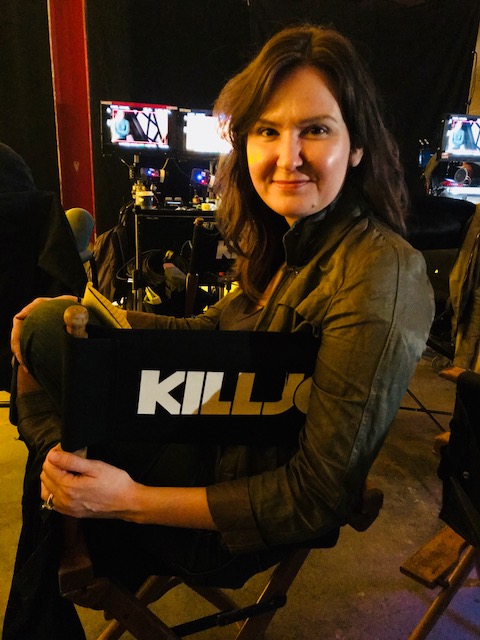
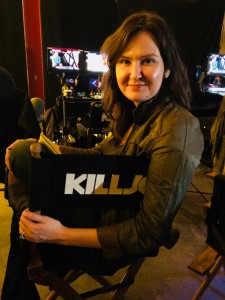
Michelle Lovretta in the Killjoys video village, the place producers & directors sit to watch the monitors during shooting.

You need a concept strong enough to attract an initial audience the crucial first year, that is producible within a reasonable budget, and that has a built in story engine ensuring that you can tell this story for years to come. Lots of TV ideas make for great pilots but unsuccessful series, simply because they run out of story.

Even if people come for the concept, they usually stay for the characters. Movies are a one night stand, but television is a longterm relationship, so the audience needs to love your leads. They don’t need to LIKE them, necessarily (it definitely helps), but they do need to be drawn to them, find them believable, and care about what they do next. Creating fresh-feeling characters and casting them extremely well is key to renewal. Actors are a huge part of every multi-season success story.

One dream actors have is to be on a long-running series. When you create a series, do you have in mind how many seasons you want it to run, so it can have a proper ending? Who is ultimately in charge of renewing or cancelling a show? How much heads up do you receive?

I usually create a five year template as a sort of litmus test to myself in the development phase, but that template often shifts radically once production begins. Television is an organic group effort, so you have to stay nimble and keep your storytelling flexible as circumstances around you change. Romances you love on the page may not work as well on screen, or an actor may leave for a different show, or the writing team may pitch you a new story arc so compelling you decide to cut something else to make room.

My job is to make the most entertaining show that I can that is also on time, on budget, and has the “story legs” for many seasons to come… but beyond that, a renewal is out of my hands. The audience decides if they want to keep watching, networks decide if they want to reorder, and studios decide if they want to shop you around. Me? I just wait, and hope, every damn time. We don’t usually get a lot of heads up notice — when you see frantic showrunners on social media saying they “still don’t know” if they’ve been picked up yet, that’s usually legit. Be gentle. They’re probably about to pass out.

Michelle LovrettaKilljoys Executive Producer Karen Troubetzkoy and Michelle Lovretta scouting a quarry on what’s called a Tech Survey – when crew and director go visit a location before shooting there, to see what equipment will be needed.

When you receive word the show will end, how do you break this to the cast and crew?

Every series is different. How you handle the news depends on when you find out, how sure you are, whether cast options are about to expire, stuff like that. The final decision can take a lot of time, and change day to day until set in stone — especially now, when so many “canceled” shows are saved by other streamers or nets.

The day our Killjoys season 3 finale aired — just hours before the public announcement was made that we were ordered for two final seasons — I still didn’t know for sure if we were renewed or canceled. Signs were good, but rule of thumb in this industry is never believe it until it’s official. So I wrote our three leads a group email the night before and asked how they wanted to find out if we were canceled – through me, through their reps, by phone or carrier pigeon. Good news they can hear from anyone – bad news is my job. But I’m extremely fortunate, so far I’ve never had to give the “we’re abruptly canceled” speech. I assume it would involve tears and alcohol. There will be a lot of both for me when our final season airs next year.

Being the Creator, writer and showrunner, how do you prepare if an actor wants to leave the show? Example: The show gets picked up for another season so the actor wants to re-negotiate his/her contract. During this time, are you still writing scripts? Do you write two versions, one with and one without the character? How long can YOU wait before you have to decide what to do with that character?

Hmm. Well, first, I’d want to know why they want to leave. Are they unhappy for legit reasons, and if so, can I help?  Did they get an amazing opportunity elsewhere, and I want to advocate for them if I can?  Are they a toxic jerk, and I can’t wait to write that death scene? (Okay, I’ve never encountered that last scenario, but I think we’ve all read about them.)

Television contracts are usually multi-year for lead cast, so they tend to be locked in. Leaving the show under those circumstances is a big deal, though not unheard of. I’ve certainly been in writing situations where we weren’t sure if a cast member was available, usually in cases where you don’t have a secondary cast member under a first position option and they could book something else at any time; or where an actor’s reps have prenegotiated an exit for a personal commitment, movie reshoot, etc. You just hope for the best, prep the strongest story you can, and have a backup plan if you ultimately can’t book them. And, yes, sometimes — if you have enough advance warning and the character or storyline is crucial enough — you may write two or three versions of an episode so that you’re prepared with options. I’ve done that. I don’t ever want to do it again.

As far as “how long can you wait”, well, actors are human – sometimes they get ill or have an accident or can’t travel, and in those cases you get NO warning. So you deal with it. You pull all nighters, maybe rebreak an emergency draft with the team on Friday for something that shoots Monday, and then work with your director (and AD …and line producer …and locations supervisor …and heartburn meds) to move scenes around and buy time. Hopefully, you have the budget to reshoot or the story flexibility to compensate – but often, you’ll have neither. That’s just TV. Shit happens – be decent about it.

Michelle Lovretta and Andrew Stearn

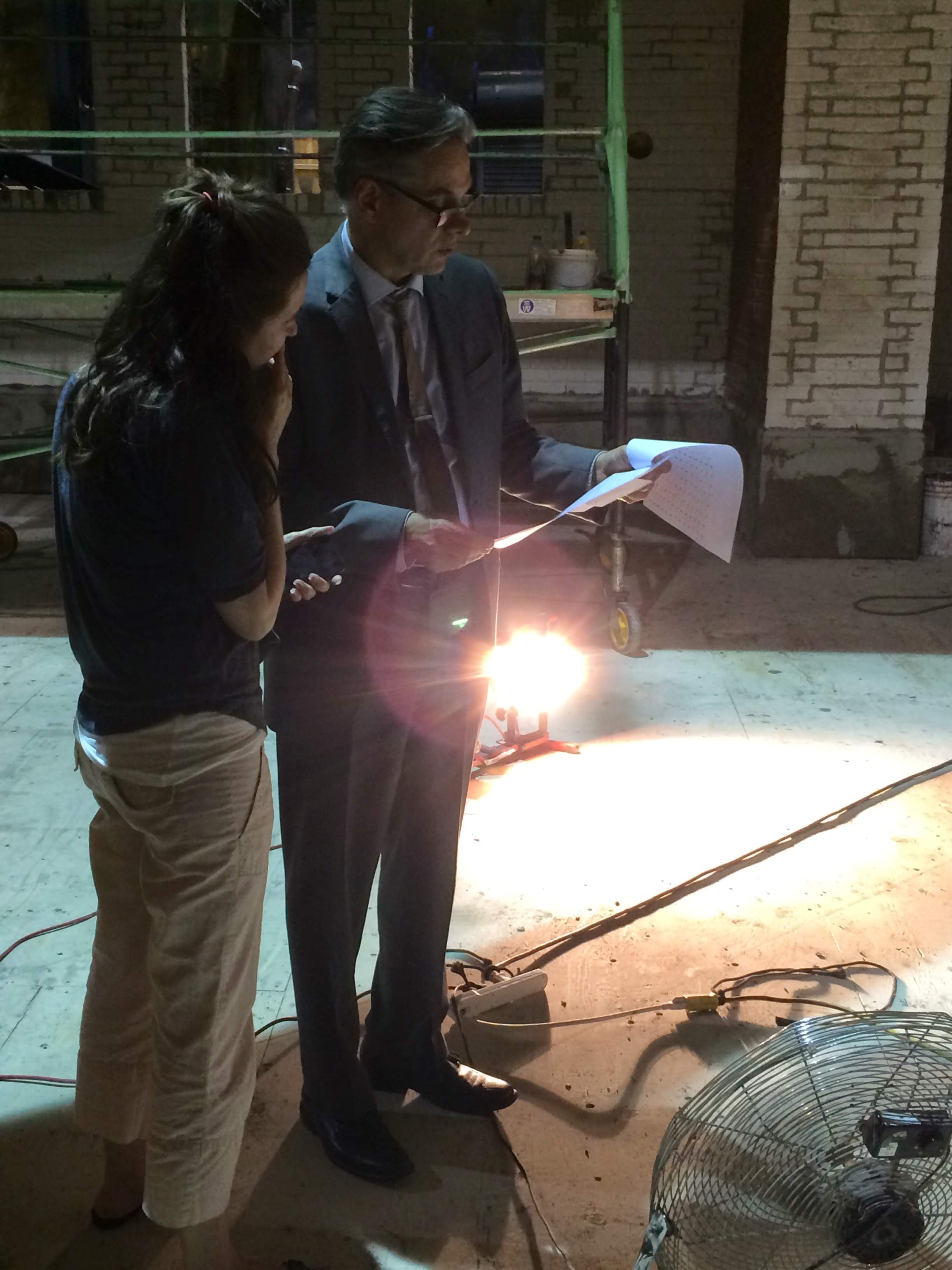
Michelle Lovretta and Andrew Stearn, the Production Designer on Killjoys Season One. They are looking at drawings for the Royale bar while they stood in that set as it was built.

How do you have time to read if you’re so busy writing? What are some of your CHILDHOOD favorite books and authors? Now?

As a kid my favorite books all involved swords or spaceships; not much has changed.

One of the petty things I dislike about my job is that I spend so much of my day reading and writing for work that I have no energy left to read for pleasure. Now that Killjoys is ending, I’m finally going to be able to make a dent in the huge pile of books I’ve been saving up. I’ve been lucky enough to “meet” some great writers and publishers online who have sent me their latest and those books are now on the top of my pile: I just started Charlie Jane Anders’ “The City In The Middle of the Night” and it’s blowing my damn mind, and then I have a ton of comics from Boom to eat up, starting with their Sparrowhawk series.

You’ve had LGBT representation in Lost Girl and Killjoys. Do you find the fanbase changes when LGBT characters are brought into the series?

You know, I’ve never really tracked audience numbers as relates to those relationships, or the straight ones, so I’m not sure? Shippers are definitely a big, fun, loud fanbase, whatever couples they support. But in the end, that’s not really why I’m writing these love stories. I’m writing them for me. Lost Girl was developed well over a decade ago and it was the second series I built around a gay character (the first was a legal series starring a lesbian that I may develop again soon) and trust me, back then you didn’t pitch “my show is super inclusive, y’all” expecting it to be an easy sell. I write and fight for these characters because I love them and their crazypants, fictional worlds.

Lost Girl

Ksenia Solo & Anna Silk aka Kenzi & Bo, Lost Girl.

Most of my writing features a variety of sexual identities for three simple reasons – because that’s the real world; because that’s how those characters were born in my head; and because I value all orientations and don’t self-edit. Main characters pop into my noggin pretty fully formed: I know if they like pudding or pie, I know if they prefer their mom or their dad, and I usually know who they’re attracted to. Then I just let them be who they are and follow their story wherever it takes us.

Are there any differences in the way you write a storyline if the couples are male / male, female / female, male / female? Do you have more of a passion for same sex or different sex couples when it comes to the story?

None that come to mind, other than trying to be mindful of toxic tropes so that I can avoid casually hurting people.

Ironically, I’m not a very sentimental or romantic person in real life, yet I love exploring relationships through my writing — parental, platonic, romantic. Maybe that’s just a safe way for me to socialize and bond with a ton of different people, while staying a happy hermit? Writing: it’s like relationship cosplay!

Honestly, though, as much as I love worldbuilding as a genre writer, it’s really FAMILY building that thrills me, especially the found families we choose on our own. And if some evil wizard told me I had to pick only one type of relationship to write over and over for the rest of my life, it would definitely be platonic soulmates, like Bo & Kenzi in Lost Girl, and Johnny & Dutch in Killjoys. That’s my true oxygen.

When you started out in show business, did you ever think you’d end up doing conventions such as Fan Expo Canada, where you could actually meet and talk to the fans? Did hearing the fans’ voices ever cause you to change a storyline?

Ha! Well I’m a big nerd but an even bigger hater of crowds and lines, so I’m really lucky — the first con I ever attended was as a guest on a panel for my own show. They zip you right in. That’s still the only way I’ve ever experienced SanDiego Comic Con, with Lost Girl. Shit is it ever fun. Meeting our fans has been a thrill, they’re so passionate and kind and smart. And many have taken the time to tell me that the types of stories and characters I’m writing made them feel seen and respected. That matters to me.

I can’t think of anything fans have said about any characters or storylines that have made me change anything, though? I’ve been doing this a long time, and I’ve learned three things about fan feedback: someone will always hate what you do, someone will always love what you do, and the loudest voice isn’t necessarily speaking for the largest fanbase. So it kind of becomes a wash and cancels itself out.

Michelle Lovretta_V modesta white wall 1

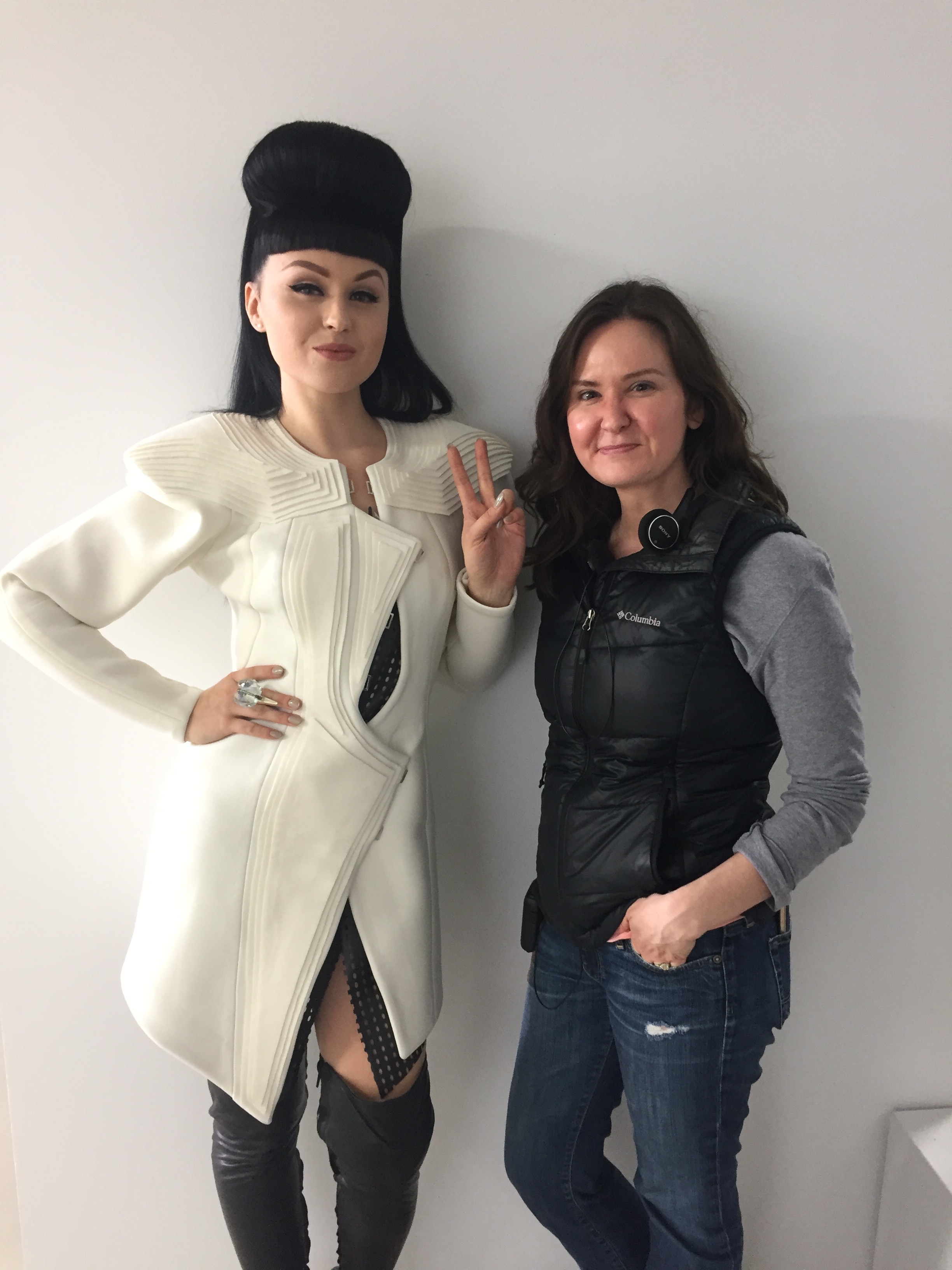
Viktoria Modesta, a very very cool “Bionic Pop Star” from the UK, who guest starred in Killjoys Season Three, with Michelle Lovretta.

In real life, what makes you laugh? What makes you cry? What makes you angry? Do you use your real emotions to write scripts?

Oh, I’m pretty simple. I care a lot about my sense of what’s right versus what’s unfair, and that’s the type of shit that sets me off. I despise cruelty, bullies, thieves, cowards, entitlement, all the “isms” – the usual shit. I’m not an easy crier, but goodbyes, and acts of true selflessness, make me bawl. I cry for things that are too beautiful and pure and good. Humanity at its best, when conditions are at their worst.

I’m sure all of this, as well as my specific sense of humor, shows up all over my work. Whether I want it to, or not.

Anything else you’d like to add to help actors understand the process of a series being extended season after season?

These days there are a million different intangibles that exist on the business end of the renewal equation — is it selling well internationally, does it draw good enough numbers or critical praise at home, is it “noisy or buzzy” on social media, does someone high up at the network love it enough to champion it. All of those things are out of your hands, though, so I usually try to make my peace with the fact that every last episode of a season that I write may also be the last episode of the series, ever — because, you just never know. Most actors understand that, and do the same.

But, as far as your ROLE being extended season after season, remember: all small roles are an audition for a bigger one on that same show.

Many of our longest running, most beloved characters on both Lost Girl and Killjoys started out as day players we hadn’t intended to see again, but the actors so elevated their small parts that I instantly wanted to keep writing them. It’s…alchemy. Turin (Patrick Garrow) started with just one single scene in the Killjoys pilot, but became a regular for five seasons. Gared (Gavin Fox) started as a one-off villain, but had such great chemistry with Pree (Thom Allison) that they became one of the show’s main romances. Many secondary characters survive for multiple seasons not because the story dictates it, but because the writers are excited to write bigger and better arcs for that actor/character combo. That “surprise factor” is one of my favorite parts of writing for television, and unique to the medium – in a novel, there’s no actor there to add a new spin for you; in film, you very rarely have a sequel with which to expand a character’s role. TV is organic, growing, flexible. Actors can really have a helping hand in shaping it.

Every job is an audition for another one. Be kind, be professional, commit to the part. You never know what might happen next…

Michelle Lovretta_iceland brekkie

Michelle Lovretta having breakfast in Iceland at a restaurant in Reykjavik.

imageedit_34_5681247380

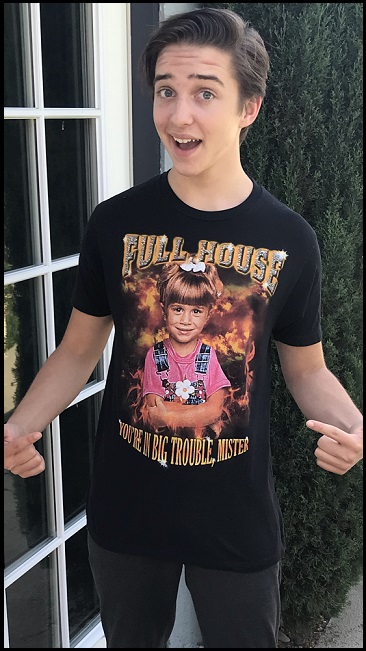
Michael Campion is one of the stars of Netflix Uber-popular comedies Fuller House, currently streaming three seasons with the fourth season in production.

You’ll recognize Michael as Jackson Fuller, the teen son of CJ Tanner played by Candace
Cameron-Bure.

Often time, young performers, can have bouts of insecurity. Getting through the fear of what other people think is definitely a hurdle. Michael is no different.

Today we learn a great deal from Michael, including the audition process, first screen kiss being an actual first kiss being an actual kiss (whew!) and the difference in types of magic shows!

Michael Campion
Photo by Robert Kazandjian

Tell us about your audition for Fuller House.

It was a very long audition process. I put myself on tape in Orlando and sent it to Los Angeles. After about the fifth audition, they liked me enough to fly me out to California. From there, I did my final in-person audition. I arrived at Warner Brothers after a very long five hour flight and stepped into a stage-like room filled with the executive producers and casting directors. It was nerve wracking! I guess I did a great job. They told me in the room just a few moments later that I had gotten the part. It was surreal.

You weren’t born yet when the original Full House was on television. Did you even know that Fuller House was a reboot when you went on the audition? Did you watch any of the original Full House episodes to bring you up to speed?

I actually loved Full House growing up. My mom introduced it to me when it came on around 8:00 on Nick At Night. I had no clue however that the project I was auditioning for was Fuller House for about the first three auditions. They like to keep projects quiet at first.

You’ve worked with quite a lot of well-known actors over the years, such as William Baldwin, Denise Richards and Tom Arnold in the feature film CHRISTMAS TRADE. What did you learn from them?

I have to say that I learned one of the most important lessons from Billy Baldwin that I keep with me to this day. One day we were having a very personal conversation after I mentioned I felt uncomfortable wearing a Santa suit in front of a bunch of my peers. I was afraid I was going to make a fool out of myself. He told me that making a fool out of yourself with pride makes you seem incredibly secure to the audience, and in turn it makes you more secure yourself. It was like the light bulb went off and from that day on, his words have stuck with me like the word of God.

You’re from Florida. Where did you stay during the filming of Fuller House and the other jobs you did? Who stayed with you?

I have stayed at a number of places throughout the seasons. I mostly stay in apartments but just recently we have leased a home that we will soon perhaps buy. My mom stays with me out here because my dad owns two businesses in Orlando. To be honest, I missed home pretty bad the first season, but slowly I started to make more of a social life out here. I have become friends with more people in LA and have gotten closer to them than I ever did with my Florida friends. Now, I actually prefer LA over Orlando. To keep myself busy I do magic and read a lot of books. I also played video games occasionally. I have to pay for my own housing.

You had your first kiss on screen of Fuller House. Did you practice / do run-throughs before hand? When you read about the kiss in the script, what was your first reaction? Who did you go to for guidance, if at all. Was it a real kiss or one of those fake TV kisses that look real?

It was definitely a real kiss! Ashley and I had to kiss a few times during the rehearsals, but by the time filming came, we were pretty comfortable with it. When I first read about the kiss, I was shocked! Actually, I wasn’t supposed to find out until the week of filming, but I snuck into the writers-room and saw on the schedule that I had to have my first kiss.

What do you think about the magician Shin Lim who won 2018’s America’s Got Talent? How do your magic tricks differ from his?

Shin Lim is awesome! I’m convinced he is an actual wizard. I met him once at the Magic Castle in Hollywood and was amazed at how nice he was. My magic is very different from his. His magic routines are more about the tricks than they are about creating a story. My favorite part about magic is the incredible way magic tells stories. So when I make a routine, I start with the narrative then go on to the methods rather than the other way around.

Michael Campion What are your top three video games and consoles? What other tech do you have?

I have an Xbox One and an Alien Ware Gaming Laptop. I’m very picky about my technology because I also code and build robots. My hardware has to be tailored to my needs or I don’t use it. For the most part, I only use my phone, Xbox and gaming computer.

You’re 16 years old. Have you gotten your driving permit or license?

I have my permit and I’m waiting on my license in November. I think I’m going to get my first car for Christmas, but I’m not sure. The first time I ever went behind the wheel, we posted it on YouTube. You can actually look it up and see my first experience! It was definitely wild. I crashed into a ditch. But other than that we made it out just fine! I’ve only been behind the wheel a few times, so perhaps when I get more experienced I’ll have crazier stories.

What thing did you do that was sneaky?

To be honest, I’m not a super sneaky kid. I don’t do anything illegal or crazy, but aside from acting I also hack computers…My OWN computers of course. I’ve never hacked a computer without the owner’s permission. The only time I ever got caught doing something sneaky was when I attempted to pick the lock on my dad’s safe because I was just curious to see what was in there.

What do your non-actor friends think about your career?

They think it’s really cool and are in support of it! They see it as kind of a mystery because they don’t quite understand it all. For the most part they like it, but at times it can get annoying because I have to leave them when we are hanging out and having fun to go to an audition or a press interview.

What type of school do you attend? When you’re on set, what’s the protocol for school?

I take a homeschooling program for child actors. On set, we have a teacher and we have to get a minimum of three hours of school per day. Any down time we have we are up in the schoolroom with our teacher. Soni Bringas (Ramona) and I go to the same school!

As a successful actor, what are your future acting goals?

My end goal is to be in an action film. One day I would love to play James Bond or Ethan Hunt. In fact, action/drama films are my favorite! If I had to chose my favorite movie it would have to be Inception.

What advice do you have for young performers?

I say…start small. If you want to make it in this industry you can’t go into it wanting to be famous because there are 1000 other kids ahead of you thinking the same thing. Love the craft and take it for what it’s worth. Always improve yourself by doing plays, making independent films and studying in an acting class.

Anything else you want to say?

Thank you so much for interviewing me! You asked some excellent questions. If you want to find out more from me, my instagram is @michaelcampion!

Empowering the Actor with Acting Coach Joseph Pearlman

Acting coach Joseph Pearlman speaks with a tremendous positive energy and enthusiasm that’s downright infectious. But it’s the information he imparts to the actors he’s working with that’s the real gift he offers. Pearlman’s message is all about empowerment: helping actors to not only see the greatness that already lies within themselves, but also to help them open their minds to another way to achieve success outside of the Matrix-like rules the system uses to entrap the thinking of actors.

Pearlman is a native of Boston who went to NYU and then a program at the Royal Academy of Dramatic Arts, after which he worked in regional theater in New England before moving to Park Slope and forming his own theater company. He subsequently moved out to Los Angeles, and after a revelatory year training with – and ultimately teaching with – legendary actor and teacher Jeff Corey (“Butch Cassidy and the Sundance Kid,” “True Grit”) Pearlman decided that helping other actors find their own revelations and breakthroughs was what truly motivated him. 

At his Pearlman Acting Academy he’s worked with talents like Zooey Deschanel, Julian Sands, and Eugene Simon (“Game of Thrones,”). He was also named one of the “Top Ten Acting Gurus” on the app Acting Genie. He took a few moments to chat via Skype from his offices in Los Angeles.

So where did your love for acting and actors get started?

I’ve always done plays and acted since I can remember. I went to one of those all-boys, New England type of prep schools that was very jock-oriented, so my escape from all that was doing plays at the all-girls school where my sisters were. So there was definitely an ulterior motive: I was going there to hang out with girls, but there happened to be theater. I went to New York University, and studied there, and I was lucky enough to get into this incredible program at the Royal Academy of Dramatic Arts where I spent part of my last year at NYU. And all along – I didn’t call it coaching – but I was helping actors with their performances. I somehow had a knack for helping them get from point A to point B. I moved out to LA around 2004 and I was hired at a really cool acting studio to teach my own class, where I worked with a young Zooey Deschanel, and a young Ryan Reynolds, and a young Amy Adams, all these incredible actors before they broke out. And ultimately the studio – the woman who ran it was very sweet – but the process was just something I couldn’t get on board with. So I started my own studio and a lot of the folks came with me. And over the years, with word of mouth and helping actors get results outside the classroom, it just started to build from there.

Did you have any coaches yourself who inspired you?

I am fortunate to have had a mentor named Jeff Corey. He was probably in over 200 films in his career. He was blacklisted in the McCarthy era and started teaching acting above his garage. He taught a young Jack Nicholson, a young Stephen Spielberg, a young James Dean. I trained with him in the early 2000s. One of his core philosophies – and Jack Nicholson talks about this – is that nine-tenths of the performance is the personality of the actor. That doesn’t mean you’re playing yourself – it means you’ve got to [realize] 75 percent of every role you have in common with [the character.] We’re all human animals, we can relate and identify with a lot of stuff even if it’s outside of our realm of experience. And that’s just stuff you can wipe off your deck. You don’t have to act it. I think the really special experience that sparked all of this was working with Corey and being in that environment, seeing actors like Sean Penn come in and work in a small group. It was the first time I’d ever seen someone help an actor have a transformation every single time they got up. Guaranteed. It blew me away, and it was like, ‘This is what I want to do.’

So tell us a little about your philosophy toward coaching actors.

Actors need more information. They need to be empowered, and they need to have a lot of stuff taken off their plate that’s put there by fear, uncertainty and doubt, and that’s put there by people telling them, ‘This is how you’re supposed to do it.’ I definitely have a lot of fun empowering them in that way, and kind of giving them permission to break the rules in a way. Because everything is changing, even in the last year, everything is constantly in flux. In terms of the lay of the land this year, you can’t just be good, you have to be great. And when you’re great, there are no rules. There’s no ‘wash-rinse-repeat’ cycle. Most actors think they just need to get an agent, and then they wait for that agent to get them auditions, and that is very far from what happens. 

What direction do you see things going in?

The other thing actors don’t realize is that the casting directors don’t cast them, ultimately. They’re a major part of the process, but it’s the writer, director and producer. And what’s happening is that this has been one of the slowest years for casting directors as a whole, because production has taken a lot of what casting has done, which is they’ve automated it so much. Production companies are saying, ‘Well if they can do that, why are we paying them when we can do that too?’ So what I’m doing is orienting the people that I work with to build game-changing relationships with the writers, producers and directors of the projects that they want to be a part of, long-game relationships, and from those they’re getting early access to sides, early access to scripts before they ever even hit casting. They’re able to get general meetings with production companies. So a lot of castings for my clients have come without ever setting foot in a casting office. 

I’m sure most actors would love it if they could bypass casting and get hired straightaway! 

It’s definitely an exciting thing, not because we don’t like casting directors, but there’s a lot of snakes and eels surrounding those offices, and it’s very hard for actors to penetrate that. And I’m happy for actors who don’t have to give their power away by going to some of these workshops that have been exploitative. I have a client that booked the lead in Ridley Scott’s new movie – I’m talking the lead in the movie – just by building a relationship with Ridley Scott’s production company, getting early access to a script, sending tape after tape in, and never seeing the inside of a casting office.

How does that work exactly?

What needs to happen in order to start building these relationships is actors need to know how they are going to sell themselves once they pick up a telephone or how they’re going to empower their rep who knows how to pick up a telephone to sell them. This is not the typical stuff you see in these branding workshops around town, it’s not your ‘acting niche’ or your ‘acting type.’ It’s more closely related to what’s taught at Harvard Business School, which is ‘value proposition.’ What that is is basically a brief statement that describes what’s awesome about you, and the number one reason why somebody should hire you. It’s something that they can’t ignore. We go through about 100 questions and we start putting together this power statement, this two-sentence statement that we’re able to sort of part out and use for every pitch we make. 

And how has this approach been working out in the real world?

The long and the short of it, we’ve had 18 actors booking series and film leads in a single year without the help of a rep, most of the time outside of the traditional casting experience, by building game-changing relationships with writers, producers and directors in 3 to 60 seconds on the phone, and then maintaining it throughout the year. It’s badass, it’s empowering, and the actors are no longer just waiting and waiting and waiting. They’re not beholden to a casting director as this sort of gatekeeper to you being seen by the people who are actually going to hire you. And they’re getting hard results. 

So how does the actor get to this point where they can take this approach?

The best advice is to be great. Devote yourself to being the best actor you can be. Stop obsessing about reps, stop looking for reps, don’t worry about pictures, don’t worry about your resume. Just devote yourself to being so great they can’t ignore you. The other thing too is that great actors know the work was great not because they watch the playback in some acting class, it’s because they feel it. What you’re watching on camera is the result of this whole chemistry experiment. You can’t go looking for that on video. I encourage actors to know that the work was great on their own. The number one thing that’s happening is they’re having fun. If you’re not having fun, it’s not working. Period.

Okay. But in the meantime, let’s assume most of us will still be auditioning. What’s some advice?

The number one audition rule is don’t guess what you think someone is looking for. Don’t try to please the casting director. Assume you are who they’re looking for and bring yourself to the piece with a phenomenally brave and fun choice. Because they don’t know what they’re looking for. They’re looking for a solution to the problem. And no one likes somebody who’s trying to please them. It’s nice when somebody is like, ‘Hey here’s a solution to the problem. I hope you guys are having a great day. I’ve got to go somewhere else right now, but I look forward to hopefully working with you guys,’ and then leaves. 

And are there any common mistakes you could point out that lots of actors make?

Here’s one big thing: actors think that it’s their job to obey, both emotionally and technically, the stage directions and the character description. They think those are their acting instructions. And what’s crazy about that is, that stuff for the most part is written by a casting director, and not the production company. What it’s for is that it tells the actor about the world they’re in. What I tell actors is don’t obey the character description, because you can be sure every other actor is going to be doing that.

Anything else?

Another thing is a lot of actors think they have to bring their training into the actual acting. So one of the hardest things for an actor to do is let go. If you have done great work, if your work has been strong medicine in your body, it’s like a properly packed parachute that prevents a skydiver from falling to his death. If you’ve done your work properly, all you need to do is jump out of that plane and pull the ripcord and let that parachute gently guide you down. What I always tell actors is: what if your best acting self is just as easy and loose as if you were playing yourself? Would you feel you were interesting enough? I’m not telling them what if your best acting is you playing yourself. I’m saying it should feel easy and loose and effortless. A lot of actors don’t trust that. They want every moment to feel as though they’re birthing a calf. 

Any final thoughts?

The real joy in my life is how do you prepare a piece to guarantee an audition with it so that you book a role, you get a callback, and somebody falls in love with your acting. That’s my real joy, is helping actors do that. Because once you create an opportunity for yourself, you’ve got to be amazing.

Voiceover Casting

It’s hard get a handle on all the various mythical, magical, and downright wacky fictional landscapes veteran voiceover casting director Dawn Hershey-Lopes has helped voice actors to inhabit over the years. Coming from humble roots starting out as a receptionist at Nickelodeon Animation right out of college at San Diego State University, she worked her way up to casting supervisor while working on shows like “Hey Arnold” and others before heading over to web series pioneer Icebox. Later she helped to launch Blindlight, a studio specializing in video game voiceover. While there, Hershey-Lopes oversaw casting for games like “Halo 2,” “Elder Scrolls IV: Oblivion,” the “Transformers” game, and the “Iron Man” game.

Although she left Blindlight in 2008 to start a family, Hershey-Lopes continues to have a tremendous impact on the field as a freelancer, working remotely from her home on an acre of land in northern California with “the husband, two kids, two dogs, two cats and two goldfish.” She manages all that while casting shows and films like the Teenage Mutant Ninja Turtles movie “TMNT,” “Tom and Jerry,” “Harvey Birdman, Attorney at Law” and “Scooby Doo, Guess Who.” 

Hershey-Lopes took time out from her various casting and parenting projects to offer some thoughts on the voiceover field and advice for actors looking to break in. 

On breaking in to the business – and overcoming early setbacks:

One of my best friends [from SDSU], Chrisie, got a job at Warner Brothers Animation. When I graduated, she got me a [temp job] foot in the door as assistant to the assistant for the president of WB Animation – and then after three days I was fired, because I knew nothing. This was like 1993, I had never used email, I had never had internet. They asked if I take dictation, and I was like, no. I could barely answer the phones. They hated me. So I got a receptionist job at Nickelodeon Animation, and I worked there for 9 months, until a casting assistant position opened up, and I [became] the assistant to Joey Paul who was on the show “Hey Arnold.” I worked on that show for five seasons, then I became the casting coordinator, and then casting supervisor before I left to go to Icebox.

The importance of developing relationships in the business:

When the dotcom crash hit, I went on to form my own company with three of the guys from Icebox called Blindlight, and I was head of casting. And all we did was video games. I would cast like “Halo 2” and all these big names. So at the same time I was working for Blindlight I was also freelancing for any other things that came along, and that’s how I got all the Adult Swim shows, and “TMNT” and all these other shows. I just started developing these relationships working with all these people and working for free a lot, and then they came back around with a real paying project, and they’re like “You wanna work for real?”

Current work and life:

I left Blindlight in 2008 and took time off and started my family, and I’ve been freelancing since, as a true freelancer from Northern California. I do everything online now from home. I exclusively do animation. I left video games in 2008, so I really just do voiceover [for animation]. I’m working on season 2 of “Scooby Doo Guess Who,” which is going to be a streaming show on Boomerang, and then I’m on season 5 of Tom and Jerry, and season 3 of an online show called “Clash-A-Rama,” which is based on the “Clash of the Clans” video games.

On revisiting an old Adult Swim favorite:

I just finished working on a Harvey Birdman special, called “Harvey Birdman: Attorney General.” That’s going to air on Adult Swim in October sometime. I cannot believe we got [Stephen Colbert] but he did it. He ran down from taping his show, went into this little crappy closet booth, but we knocked it out and we did it in one take. It was amazing. We were all phone-patched in from our little corners of the world. We patched him in from New York, so it was great. Everybody did it [from] the original cast.

What she’s looking for in an actor:

The number one thing I look for in an actor is the ability to act. Just like any other casting director in any TV show or movie, you have to have the ability to act. And that includes comic timing, accents, believability and how well you read – because you’re actually reading off the sides, you’re not memorizing anything in animation. So when you’re auditioning and performing, you have to be able to read fast and clearly, and you have to be smart and you have to be savvy.

On the biggest advantage VO work has for actors over live-action:

It doesn’t matter what you look like! Whereas in film auditioning I think that’s probably like 90 percent of the casting: what you look like, and how tall you are against the other people in the film, and what you project as an actor, as a physical character. So all I have to deal with is the voice, and it’s so much easier. You can just really rely on the acting. You don’t have to take a hit in the acting because the person looks exactly like a young John F. Kennedy.

Best advice for actors looking to break in to VO: 

I would say you should do several workshops. It’s just going to depend on your budget, how much you’re willing to spend on taking workshops. But to get into the business, if you can take three or four solid workshops before you make a demo reel, that would be what I would suggest. It does cost money. Unless you’re super tech savvy and can produce it yourself, you’re going to have to spend some money on workshops and a demo reel, because that demo reel is what you’re going to send to an agent to get represented. And you’re going to probably need to take workshops on different areas of voiceover: there’s movie trailers, promos, commercials, books on tape, animation, video games, jingles – so you’ve got to think of all these aspects of voiceover and which ones you feel strongest in. 

But do your research first:

I always point people to this thing called the Voiceover Resource Guide, and they have it online now. They have one for New York and one for LA. It’s really a wealth of information. They have everything from every recording studio, with all the contact information, every voiceover casting director, AFTRA/SAG rates for jobs, workshops, trainings, and who teaches them, and people list their prices. And start contacting them, because some of them are like a huge waiting list. Like Bob Bergen’s [who  voices Porky Pig and Tweety Bird] animation workshop, you’ve got to wait like six months to get in. They’re usually taught by voiceover actors who do the work themselves and then they teach, [but] there are a few voiceover casting directors who teach, and a few production studios that teach.

 And know animation if that’s where you’re aiming to work:

It helps the more you know about animation history. There are certain people who work for the DC comic book franchises, who are obsessed with the comic book world, who know everything there is to know about all those characters. And then you’ll have people obsessed with the Adult Swim lineup. When they know a lot about the show they are auditioning to work for, it usually helps when they come in to meet producers. I would say educate yourself – but those people just naturally educate themselves because they’re obsessed with a certain genre.

On the importance of getting your audition in early:

If you have an agent, you can go to your agency and they’re going to have a studio to record auditions. They’re just going to line people up out the door and record them one after the other. You can also book a studio for like $10 to record an audition. But I would say at least 50 percent of voiceover actors have their own studios that they’ve built. They have their microphone in there and their music stand and the walls are all soundproofed, and they get the copy from the agents for the ten shows they’re auditioning for that day, and they go in their little closet at home and read them and then the agent sends them out. It’s just so fast-paced now, if you’re not getting your audition in right when the agent sends it to you, like that night or the day after, then you’re going to lose out, because there’s 100 other people that have already gotten theirs in. 

Acting Classes

“Acting is behaving truthfully under imaginary circumstances.” – Sanford Meisner

“Acting is not about being someone different. It’s finding the similarity in what is apparently different, then finding myself in there.” – Meryl Streep 

Opening the door to a discussion of various acting techniques can be as perilous as bringing up topics like politics and religion at Thanksgiving dinner with distant relatives. Tears have been shed, friendships have ended, and I’d even bet that blood has been spilled in what started out as civil discussions of the relative merits of Stanislavsky, Strasberg and Meisner. 

But despite the contentious nature of such discussions, they must nevertheless be addressed, if for no other reason than that choosing one technique over another can have great consequences for an actor. Here then is a very, very abridged and all-too-brief overview of some of the better known schools of thought on acting technique.

1. Stanislavsky

Konstantin Stanislavsky is widely considered to be the grandaddy of most modern acting techniques, the fount from which much of modern acting stems. He was among the first modern practitioners of theater to suggest that acting could be broken down into a step-by-step formula that involved more than vocal and physical training. Stanislavsky’s “System” involved a holistic, psychophysical approach he termed the “art of experiencing” in which actors are taught to direct their conscious thought to activate subconscious and emotional responses to justify the character’s actions. 

2. Strasberg and The Method

Building on Stanislavsky’s System, Lee Strasberg is most closely associated with developing what became known as The Method, and the founding of The Group Theater. Strasberg focused exclusively on the psychological aspects of the actor’s own real-life experiences, prompting them to use the personal emotions generated by those experiences to elicit responses to on-stage stimuli. Perhaps the clearest explanation of the main difference between Stanislavsky and Strasberg is that Strasberg would have the actor ask themselves what would motivate them, the actor, to behave in the way the character does, through recalled personal experiences and emotional responses. Strasberg labeled this technique “affective memory.” Stanislavsky on the other hand would emphasize that the actors were also working with the given circumstances of the play, not directly from their personal experiences, and that actors could just as easily come to develop their characters from the “outside-in” as from the “inside-out” of Strasberg’s affective memory work. Some of Strasberg’s students include James Dean, Elia Kazan, Dustin Hoffman, and Al Pacino.

3. Michael Chekhov

Chekhov was considered by Stanislavsky to be one of his most promising students. He suffered a nervous breakdown when applying Stanislavsky’s memory work, which informed the way Stanislavsky delimited the use of such techniques. Chekhov subsequently further developed the teacher’s “outside-in” approach to acting technique and building a character, which he called the “Psychological Gesture.” With this method, the actor physicalizes the character’s need or internal struggle with an outward gesture, which is subsequently suppressed and internalized, allowing the physical memory to inform the actor’s performance subconsciously. Chekhov’s techniques have been notably incorporated by actors like Jack Nicholson, Clint Eastwood, Marilyn Monroe and Yul Brenner.

4. Stella Adler

Stella Adler was also a student of Stanislavsky, and a member of the Group Theater, but parted ways with Strasberg and his Method when she found that his emphasis on the personal emotional and psychological approach was too high a price for an actor to pay: “Drawing on the emotions I experienced — for example, when my mother died — to create a role is sick and schizophrenic. If that is acting, I don’t want to do it,” she said. Instead, Adler developed techniques that helped actors to use their imagination to generate emotional responses within the given circumstances of a script rather than dredging up their personal emotional trauma and putting it on display. She considered half the actor’s job to be internal: imagination, emotion, action, will – and half external: characterization, physical movement, voice, etc. 

5. Sanford Meisner

Meisner was an early member of The Group as well, but didn’t take long to become disenchanted with Strasberg’s emphasis on affective memory work. He, like Adler, sought to emphasize the actor’s imagination and honest reactions to the given circumstances of the text with which they were working rather than emphasizing the internal emotions of the actor himself. Meisner’s approach prompts that actor to “get out of their head,” and focus instead on their scene partners, rather than intense internal analysis and reliving psychological and emotional trauma. His technique involved a series of interlocking exercises emphasizing the actors improvising and reacting to one another, and out of that, developing an internal emotional life for their characters. The list of Meisner-trained actors is insanely long, but includes Robert Duvall, Jeff Bridges, John Turturro, James Gandolfini, Stephen Colbert and James Caan.

6. Uta Hagen

No list of acting techniques would be complete without mentioning Uta Hagen, author of 1973’s “Respect for Acting,” which still graces the reading lists of many theater students nearly 50 years after being published. A gifted actor who originated the role of Martha in “Who’s Afraid of Virginia Woolf” and who toured as “Streetcar Named Desire’s” Blanche DuBois opposite four different Stanleys, including Marlon Brando and Anthony Quinn, Hagen later credited director Harold Clurman for compelling her to give up her “tricks” that she used “to construct the mask for my character, the mask behind which I would hide throughout the performance. Mr Clurman refused to accept a mask. He demanded ME in the role.” Her technique involves something she called “substitution,” and later changed to “transference,” in which the actor should identify their own thoughts and feelings with those of their character. However, Hagen’s rather complex technique diverged from Strasberg’s Method by emphasizing that those “thoughts and feelings are suspended in a vacuum unless they instigate and feed the selected actions.” Some of Hagen’s students include Jack Lemmon, Matthew Broderick, Charles Grodin and Gene Wilder.  

By the time you’ve gotten this far, you’ve probably noticed that there seems to be a lot of overlap and aspects of similarity between various techniques mentioned here. That’s because they are similar in lots of ways. And truth be told, while people will argue the merits of various schools of acting thought to death, most good acting teachers incorporate aspects of more than one, often several. 

One strong word of advice that you’ll hear over and over again is that if an acting instructor you meet promotes one and only one technique to the point of denigrating others – in other words, if they come across as a true believer who drank the Kool-Aid, you might reconsider working with them. You only have to look at the actors’ names associated with each school of thought above to realize that there is more than one legitimate approach to acting. 

But at least with this admittedly brief and incomplete primer, you’ll have some idea of what you’re getting into!

Michael Donovan Casting Director

New York native and L.A. transplant Michael Donovan has been involved in show business for a very long time. In fact, reading his CV, you start to wonder if the guy ever sleeps. His recent four Artios award nominations brings his total to 30 noms, with 7 wins racked up so far.

“I’m pretty much known as a theater guy on this coast,” Donovan says of the over 900 plays he’s cast, but he’s hardly confined to one medium. Donovan has also cast over 50 films (“So This Is Christmas,” “Flight 93: The Flight That Fought Back”), about a dozen series (“Blood Relatives”), and over a thousand commercials. 

Donovan went to school originally to be a teacher, but quickly fell in with a bad crowd – the kind of crowd that got him hooked on acting and musical theater, leading to a love and lifelong passion for the art, both on stage and in the casting room. 

These days Donovan teaches senior acting classes at UCLA when he’s not casting yet another project, or traveling around the U.S. to guest-lecture at colleges and universities on the ins and outs of the acting business.

We caught up with Donovan as he was returning from a walk with his dogs in the Hollywood Dell neighborhood in the hills above Hollywood.

Making the switch from acting and directing to casting: 

I moved to L.A., and directed a play in Hollywood that another casting director came to see. She came backstage and was very enthusiastic about the direction, and asked me if I’d be interested in directing [commercial] casting sessions. And I had no idea what she was talking about. Two days later I was hired, and I was like, ‘Oh my God…’ and I was winging it. But it was really just adjusting to the speed and the pressure of staying on time and figuring out how to make all that work. And anyway I found after a very short time that I loved it, and it became my survival job. I would freelance and work with another casting director, and basically when I was available I’d do that. And then eventually, over a couple of years it became more and more about the casting and less about the acting. 

The advantage of casting so many different types of projects:

What is exciting to me about what I do is that if I meet you for one medium, I have no problem bringing you in on another one. I feel like an actor’s an actor. That’s kind of how I got started: I knew all these actors who weren’t getting theatrical work, and I was like, “Why not?” So I started booking them theatrically.

Circling back to teaching:

I went to college to become a teacher, which is ironic, because I’m teaching [at UCLA] now. So I added the whole drama major later. I guess part of it was just making the commitment. I made the commitment later. Had I known earlier I might have done that differently, but no regrets. Those years taught me to be a good teacher as well. What I love about teaching is I get to share the screw-ups that I did. 

On not treating actors like sh*t:

My years as an actor hopefully made me a much better casting director. I protect actors to the best of my ability, I have empathy for actors, and I know how to speak to actors. I know what I wanted to hear at an audition, and I often felt that I didn’t get what I needed to know at an audition. I remember auditioning before I became a casting director, thinking, “Can’t someone do this better? Do we have to be treated like shit?”

The importance of having a theater background:

For theater there’s a different energy than being in say, a film: in knowing how to take the stage, the ability to stay in character over a period of two and half hours or whatever it might be. That’s a skill I look for. I don’t care what I’m casting, I want somebody who’s theater-trained. I think nothing trains you better than that.

And actually, don’t listen when they tell you to ‘do less’ on film:

Film tends to be more subtle. I use the word “condensed.” Everybody always talks about this in class, saying “Do less, do less.” That’s not true. Don’t do less, just condense what you’re doing. By doing less you end up eliminating some of the wonderful work you’re about to do, and I don’t want that. I just want you to find a way to condense it down.

Common sense and self-taping:

Can I talk about self-taping? Let’s talk about self-taping for a second: Yikes, people. Come on. I got a self-tape a couple years ago, and the guy is standing in front of a bookcase that’s filled with books. And a few seconds in – the tape is not good – and I found myself turning my head and reading the titles of the books that were on the shelf. So here’s the deal: find something that is a completely plain, nondescript background. It doesn’t have to be brilliantly lit, but you have to be lit. And you have the huge advantage of, if it didn’t work the first time, don’t send me that take! Do it until you get one you’re proud of! That sounds so simplistic, but… I don’t need it to look like a full production company did it, but I’d like to be able to see you and hear you clearly and know that it’s your best take on the material.

The two sides to the controversy over L.A. CDs running workshops and classes:

It’s really a shame, because basically [casting directors’ classes and workshops] are pretty much gone. And yeah, there were a few bad apples. But for the most part these were hard-working people with small businesses and it was a great way for actors, in a low-pressure situation, to get in front of us as casting directors. The bad part of it was people were saying, “Oh that’s a paid audition.” It wasn’t a paid audition. It was a class. I taught when I did these workshops. It was such a huge advantage for the actors being taught by people who are actually doing it. Part of the problem with a lot of academia across the country is that these people used to do it. They still have very valuable things to teach, but the business is changing constantly. The advantage of the workshops was going to these things with people who are currently doing it, and can tell you the most up to date information. 

Listen up, actors: pay attention to the breakdown!

If you’re looking for advice, I’d tell people, I’m okay with pushing the envelope a little, but if we said all ethnicities, we meant all ethnicities. If we said Asian, we meant Asian. You know what I mean? There’s a reason why it’s either a certain ethnicity or it isn’t. There’s a reason why it’s a certain hair color or it isn’t. And to just ignore that, to me you end up looking unprofessional. 

And update your headshot:

The same thing applies to pictures, if you send in pictures that don’t look like you anymore. So now you end up going in on something you’re wrong for. It’s important because you missed the thing you were right for! You changed your hair color, you gained weight, lost weight, you muscled up – any of those things. You are not presenting an accurate picture of what your current situation is. I don’t think actors change their pictures often enough. 

And by the way, bring your headshot to every audition:

I do some casting in New York too, and I find it’s less of a problem there, but a certain amount of actors at every audition walk in without a headshot, and that’s not cool. The thing is, sometimes we don’t need it. For commercials you almost never need it. But for theatrical auditions, they look at it while you’re auditioning! Even if you walk in and we say we don’t need it, how did it hurt you to have it? Particularly someone like me, who does multiple projects at any given time, one of my other producers might wander over and say hello, or a director might pop in, and they might really like the actor and ask if you have a headshot. And you have to say, ‘Uhhh, no, I don’t have one…’ Come on. I just think it’s your business card, and you need to have your business card with you. If you get to be Meryl Streep, then you don’t need to bring in a headshot. 

On preparation:

The cardinal sin is being unprepared. It’s just unforgivable. Whatever happened in your life – you were on set all night, you were working at your other job, you just don’t feel well, any of those reasons – I think the better choice is to have your agent call and ask if you can reschedule. If we can’t reschedule, you have to decide if you’re prepared enough to go in, or if you’re better off just canceling, because again, you’re wasting time. You’re wasting your time and you’re wasting our time. 

Show them what you can do, not what you can’t do:

Don’t choose to audition with a role you cannot play. If you’re auditioning with something that just makes no sense, a role that’s too young for you, too old for you, just completely wrong for you, it just doesn’t make any sense. Choose something that shows you off well. I always tell my musical theater students, don’t show me what you cannot do. 

On bringing joy and a love for acting to the casting room:

I have a commitment to every single audition that I do: I bring in people that I haven’t met. I’m always excited about my day. I love what I do. I sit there and I have talented people sing to me every day, I have talented people read to me every day – it’s a very nice thing that I do. 


LA Acting Auditions

Most of the time, casting directors have very specific areas they focus on: commercial, film, or television, for instance. Especially when it comes to voiceover versus on-camera work, most CDs do one or other — rarely both.

But Terry Berland of Berland Casting in Los Angeles isn’t your typical casting director. 

A New Yorker born and bred, Berland got her start working in advertising on Madison Avenue, cutting her teeth casting both the actors to be used on camera in agency-produced spots, as well as those who would do the voiceover. By the time that kind of in-house commercial casting had started to decline, Berland had climbed to the top of the profession, heading up casting at Madison Avenue ad powerhouse BBDO Worldwide. 

So it made perfect sense that she would continue casting commercials, opting to head out west to open up and partner in running the commercial division of Liberman Hirschfeld Casting for a time before opening her own shop. It also made sense that she would continue casting both voice and on-camera talent, as she has done for the past 25 years, and continues to do out of her Wilshire Boulevard offices.

When she’s not casting projects like “Invader Zim,” or “Whining Low,” Berland enjoys helping out actors by teaching high-quality classes and dispensing her accumulated wisdom from sitting behind the table in thousands of casting sessions through her book, “Breaking Into Commercials.” 

She was kind enough to take some time out of her busy schedule to chat and offer some thoughts for actors.

On the relationship between casting directors and actors:

Casting directors are only as good as the actors they bring in. So an actor needs to feel very much a part of the process, equal to the casting director. They should come in with the attitude: ‘I’m here to solve your problem. [I] have a creative choice, and it’s my way of solving your problem. Your problem is that you want to find the right person to make this character come alive.’ So maybe a big mistake is for an actor to walk into a casting and not feel like a part of the process. A big part of the process. 

On the similarities and differences between voice and on-camera acting:

A similarity for the actors is you have to connect. And obviously there’s different techniques. There’s techniques for connecting on camera: for on-camera it’s like a short scene. For voiceover, you have to connect also, so that’s similar. The difference with voice acting is, because you’re only hearing the voice, the actor has to know how to subtly change things, and convey their message with a lot of nuances in their read. In on-camera you have the visual to help the message along, but with voiceover you only have your voice. So there’s transitions in copy: maybe you start out bright, then there’s a discovery, then there’s an invitation to do something, and then a result. And that all has to come from nuances in your voice.

On teaching:

I’ve been teaching for years. I love educating. I teach on-camera based on short scene, and also voice-over. The method I use is proven; people book more, get more callbacks, get agents. So it’s very satisfying. We just have to be very, very clear, when we’re a casting director that they’re coming to learn from us, and they’re not coming to audition. It’s teaching. 

On giving a good audition:

Auditioning well is based on acting. The biggest mistake is not realizing they need to be an actor. Even when it comes to, ‘Slate your name and tell me something about yourself,’ it takes a certain way. In commercials, you need to look at that camera and be open and friendly and decide what you’re going to say with a personality. If its an improv they have to know how to do a commercial improv.

On being needy as an actor: 

There’s just so many different things that can go wrong when [the actor is] in the room. I would say one big thing is they should know what they’re doing – they should be confident, yet friendly, not above it all, they should know what empowers them, and they should not come off as needy. Because when there are clients in the room, you’re with the very people that can book you. And some people behave in a very needy way. We can feel it, and it’s not attractive.

On dealing with mistakes in an audition:

If you’re doing a commercial read, and you make a mistake, improv around your mistake and try to get back on track. One of the worst things to do is to apologize and be down on yourself and make it a big tragedy that you made a mistake. Someone that’s really trained in a fun way will try to improv around their mistake, and then either they get back on track or they don’t. But a big mistake is that when you do make a mistake, to make a big deal about it, to start apologizing. A mistake can actually be a little gift. Knowing how to improv around that can be a real gift.

On crossing lines:

When it’s a callback don’t cross a line figuratively or literally. You wanna stay on the mark that you’re given, and don’t walk over to [the clients] and start shaking their hands and saying ‘It’s so nice to meet you!’ 

On connecting with the casting team without being needy:

The best way to make a connection is to be good at what you do. Be friendly, open, say hello. But you don’t want anything from them. Don’t be attached to getting the job. The best actors go in, they do the best work they can, they’re well-trained, they know they did a good job, they leave, and forget about it, and go to the next one. And it’s an interesting dance, because of course you want the job. Let’s not pretend you don’t want the job. But you can’t have so much invested in that one particular job. Your job is to go in and give a good audition, and then the next one, and the next one. 

On being neutral:

So I’d say another bad mistake actors make is they’re afraid to make strong choices, and they neutralize their audition choices. If you’re neutral you’re no place. You have to be distinct. We love when everybody’s good. I could have 25 actors come in and read for the same role and they’re all really good, they’re all just a little different. And then it’s subjective from the people who are choosing them, because the casting director doesn’t book them, it goes to the selection process. 

On choosing where to plant your flag as an actor:

I would say go where you feel more comfortable, where you like the lifestyle. Good things are going to happen in [New York or L.A.], but the main thing is that you like the lifestyle initially. You should be happy with how you’re living, and where you’re living and then the right things will come to you. I know a lot of actors who do this: once they get started in one place, they then see thing more clearly and they reassess things and realize they want to live on the other coast because of their needs, their career needs, so they just make the switch. And say you start out in New York – there’s great training that’s really respected. Make sure you take full advantage of where you are. If you decide at a later time that you got everything you’re going to get out of that market, then you can always switch. But enrich your resume wherever you are.


Acting in las vegas

Phil Valentine has worn a lot of hats over the years.

He’s worked in just about every capacity in show business you can imagine, both behind the camera and in front of it, all across the U.S. Valentine has been an actor, an agent and a casting director, among other jobs, and his claim that he “probably knows someone in just about every major city” in the country seems totally plausible when he rattles off the places where he’s worked. 

The native New Yorker cut his teeth as an actor in the big city before moving out west to L.A., as well as working in Houston, Denver, and half a dozen other smaller market cities across the country. He’s living proof that there are an unlimited number of paths to making a living in show biz. 

Valentine is now based out of Las Vegas where he works primarily in casting, though he frequently travels to Los Angeles for work as well. Here’s what he had to say about Vegas, casting, and how actors can help themselves.

On current work:

My biggest client is R&R Partners, and they do all the “What happens in Vegas stays in Vegas” commercials. And that’s how I became a casting director – they actually asked me to become a casting director. They weren’t really happy with a lot of the CDs in town. To be honest with you, Vegas doesn’t have a great reputation when it comes to actors, agents, CDs. We get a lot of business out of New York and L.A., and we don’t really follow a lot of the same rules as they follow. In theses secondary cities, agents go non-exclusive, so everyone is sharing the same talent. So it can be very frustrating, because when you do get somebody who gets cast, it becomes a fight over who sent them. And the production companies really don’t want to deal with that fight. 

On actors and their relationships with agents:

When you’re working in a market like here, or Houston, where I worked for three years, and you want to make a living, I understand, it’s difficult. But when you have a 20 percent agency fee – and if that’s what you want to do, that’s fine, as long as you’re up front with your actors – but then they’ll also have a 20 percent “talent fee,” these things they create, that they just make up, and sometimes I find out the agency is making more than the talent. It’s not uncommon. It’s not right, but it happens frequently enough. So that creates an animosity that the talent misunderstands because they think they’re being cheated by the production company and actually its the agency. So I’ll tell the agencies – and they hate this – I say, ‘I’m telling the actors what I’m paying you.’ Because you’ve got to get out of that mode where the talent thinks they’re working for the agency. No. The agent works for the talent. And that’s really the understanding in New York and L.A. 

On the gulf between casting directors and actors:

It’d be great for actors to go to seminars with casting directors because they seem to be for the most part strangers, and they have assumptions about each other that are just not true. The casting director is really your best friend. He really does want you to do a good job because that makes him look good. If actors could be behind the scenes, that would be eye-opening to them, not only to see what other actors do, both good and bad, but to hear what is said about them behind the scenes. It’s not evil, it’s not mean-spirited. It’s all these people working together – the director, the client, the ad agency – and they’re all trying to do a good job and they want the talent to be good. It’s all very collaborative, and it’s not like the actor against the casting director. There seems to be a fear there that’s unsubstantiated.

On actors’ misconceptions:

Probably the biggest misconception is that actors think casting directors cast. And we don’t. We present. We present actors to the decision-makers, but we don’t make that decision. 

On common mistakes actors make:

The actors will show up without a head shot. That’s still a common mistake. They’ll say, ‘Well didn’t my agent send you my headshot?’ And I’ll say, ‘Yeah, in digital form, but I still need something to hold.’ They need something to look at, they need something to write on. And at the end of a session it’ll often be really low-tech: we’ll have a bunch of headshots on the floor going, ‘Do these two look like they could be husband and wife?’

One casting secret you probably didn’t know:

If there’s one thing that I’ve learned, being a casting director, when the casting starts, the decision-makers frequently don’t agree on what exactly they’re looking for. The casting director, the ad agency, the director, the client – they will often not agree on what beautiful is, on what funny is, what whatever is at the beginning, starting out, because they’re looking to get ideas from the talent. And as more talent comes in they become more and more specific in their descriptions to the talent because they’ve been getting ideas as the talent has come in and auditioned. It’s rare that the first person that comes in and auditions gets chosen. It happens, but it’s rare. They’re usually the guinea pigs. Not on purpose, though, it’s only because they just have a vague idea of what they want. And the people that come in in the afternoon or who come in the second day get a lot more specifics on the character and what they want.

On what they want in an actor:

The decision-makers like actors that are not only talented but smart. They like to collaborate back and forth. You can hear over and over about scenes in famous movies that were not written but just happened in the moment. That takes an actor who is confident, and who will go with his gut feeling. It’s not a play; you can do something on camera and the director will go ‘Cut, yeah, no I didn’t like that. Let’s go back to what we were doing before.’ 

On trusting your instincts:

You know what an instinct is, that’s when your subconscious has figured something out that you consciously haven’t figured out. So it’s giving you an impulse to do something because it feels right.

On doing theater and getting a closet full of ‘costumes':

I would say theater actors have so much more dimension to their acting. When you do theater, you spend weeks and weeks rehearsing, and you go through blocking, and tech rehearsals, and you really do get a chance to create a character because it’s such a collaborative effort. You do that character over and over again night after night, and you tweak it and you adjust it based on the audience’s reaction. So by the end of the run, that’s when that character is perfected. And when the play is over, the character doesn’t die, it becomes a costume, and that costume goes in a closet in your head. So the more plays you’ve done, the more costumes you have. So when theater actors come in to an audition, and I say, ‘He’s an alcoholic, but he’s on the wagon, and he’s going through a divorce,’ they start pulling pieces of costumes out. And their performances are so deep, with a lot of dimension. It’s more interesting. As a casting director I can tell someone who has theater experience versus someone who doesn’t without looking at their resume. So many people decide they want to be an actor, and then tomorrow decide they want to be a film actor. But if you don’t have any costumes, they only character you can play is yourself. And there’s nothing wrong with that, there are a lot of actors who don’t have a lot of versatility. But if you look at the Dustin Hoffmans, the Robert DeNiros, Meryl Streep, these really great actors with long careers – the one thing they have in common is a theater background.  

See what’s Casting in Las Vegas Now

NYCastings-Commercial-Print-Work

 Actors are funny creatures. 

Funny-haha? Sure. Quite often. 

But let’s be real: some of us are also funny-peculiar. 

Surely we all have that one actor friend who has a boatload of weird rituals and quirks that go way beyond avoiding saying “Macbeth” in a theater. Perhaps it’s just a function of working so closely with other people on such an intimate level as we do in acting, but you really get to know each other’s odd tendencies in this business.

But one peculiarity that’s hard to understand – and is actually much more common than you’d think – is the tendency some actors have to look down on commercial print modeling work.

A lot of otherwise motivated, hungry, talented and eager actors will just glaze over when you bring up the possibility of picking up some extra work in commercial print. Worse still, some will even turn up their noses at it, as if that sort of thing is simply beneath them.

Well, for any actor who has ever seen the time between booking jobs stretch out a wee bit longer than is completely comfortable for the old bank account (hint: that’s all of us, at one time or another) it seems strange indeed that some actors would snub a revenue stream that capitalizes on our skill sets. 

And lets’ be perfectly clear here: we’re talking commercial print modeling, not fashion modeling. You’re probably not going to be asked to bust out your own version of Derek Zoolander’s “Blue Steel” signature look or anything like that.

Aside from knowing that you won’t be walking any runways doing most commercial print jobs, the two most important things you need to know before taking a closer look at pursuing this kind of work are these: it requires acting, and it pays – sometimes very well indeed.

Why on earth wouldn’t any actor pursue commercial print work? Here are a few things to keep in mind about commercial print.

1. You Do You

Commercial print is a very different beast from fashion modeling. As a friend of mine put it, commercial print is “modeling for regular-looking people.” In commercial print, it’s all about the product the ad is selling: toothpaste, insurance, shampoo, cell phones – whatever. That means they need actors who look like the kind of people who use those products. That means you, right? Next time you pick up a magazine, take a look at the kinds of people who are featured in the advertising. They are moms and dads doing laundry, families in the park, kids playing video games, schlubby office guys, couples sitting around in their lazy Saturday sweats watching television – all normal people doing stuff normal people do. That’s the most important thing to keep in mind if you’re on the fence about going for it in commercial print: not only will regular looks and average bodies land jobs in the field, production companies and their clients WANT models who look like normal people. For 90 percent of commercial print projects, they PREFER people like that. Sure, there are advertisements featuring ripped washboard abs and beautiful, unblemished faces. But the vast majority of commercial print work is open to all types of people, not just those with chiseled cheekbones who can flash “Blue Steel” on command and subsist on a diet of half an apple per day. All shapes, sizes, faces and looks are needed. This is what makes commercial print such an intriguing avenue for creating yourself an extra revenue stream and another way to gain valuable experience: literally anyone* can do it and make good money at it!

2. *Anyone With Some Acting Skill, That Is

Let’s be clear: just because commercial print is 2-D work, that doesn’t mean there isn’t any acting going on there. And have no doubt: the people who are most successful working in the medium are indeed actors. In fact, for actors looking to build and expand their tool kit, commercial print work can be taken advantage of as a unique challenge. It’s not as easy as it sounds to convey emotions and communicate messages just through body language and facial expressions in photographs when you don’t have the advantage of using words and nuances of speech and motion. And working in commercial print affords you the opportunity to hone your skills at using your entire instrument. You can think of the acting you will be required to do in commercial print work as acting one frame at a time: if your role is a successful businesswoman who is satisfied with her life, then you have to convey that in snapshot form through your body language, your facial expressions, and your energy. 

3. Breaking In

It can be tough to find an agent for commercial print work if you have little experience in that area, even if you are an accomplished actor. That’s why its great to take advantage of NYCastings and get your resume and headshot uploaded so thousands of casting directors can see you. You can also self-submit, and there’s a section specifically devoted to commercial print work!

4. Keep In Mind You Are Selling You

While of course what all advertising is about is selling something, be it a product, a service, a movie, a stock, a theme park – whatever – it’s important to keep in mind that underneath it all what you are really selling is YOU. Especially in commercial print, where, as we said, the ability to present a snapshot of whatever emotion and energy you are trying to convey is so important, it’s vital to bring your best, bubbliest, friendliest you to the audition. While of course there are commercial print ads that feature, say, angry or depressed people (side effects may include…) 90% of commercial print ads that are selling products are looking to show their product in a fun, happy light. That’s to encourage people to buy it so that they too can share in the fun, happy life that you are presenting. And without the benefit of having spoken lines, its vital to show the production team that you have that kind of energy. The ability to bring out your personality without reservation and without nervousness is a key to booking lots of commercial print work. Once you get on a shoot – which can often be eight hours or more of work that is much more grueling than you might expect – they are going to want to be working with people who are energetic and fun and can remain that way throughout the day.

All in all, for actors to leave commercial print off their list of auditions and places where they submit is like leaving money on the table! They’re looking for you; you just have to make yourself available by submitting today!


NYCastings - The Right Place at the Right Time

We’ve all been brought up on the stories of the huge celebrity who is “discovered” in some random, unlikely place and suddenly catapulted to fame.

In the old days, she was a waitress in a midwest coffee shop who happened to wait on a big Hollywood producer who was passing through; these days it’s someone who is caught on video doing something stupid/clever/heroic who goes viral and catapults from having a middling YouTube channel to inking a network deal.

These are indeed people who were in the right place at the right time. But for most of us, you could pour coffee for several thousand years while peering out the window waiting for your big break to roll up in a shiny new convertible and sweep you away to Hollywood before you catch your big break.

And anyway, it would seem like being in the right place at the right time is something you can’t really do anything about…isn’t it?

Well, yes and no. 

If there’s one thing we all should have learned in our first acting class it would be the importance of understanding the root of the word acting: “to act,” which is to perform actions of some kind. 

As actors, when we perform, we choose actions, we act on impulses, we DO things. The thought of sitting around and passively waiting for something to come along just doesn’t sit right with this kind of mindset. So looking at being at the right place at the right time through this lens, here are some ways you can take action to guarantee yourself the best chance when opportunity does come knocking!

1. Get Yourself In The Right Place

In order to be in the right place at the right time, you have to start with being in the right place. All the preparation in the world means nothing if you’re sill working in that nowheresville Kansas diner. Sure, the occasional producer might pass through, but they’re going to be few and far between. You’re probably better off if you get your purty face in front of as many casting directors, producers, agents and directors as possible. Especially if you don’t have an agent yet, you’re going to have to do some leg work to really get yourself out there to find the best opportunities possible to get cast. Luckily we live in the digital age – you can connect instantly with casting directors and agents right here! By checking out the Casting Notices on NYCastings you can view hundreds of available roles, broken down by genre, region and character type. All it takes is to join (for free!) and you can immediately start scanning the NYCastings listings for those “right place/right time” opportunities that uniquely fit you. Better yet, by uploading your headshot and resume, you can automatically submit yourself to be viewed by thousands of casting directors who are looking for talent. You can also help yourself to work simply by signing up for one or more of the email lists NYCastings has, lists that connect actors looking for work with the biggest industry professionals who are looking for talent –YOUR talent! So join today and Start Submitting Yourself to Work!

2. Be a Good Scout

Be prepared, in other words. The closer you are to the finish line when you start, the better. If you’ve ever chatted with someone in line at the coffee shop and found out that they work in the industry, only to discover you have no resumes or headshots on you, then you know what the reverse of this is like. Another common fail in this regard is going to an audition and not having hard copy of your headshot and resume. Being in the right place at the right time means nothing if that moment slips by without you taking advantage of it. Despite this being the digital age, you should always try to have a visual, tactile way for people to remember you, even if that means business card-sized headshots/resumes. And while we’re on business cards – which I realize some of us hate – it’s a good idea to consider thining more like a businessperson. Networking is key to this business just like any other; stop thinking of auditions as just being about that one job you’re up for; you never know what members of the production team might have coming up down the road, or what a fellow actor is working on, or any one of a thousand other scenarios where someone at the audition might be looking for talent like your own. And make sure these essential tools are up to date and professional. If someone who got your name from a mutual contact emails you asking for your info because they might want to cast you in something, you don’t want to have to scramble around trying to feverishly update your resume or offer some long-winded explanation as to why your headshot from ten years ago features a you with green hair.

3. Be Prepared, Part Deux  

While tales of the completely inexperienced waitress in nowhere Kansas hopping into a convertible and rolling into Los Angeles or New York to become an A-List starlet overnight are lovely to think about, the truth about acting, as we all know, is that it requires hard work. If you’re not out there chopping wood every day — taking classes, working on projects even if they are low or no-pay, performing in improv and open mic nights, doing anything and everything possible to develop and hone your acting skills – then when that big moment does come along and you’re in the right place to catch a break, it won’t be the right time because you won’t be ready. Acting is a lot of things, but one thing it definitely requires is muscle memory. And anytime you let those muscles go flaccid, it shows, especially to other professionals. In the off-season, even the most talented and naturally gifted professional athletes don’t sit on their asses; they work out, hard. Treat your natural acting talents with the same respect: even if you are between jobs, memorize some new monologues, audit a new class, check out the ads seeking actors at the local film school – keep working so your skills are razor sharp when the moment comes along.


The bottom line is we all have so many opportunities to make our own luck these days. If you aren’t taking advantage of each and every one of them, you’re doing yourself a disservice. Acting is a hustle in many ways, but the rewards – tangible and intangible – are something most of us wouldn’t trade for the world! 


NYCastings Don't be a hot shot
Actors, cut it out right now.
 ..
I’m talking about your ego, of course. There’s no place in show business for arrogant actors.
 ..
While I admit having an ego is fun, it will be disruptive to your career. So instead of thinking “in the now”, or actually not thinking at all, you may want to park it if you want a long-term career in the entertainment field.
 ..
FAME AND FORTUNE:
 ..
Life is good, you’re getting meaty roles that challenge you, you’re making a lot of money, you’re on top of the world. Don’t let these types of riches make you think you’re better than anyone else, because you’re not.
 ..
Even if it’s true, no one wants to hear from YOU how great you are, or how great a Director thinks you are, or how great YOU think a Director thinks you are.
 ..
I’ll put it simply: Stay humble.
 ..
It can be very difficult to behave down-to-earth. Even if you were born with a silver spoon in your mouth vs. working your way up the ladder, you need to remember not to let your fame and good fortune get in the way.
 ..
8 WAYS TO KEEP HUMBLE – WITH FAME AND FORTUNE:
 ..
– Be aware of others around you. By listening to people and truly understanding what they’re saying gives you an inside look into what’s important to them.
 ..
– Make an effort. It’s not that difficult to go that extra mile. If someone drops their pen and you’re right there, pick it up. Help a restaurant server clean up your table. Pay for the coffee or toll booth fee for the person behind you.
 ..
– Be selfless. You don’t need to be acknowledged for doing something good. Just do it because it’s the right thing to do.
 ..
– Put others first. Think about how you would want to be treated in a situation, then treat that person the same way times 10.
 ..
– Speak your mind. There’s no need to pussy foot around delicate conversations, yet you should still consider people’s feelings and emotions.
 ..
– Say thank you. There are tons of ways to express gratitude without actually having to say the words “thank you”. You can leave more than a 20% tip; You can handwrite and snail mail a note.
 ..
– Accept criticism. Why not? Even if you don’t want to hear it, take it. In the long run, not only will it perhaps make you a better person, but it may give you insight as to how to play a character. Seek ways to better yourself.
 ..
– Ask for help. Don’t be too good to ask for help. An example you’re probably familiar with is the guy driving around town refusing to ask for directions.
 ..
STILL YOUR AVERAGE JOE:
 ..
You’re at the beginning / middle of your career and things haven’t taken off as much as it should have in your mind. But you know you’re a great actor and you’re going to beat out 100’s of actors and book that over-the-top role any day now.
 ..
Keep your ego in check. It’s always a great feeling when you come out of an audition feeling like you did an amazing job, but keep it to yourself. Last thing you want to do is strut your stuff out of the audition into the waiting room filled with actors waiting their turn.
 ..
When you’re in the waiting room, you’re still being “auditioned” even if you don’t realize it. The person who signs you in is a direct link to the Casting Director. Also, the client themselves might be passing through the waiting room to grab a cup of coffee or use the restroom. You just never know, so it’s best to keep to yourself and leave when it’s time to leave. Do not let your ego overcome you.
 ..
8 WAYS TO KEEP HUMBLE – STILL YOUR AVERAGE JOE:

 ..
Same exact eight ways as “With Fame and Fortune”.
 ..
I get it — how it might be hard to suppress your ego when there’s so much excitement surrounding you. Sometimes you really want to pat yourself on the back. And you can — but do it in private.
 ..
I will not name this actor, but his actions put such a bad taste in my mouth that I remember it as if it was yesterday. This happened in 2009, that’s how long this story has stayed fresh in my head.
 ..
A hot shot green teen actor just booked a huge role in a TV series. Also cast was his on-screen best friend. Hot Shot Green Teen was screaming all over social media how he is the MAN, and on and on… On-screen best friend, on the other hand, didn’t say anything in public about how incredible he is for getting the part. He was very professional, went about his business, and didn’t boast. Guess which one of these actors is no longer acting.
 ..
No one wants to work with someone who is self-centered and hard to get along with. So keep this in mind: Stay humble, be kind, help others. These few little things will get you further in your career as well as in life.

On this episode of Surviving Show Business Aaron talks with the soon-to-be Husband and Wife team of ‘BriGuel’ on how they are making their own TV show. They turned their experience in Music, Acting, Comedy and production skill into their own special brand of entertainment. In the interview they tell us how and why they are making their own show and their methods of marketing it.

See more about them at:

http://www.briguel.com/

https://twitter.com/wearebriguel

https://www.facebook.com/WeAreBriGuel/

Watch their new Music Video ‘Love’


Directing Young Performers – With John David Coles
As a young performer, you’re going to be working with numerous Directors. Each Director has their own style so you’re going to have to learn how to adapt from one style to the next in order to share the Director’s vision. When you see eye to eye, that’s when everything comes together and makes great entertainment.
 …
I think it’s better to be a little lost and find your way with the Director and the writers. – John David Coles
 Director and Executive Producer John David Coles, who resides in New York, has worked his craft since boyhood. Each and every step he took brought him to where he is now — a well respected, always working Director.
 …
John recently completed work on Season Two of the USA Network show The Sinner starring Bill Pullman, Jessica Biel and Elisha Henig (young performer). Other projects you may recognize him from include Homeland, House of Cards, Law & Order, Grey’s Anatomy, Sex and the City and Desperate Housewives.
 …
John shares his expertise below by giving us an inside look at what it’s like to work with young performers.
 …
You’re not only a Director, but an Executive Producer as well. What led you into the entertainment field?
 …
I made a documentary about Amherst, where I was going to college, and the school put on a symposium. One of the people that came was Arthur Penn (Bonnie and Clyde, The Miracle Worker). It turned out he was starting a film called Four Friends in Chicago, and he remembered that I wanted to be an editor, but they didn’t want to take a green Production Assistant to Chicago, so they left me in New York.
 …
I was introduced to film editor Barry Malkin, who I ended up working with for four years. (Barry had numerous collaborations with Francis Ford Coppola.)
 …
While I was doing that, I made a short film called Hellfire, which was about a television evangelist. It got a lot of attention at film festivals, so that became my calling card. That’s how I got into doing my first feature, Signs of Life.
 …
You have your own production company called Talking Wall Pictures. What are the ups and downs of having your own production company?
 …
When I was first starting out, I also did a lot of theatre. I directed some theatre and I got to work with some of the most wonderful people such as Stella Adler. So I was studying and working and meeting people. It was through one of those relationships that I met a playwright and we wrote Signs of Life.
 …
After that, I developed Talking Wall Pictures. I determined that would be a more interesting way to go, in doing so, to give playwrights who I think have very distinct voices, a place to explore their ideas in film in a context in which they would have a lot of freedom.
 …
Regarding ups and downs, for every one project you make, you develop a dozen. Sometimes they work out and sometimes they don’t. It could depend on financing, casting, etc. Sometimes developing a project leads to other opportunities. So having a production company that develops screenplays has been a very positive thing, but it has been a roller coaster.
 …
You’ve also directed theatre. What are the differences between directing the stage vs. the screen?
 ..
There’s no doubt that when you direct a movie, you’re manipulating all of these things that you put together. When you direct theater, you’re creating a little family that can live without you.
 …
Who are some of the young performers you’ve worked with and on what films / shows?  
 …
Over the years I’ve had a number of occasions. Most notable was my second film, Rising Sun, and it starred Brian Dennehy and a very young Matt Damon in his very first feature role. He was in college at the time, at Harvard. He wasn’t a kid but he was 17 or so at the time. He took a semester off. One could see the incredible raw talent and it was obviously the beginning of what would be a long and extraordinary journey for him.
 
Most recently you’ve been working on USA Network’s The Sinner. This is a dark story about brutal crimes. How did you come about this opportunity?
 …
I came in at the start of the second season. I was in Berlin doing a show called Berlin Station and also worked on Mr. Mercedes during The Sinner’s first season. They were looking for someone to be a producing director for season two and they wanted someone who was local in NY who shared the sensibilities of the show. So I met with them and I really hit it off with the creator Derek Simonds.
 …
You’ve worked on productions that have been filmed in different locations other than your home base. How does it work when young performers need to be re-located for a job?
 …
Usually what happens is they, like every actor, find an apartment if the job is long term or a hotel if it’s short term.
 …
Younger aged performers can only work a certain amount of hours a day. When directing scenes with these actors, how are you made aware of time? Does having the time limit affect your work?
 …
There is a guardian, usually a parent that comes with him or her and then there are very clear guidelines both from the state, the Labor Board and SAG-AFTRA about how long you can work with a kid, how long they have to be tutored each day. So it’s hard on a show like The Sinner where you have a 13 year-old actor who had such a large role because he’s not allowed to work more than a certain number hours a day. So you find yourself doing some very creative scheduling. You have to find ways to work other sequences in between.
 …
The Assistant Director does the scheduling and also keeps track of the kids’ hours. When you’re directing television, you’re doing five to eight pages a day. Time is a very central issue to a day’s structure, so you know exactly when a kid is coming, when they have to break, when they have to go at the end of the day. Often times you’ll have to improvise to stay within those parameters, for example, if the shot is outdoors and the weather changes.
 
Tell us the story about the most memorable scene you had with a young performer.
 …
Without question, the most memorable scene with a youngster is The Sinner finale; a scene with Carrie Coon and Elisha Henig. It’s just a scene in which we see a young man taking control of his life and becoming a grown up, right in front of our eyes. It’s a very powerful scene. It was one of the more satisfying challenges.
 …
Have you ever had to deal with a difficult parent or guardian?
 …
Because I’m the Director, usually what happens, if there are issues that have to deal with the relationship of the parent to the production, for the most part that’s handled by the producer and the parent. I’m a creative producer, not the line producer, so issues like that are handled by the line producer and the AD’s. Every show has its own dynamics. On The Sinner, we did four months of shooting and it was a family dynamic.
 …
How much say do you have in casting young performers?
 …
As with all the main roles on The Sinner, it was a combination of the creator Derek Simonds, the Director of those episodes Antonio Campos, the other Executive Producers such as Charlie Gogolak and Jessica Biel, and me. So I think everyone had a say in it, but for the most part it was Antonio, myself and the creator. We went to the casting and then we presented our choices to the network. We worked through it internally, then the network. On The Sinner it was a very positive process for everyone involved.
 …
What advice do you have for young performers who have just booked their first major role?
 …
If I had a piece of advice from working with young performers, I would say don’t over prepare. I think there’s a tendency to work everything out in advance either with their coach or parent, and then they come in with a certain way of doing it. I think that if they can understand the role, do their research and be open to what the Director and writers have in mind, that would be better. That’s a big hurdle I’ve seen with young performers. They tend to come in and are not necessarily in the moment because the over preparation leads to a situation in which what the Director and the writers want isn’t what the actor has prepared, and then they find themselves a little lost. I think it’s better to be a little lost and find your way with the Director and the writers.
 …
Anything else you’d like to say?
 …
It’s been lovely. I enjoyed talking to you, NYCastings!

On this episode of Surviving Show Business with Aaron Seals we talk to Jeff Fisher. Jeff is best known as showrunner/director with experience on shows like “Keeping Up With The Kardashains,” “The Real Housewives of Atlanta,” “The Simple Life” and “The Real World/Road Rules Challenge.” He’s written, directed and produced two independent films, both of which received distribution and directed television movies for Lifetime and Hallmark Channel.

OK Magazine called him ‘Hollywood’s Next Big Thing!’

Casting Director Donna Morong

Casting Directors can certainly tell if you’re serious about acting. Your audition is one of the most important steps in your career.

There are many layers of auditioning — there are in-person appointments and cattle calls, self-tapes and group auditions. Sometimes it’s just the CD in the room, other times the Director, producer, network executives and sometimes even the client (for a commercial, for example) also might be in attendance. You might get the job from one audition or have to go on 16 callbacks.

So how do you keep the attention of the people staring at you during your audition?

We asked seasoned Casting Director and acting teacher Donna Morong!

Donna recently wrapped up working on the film Better Start Running, starring Jane Seymour, Jeremy Irons, Maria Bello and Analeigh Tipton.

You’ll recognize Donna’s other work such as 10 Things I Hate About You, which starred Heath Ledger and Julia Stiles, Princess Diaries with Anne Hathaway, Lost Boys: The Thirst starring Corey Feldman, A Cinderella Story: Once Upon a Song with Lucy Hale and Gone Baby Gone starring Casey Affleck, Michelle Monaghan, Morgan Freeman and Ed Harris.

Donna teaches at the Aquila Morong Studio with heavy hitter CD Deb Aquila, who cast La La Land and The Shawshank Redemption and sex, lies and videotape, just to name a few.

Why did you become a Casting Director?

I got into casting after acting in NY off Broadway and training with Bill Esper in NY and at Rutgers. While I was there a producer introduced me to Pat McCorckle and Roger Sturtevant for a summer internship, after I expressed interest in casting. I was training to be a teacher in Meisner Technique and I kind of discovered casting on my own as a possible career. I wanted to be part of the creative team and found I was more suited to be on the other side of the stage. The rest is history! I worked on a wonderful musical Charlotte Sweet, that summer and fell in love with casting. Then I got my big casting break when Meg Simon and Fran Kumin hired me. They were the hot Casting Directors for Broadway at the time and I got to work on the original productions of Brighton Beach Memoirs, Biloxi Blues, The Real Thing, Hurly Burly, the female Odd Couple.

What mistakes did you make when you first started out as a CD?

I did some horrible things. I kept Buddy Ebsen, a very famous, but aging star from the Beverly Hillbillies, waiting in the waiting room for an hour.  His agent chewed me out and I ended up sending him flowers. I don’t think either of them ever forgave me. I was taping Valerie Mahaffey once and she chastised me for sitting when she was standing and messing up her eye line. I never made those mistakes again.

Who chooses how many days a casting call is and how many actors will be seen? Is there a limit per day of how many hours you will see actors?

That totally depends on the project. I work on independent films where I have more latitude than TV. When I was a Disney exec I could sometimes spend months casting. There were time when I would only have a day if we were re-casting a part. The start date and money really dictate how long you look for a part. In terms of number of actors, Casting Directors work differently with different directors. Some Directors and some Casting Directors, as well, are highly selective and other Directors like to see lots of actors. Pre-reads and self tapes allow Casting Directors to see many more people.

Do you give guidance to the actors during their audition?

I will definitely direct actors if I think they have something that can work for the role but have made a choice that doesn’t serve the story. I also do give advice to actors just starting out if they are making an obvious mistake, or come in with excuses and not being fully prepared.

Different actors audition with the same lines. How do you keep from zoning out?

I try not to read the same role more than three times in a row. Pre-reads can be brutal especially with children or when you are auditioning actors who are very inexperienced. I am always thinking, “Why did this actor make this choice?”, which keeps me connected to the audition .

What are some faults an actor has that will put you to sleep in the audition room?

I don’t think I have ever fallen asleep! Actors who don’t make choices; actors who use the same tactic throughout the scene and don’t recognize when the turn of the scene; actors who struggle with English make it difficult to pay attention.

After hours and hours of the same thing, what can an actor do to make their audition stand out?

I don’t believe an actor should be in that mindset. An actor should try to put themselves in the imaginary circumstances and recognize the turns in the scene and really LISTEN actively. The more the actor invests in understanding the given circumstances and allowing behavior to flow from an understanding of the character, the more interesting and believable she/he will be. A person can be fascinating tying their shoe if their focus is completely on that activity.

Is there any such thing as a “bad” audition? Describe one of the bad auditions you’ve seen.

Ha! I have seen my share of bad auditions where the actor has no idea what she/he is auditioning for, hasn’t read the script, or done research. One actress, who is quite well known, came in an hour late, drinking a Big Gulp and had a million excuses, including her cat was sick, she broke up with her boyfriend, etc., why she was late.  When she read, she was unprepared and made no real choices. We felt ripped off because we had waited for her.

How do you know which actors are right for the part?

That is a very complicated question that doesn’t have one answer. I work for the Director and try to share her/his vision. One Director may feel someone is right for the part and the producer may see it differently. I may see it differently and not agree who the “right” person is. Filmmaking and casting is a collaborative process.

Who ultimately chooses the actor?

Actors must remember that they are not being rejected if they don’t get a part, but someone else has been selected. Each project differs. In TV it will be network and studio execs with the input of producers if the producers are fairly new. It all depends who has the balance of power. In films it has traditionally been Directors and producers. Some Casting Directors have much more experience than young directors and will have a lot of sway over the selection. A studio, who is putting up the money, has great influence.

Anything else you’d like to say that will help the actor keep things fresh?

The most important thing for actors to bring to auditions is their love of acting. I can’t emphasize that enough. You are invited to the table and it is your opportunity to share your interpretation of the role. So many people want to act because it brings enormous joy and catharsis. Don’t try to please for the sake of pleasing but find your own integrity in what you do and you will never be boring.

Click Aquila Morong Studio for more information on how you can register!