keephollywoodknocking

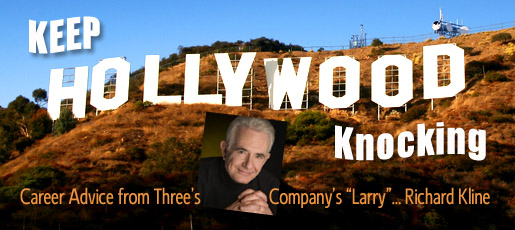
Way before the Regal Beagle, legendary sitcom funnyman – Richard Kline – aka Larry from Three’s Company, began to build a regal career in the entertainment industry with an acting degree from Northwestern, major theatre credits and enough commercial work to keep him from waiting tables.

But here’s the part to really toast a beer over… Richard Kline continues to take a step that is new’ every year. Richard hasn’t stopped working, as an actor/director, since his 8 seasons on Three’s Company, for over 30 years!

Today, he plays the role of The Wizard’ on the First National Tour of Wicked.

No doubt, this funny ladies man also turned out to also be a seriously successful actor/businessman. So if you want to learn how to get Hollywood knocking at your door… join us for this Q & A with Richard Kline.

We’ve been waiting for you…

Q&A with Richard Kline:

Q: Since your opening credits in this business, what has changed the most?

The major change in the business is that there seems to be much more competition now. I was born in New York and started with theatre and commercials. Commercials are what sustained me so I didn’t have to wait tables. I would go in for a commercial at age twenty-five for a young husband and the call would be 80-100 people. Now they call in 300-500 and they are not all the same type. It’s as if they throw creative mud up on the wall and if it sticks that is what they take. So the casting, at least in commercials, is very different.

But there are more resources available to young actors today. There are more resources available now in terms of putting yourself out there. From podcasts to webcasts, there are many more vehicles.

Q: How can actors get Hollywood to come knocking on their door?

The #1 thing in Real Estate is location, location, location – well, in acting – it’s study, study, study. The more prepared you are with acting classes, and voice and dance, the more it makes you a triple threat and a commodity when it comes to going out looking for work.

#2… Get a day job and support yourself so you can take more classes.

Also, if you want to be in television and movies you have to move to LA. I am sorry to say that… but that has pretty much stayed the same over the years. If you look at the castings outside of Law & Order, there is little shooting in New York. And, the movies that do shoot in New York still often cast in LA.

Q: Do you have any secret way to keep Hollywood knocking, once you’ve gotten their attention?

Here are some magic words… passion and focus. I think they go hand in hand. You have to be desperately passionate about wanting to be an artist and very focused on the business side.

You need a three prong attack:

1 – is the studying.

2 – is the business itself, with photos and resumes and writing. Get into a group with other actors who want to start improv or something.

3 – is attitude and the power of positive thinking. You have to have a positive outlook on yourself and maintain yourself health wise. If you are really pretty lady and you let yourself go, then you aren’t going to get those pretty lady roles. The same thing goes for men. Your body is your instrument, so you have to maintain it.

I went to college and studied acting, took classes in LA and now I’ve taught for about 12 years, which keeps me sharp as an actor because I do research for every class. I’ve never abandoned prong #1, which is studying. For me, personally (regarding prong #2), I have an agent but I am always looking out for work. And I know it sounds Pollyanna, but (regarding prong #3) I have a very positive attitude.

Q: You were the only cast member, besides for John Ritter and Joyce Dewitt, to remain on all 8 seasons of Three’s Company. What is your secret to keeping a gig?
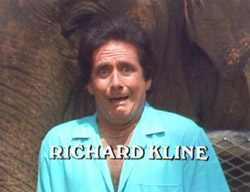
Besides my contract? (Richard laughs)

I think… because John and I got along. And, plot wise they needed me just as they needed a landlord to move various plots along.

(FYI – I think Richard sounds modest here! Perhaps that also has something to do with his longevity… having an unassuming, appreciative energy?!)

Q: In Three’s Company, there is always a misunderstanding. What is a big misunderstanding in this industry?

If you have an agent, don’t sit back and think the agent is going to do everything for you. I strongly recommend that if you have a shred of writing talent – write a script. Write a one person show and get your tukas out there, even if it’s in a church basement.

Q: Did the role of a used car salesman give you any ideas on how to sell yourself to the industry?

No. it’s just a part, like any part.

When you do a role, people say, ‘Are you like your character?’

And I say… for every part you play you have to find some part of yourself that is a little like that character. Or, you have to use your imagination. If you are playing a killer, and you are not a killer, you have to imagine what you would do if you had the opportunity to be in a room with Hitler just as he is about to exterminate one more person. Would you shoot him?

Q: Why should actors enjoy being the neighbor, just as much as main/Jack character?

If you focus on the money and fame, you are a dead person. It’s not about money or fame. That is ancillary. The most important thing is to focus on the work and become the best you can be. If you are prepared, have studied, have been in plays and continue to do a lot of work… then fame or fortune may or may not follow. But if you just look for it, then I think you are doomed. I really do.

Q: Do you have any neighborly advice to pass along?

Never leave your wallet in the dressing room.

“It is concentrated on comedy, learning how to deliver comic material – which requires a certain technique. It is not that different than being believable on stage, or on camera. But with comedy, you have to have a certain added technique to deliver the material. There isn’t a trick, but there is a way and you can learn it.”

In his class, Richard uses sitcoms, comedies, and plays. He starts out with a series of exercises, one liners and then does short scenes in which he directs you and then helps you analyze it.

Richard’s teaching style is tough but fair.

“I direct students and tell them what to expect if they get an audition. I am not a guru and I am not a dictator, but I don’t let stuff slide by that doesn’t score.”

Thank you Richard for sharing over 30 years of expertise with NYCastings. We look forward to many more years – where laughter is calling for you…

do your own thing copy

“You have this dream,” you want to host a show…

“But you can’t go to Barnes and Noble and learn how to be a successful host,” says casting director and lifestyle expert Jamie Carroll who casts for HGTV, FOOD NETWORK, MTV, the TRAVEL CHANNEL and more!

“That’s why I offer to help, why wouldn’t I,” Jamie says with an energy that refreshes the air. SECRET REVEALED…

Jamie Carroll WANTS you to succeed. (As do most casting directors! It is the truth… and so helpful to believe).

Starting out as an intern in a casting office, Jamie, “was lucky enough to work with someone who took her under their wing.” Soon, her career took off. She worked at MTV casting contestants, then experts and hosts.

To succeed as a host, it does take hard work. It takes a unique idea, a treatment, some sizzle and the guts to pitch it! But don’t get overwhelmed because Jamie Carroll breaks down every step in clear terms that make you feel at home.

Get ready NYCastings!!! For these sound, bites of advice from host & lifestyle expert Jamie Carroll…

Q: What makes a great host?

Someone very aware of themselves and very aware of their strengths.
I always say, “I look for a stronger personality than me in the room.” I want you to come in and take over. Don’t wait for too much direction from me because it’s all about you in that moment.

When you walk into that room you’ve got to trust that you are unique, that you are interesting and that you have a lot to say – because everyone does. If you sit in a room with ten people, they will all have interesting stories and interesting hobbies, which is what makes everyone unique.

Q: You’ve worked on a number of HOME shows, why the influx?

I think people are investing in their homes and with that comes a wave of experts that know how to make a nice home. It may not have been considered an area of expertise fifteen years ago but it is, it’s a valid level of expertise. And there is something about going behind the doors of where people live. There is an amount of voyeurism. It’s all about getting closer nowadays and you can’t get much closer than in a person’s living room.

Q: Do you see an uptick in the jobs for hosts?

No. And you never will because most people package the shows themselves.  For the most part, it will always be about the same.

Q: Is there a different type of host for a HOME show versus another type, like Dirty Jobs?

The skill set is the difference. Every host, from shows like Dirty Jobs to design shows, has something extraordinarily accessible about them and there has to be. They are working alongside people who are not scripted, who are not professional actors, who are there because they want a makeover on their house or because they have a sad story. A person who warms up to these people, and can basically help produce the story alongside the participant, is what we look for

You’ve got to be able to connect with another person, in a moment to moment setting, who has no training and no experience speaking in front of a camera, in full sentences or in sound bites. You’ve got to be on your game, ready to go.

We can tell when someone is very present and not afraid. It’s all about working together and creating that synergy.

Q: You mention, “speaking in sound bites.” I don’t think everyone knows about this, tell us more!

I know! People don’t know about this. I’ve done classes on camera and I ask, ‘tell me something interesting about yourself’ and they do… but it takes them thirty minutes to get there. The problem is, I am going to cut the tape down to ninety seconds and that sound bite has got to be there. You’ve got to start, hit the climax and get the heck out of there really quickly. You can see the difference when someone does that. It means everything. Sound bites, talking television, is everything… and I think you can learn it.

Q: What other questions / answers should actors prepare sound bites for?

Tell me about yourself and where do you come from are often asked.

But, with any question you should throw in the word ‘interesting,’ in your brain . “Tell me something interesting about you” or “Tell me something interesting about where you are from.” Because no one wants the longitude and latitude, they want to know something personal about you.

You walk in the door fully aware of yourself but we only have a couple of minutes to try and get to the heart of you. So if you can help us get you there – we can help you get on the air.

Q: How can an aspiring host, find the ‘expert’ within themselves?

That is a lifetime process (Jamie laughs).

I think… we become so ingrained with our hobbies that we think everyone does them. One of the most helpful things you can do is sit down with a friend, not a close friend who doesn’t want to hurt your feelings but a friend you can trust, and ask them, “If you had to pitch a TV show for me, what would it be? What would I be the host of?” See where they go.  Because you can’t be objective and you shouldn’t be. You need to have someone you trust, who looks out for your feelings but says the things that need to be said.

Q: For aspiring hosts, why is blogging so important?

You have got to show up online, you have got to show up everywhere.

I love the things you can do in a moment. You can start a blog in three minutes.
You’ve got to start blogging. You’ve got to develop yourself as an expert and you have to become an expert in a field that you are probably already closer to than you think. I know people who have been involved in environmental protection companies for years and also happen to be interested in hosting and acting. They are already close to an expert status and just have to throw themselves out there as one.

Don’t create something for you to be an expert at, that’s not cool, that’s not what we are looking for.  Nobody should become an expert in vodka, just because. You have got to love it.

Q: Once you hone in on your expertise, how do you create a treatment?

A treatment is basically a summary of your show… what it is going to look like, how it will break down and how to sell it. Those are the three main points to hit. It is helpful for a potential host to write this down for themselves as a treatment  because it helps for you to pitch yourself so you understand how your show will work.

Think about your show, your blog, and how you will tie it all together.  What is unique, what is your selling point, how will you make it all happen and how it will translate on television? Because it is TV… and it has to be active. It can’t just be talking heads all the time.

And then go into an act by act breakdown… This is the cold open, this is where we start, this is all the things we establish in the first act.

If it is a travel show, establish the location, the background and the first place of interest that you are going to go. For act two, you have the meat of the story. It will be activities one, two and three. Maybe an interesting on the street, off the cuff interview. And in act three you basically wrap it up.

Q: Does there need to be a high arc or conflict?

You don’t need to add moments of crisis because it is a Docu series. But if your passion is interviewing people who went to prison, then you may want a big emotional arc in there. I have seen people go down that route.

Q: How many shows should a person create for the treatment?

I always say do three segments, five if you can. It is harder to narrow down than you realize. I bet the first time you sit down to write ideas you will think, ‘I just wrote a novel.’ That is where the editing process comes in and you take out what is not necessary. If you can get by without it, leave it out.

Q: Are log lines important?

That is a very personal matter of opinion. Some places say yes and others say no.

Q: Once you have your expertise, a blog and a treatment… is that enough to pitch or do you need a sample show?

I always say go with the sizzle reel.  The sizzle reel is something they can watch. It is three to four minutes max, like the Cliff Notes version of your show where you can get at least one segment from start to finish on it. Most segments will be about four minutes. The quality does not have to be  killer. We are not looking for festival quality, as long as the sound is good. 

Write up a script and make it happen. Just start putting it out there. Put it up on your blog, your website, send it out to production houses. You have nothing to lose. You may not hear back… but you may hear back from one person and really all that matters is that you did it.

Just by putting things out there you gain confidence and you realize it is not as hard as you thought.

Q: What sound advice do you have for aspiring hosts?

The piece of advice I always give is, ‘Do your own thing.’

Just do the thing you can do today. I know it is a disheartening business and I have so many good friends who are actors, who get down – but that’s venting. At the end of the day, that will not get you your next job.

Take the action into your own hands, get out of the passenger seat, do the blog, create the sizzle reel and make something happen. And you know what, you might really surprise yourself.

Up next, Jamie Carroll is casting a web series with Al Sharpton on Education and Dear Genevieve for HGTV. Thank you, Jamie, for sharing your lifestyle/host expertise with NYCastings!

choosetoproduce

Award Winning Writer * Producer * Partner…

If these accolades appeal to you as an artist, then get ready to mentally devour every word of advice from the award winning partners of Choice Films and Choice Theatricals…

Summer Crockett Moore and TonyGlazer launched Choice Films back in 1998 (Tony came on board in 2000). They started with a small show in Manhattan and since grew their business to a a ½ million dollar level!

To achieve this magnitude of success, it takes a fierce hunger, a strong viewpoint and the will to work your butt off.

No matter what, don’t give up, if this is what you want to do, says Summer Crockett Moore and Tony Glazer, founders of Choice Films and Choice Theatricals – about the prospect of launching your own theatrical or film Production Company.

The driving force behind their company is to create new and exciting theatrical experiences, transcending generation gaps and speaking to our contemporary way of life.

We don’t want to be a company that doesn’t have something to say – it is about doing theatre that will change someone’s lives and make them look closer at themselves. We want to do things that make people think. We want to awaken audiences, the founders say.

To awaken audiences, you have to start your own projects, with your own original thoughts. So, NYCastings tapped into the mental resources of Summer Crockett Moore and Tony Glazer to learn more about their business strategy and choices…

Executive Summary

When we formed the company, we wanted to work on things that were fresh and had a contemporary take on things that addressed today without forgetting the past, Summer says. We worked on things that make you look at where we are and have been versus where we are going. We believe that, a little more introspection, without being stagnant, can help us make better choices in our lives.

Choice means a lot to me because I’ve been so lucky to make many along the way. Constantly taking stock in who I am as a person and producer and artist helps me get better and learn. If I am not learning I am not growing.

To start a company, Tony mentions that it breaks down into a couple of sections. One part of it is that we were driven to be involved in every phase of production. We each came from different backgrounds and didn’t want to settle on just one thing (writing, directing, etc). Initiative, I have to say is key. We were willing to put in all the hours, learning the things we didn’t know and at the end of each project see what worked, what didn’t work, how to make ourselves better and increase our profile.

It was a constant assessment that we built from, Tony shares.

The 2nd part of our starting a company is that our work is rooted in our own particular backgrounds. As a writer and director, I knew what stories I did not get to see enough of and focused on that direction.

The better we got, the more we crafted out our point of view as to what we wanted to make and we are always looking back. It is an evolving thing.

Summer agrees, that learning keeps the product line diverse. We do not want to be the type of company that does one type of thing. We have different perspectives, which make us a good team.

And in looking back, they notice that the little things at the beginning made the difference. All the building blocks that take so long to plan, ended up supporting us for years to come, Summer shares. We can track tiny choices that introduced us to people, gave us an opportunity, and introduced us to our investors.

Business Description and Vision

We like dealing with subject matter that is timely without losing site that we are doing entertainment. We are striving for people to have a good time while processing information. In a strange way, we are trying to sneak a carrot into the meatball, Tony says.

Summer also believes in endings without a clean bow to wrap up the story.

There is never an answer that tells you how to feel at the end of our projects. You need to make your own decision and I find that exciting and inspiring, Summer says. We are working on four or five different projects right now and they are not message pieces, but they all have a grain of ‘make your own decision.’ I hope this will make the audiences keep coming back.

Definition of the Market

Honestly, that is an ongoing question. What do audiences want to see? Tony says. It is a changing formula and at a certain point you will find yourself trying to temper certain ideas while working at the marriage between commerce and art.

We don’t forget that we are trying to create things people will want to see, Tony says. In terms of knowing what people want to see, you don’t know. You could make yourself crazy trying to answer that question. But you look in theatre to see what is going well, you see what people are seeing and not seeing and try and read the terrain as best as you can as to what the public may want.

For example, how do straight plays fare with a celebrity versus not a celebrity? How do straight plays fare versus musicals? It goes back to the principle that we were driven to know and learn as much as possible.

As a team, Tony and Summer conduct continuous research.

Summer shares that they, create a business plan by pulling comparable projects that succeeded and then focus on story and character and do the best they can with it.

We do a lot of testing, Summer says. We test the audience and see how you can make it better. We try to start out with having readings in front of audiences. Then you have a first screening and realize where to make changes.

You have to do all this research so you can hedge your bets, Tony adds. But at the end of the day there is always the surprise, the show that came out of nowhere and defied all the odds. You never really know what will catch fire, which is why you have to make the kind of films you want to make and temper it. You have to have a point of view because that is what makes you a unique business.

And, you never know which project is going to hit so you have to have a lot going on at the same time.

Organization and Management

If you are a playwright or an actor and you have other actors who are like minded, it starts very simply. Tony says. Someone writes a script, you talk about the script and when it is in a good place you spend a little money to get it into a local theatre and it builds from there. There are financially reasonable ways to get started, even in New York. It starts with an idea, a point of view and real commitment to learning everything about it, Tony says.

Once the business grows, it is a lot of travel back and forth to LA, dinners, meetings, seeing theatre, Summer adds. Our social lives have become our business lives. We are always working.

Marketing and Sales Strategy

A couple of things helped us immensely, Summer says. We started out very small funding our own things. The first play we did on our own in 98′ and we counted on family and friends to fill the seats. After that we got broader and within a few years we got enough interest that we could get investors and it became mandatory for us to start a marketing plan and build a database of people to attract bigger press.

We have a great press person at Springer and Associates. We had all these team members come in and help us learn and grow as we partnered with them. The more people you know, the harder you work, the more opportunities you have, Summer shares.

Within a few years we were in bigger theatres, with longer runs and now we are off Broadway and regional with a ¼  million, and ½ million investments.

We wanted to continue to grow up that ladder and not go back, Summer says.

Financial Management

When just starting out, there are a lot of places where actors audition that will have great rates for them to rent out rooms, Tony shares. But if you want agents to come see the show it has to be in the Theatre District or Chelsea area, it has to be easy for them.

If it is a general audience member, then it has to be easily accessible by train and have cool restaurants near by. If it is a musical, does the place have the proper sounds? If there are dancers, does it have the right floor? It all comes down to who do you want to come and how do you make it easy to get there? Tony says.

On a larger level, last year we were doing a big show and I really wanted to squeeze our marketing dollars to the penny and I needed more banners, Tony says. So I went and found an amazing printer who was willing to cut their rates on our postcards if we agreed to give them a link to our site and mention them on everything we were doing.

Summer shares this inventive viewpoint.

If I am speaking as a producer, it is needs versus wants, Summer says. What are my needs and then what are my wants? It comes down to what they project must have and what it can do without.

Overall

It’s a really tough thing to break into this industry, Tony says. It is a grind. You have to have the fortitude to put up with a lot of rejections, which is why I say don’t give up. There are plenty of times you feel like you are hitting your head against the wall but if you really want to do it… keep doing it and it will pay off.
The issue is not that you are not good enough. The issue is that there are so many people out there and by hanging on you increase your odds of getting seen and people saying, ‘who is that guy?’

And don’t keep knocking on the same door. There is more than one way into a room.

After all, the things that people could call failures are really important crossroads, Summer says. Because you can either learn from it and get better or let it take away your desire. For someone starting out, there are a lot of bumps and bruises and you have to get up and keep going.

Anybody can learn from their mistakes and adjust accordingly, Tony adds as a final word of advice for future production company owners. It is in your control.

Whatever stage you are at, you never stop learning. You can never say you have arrived. That is the exciting part. The education never ends. There are things I will learn tomorrow that I didn’t know and that will help to take me to the next place.

To learn more about Choice Films visit http://www.choicefilms.com/

Tony Glazer is an award-winning writer, director and producer, and a Managing Partner and founding member of Choice Films and Choice Theatricals. Tony’s plays have been produced in New York, Los Angeles, Chicago, Philadelphia and Canada. His feature film, Junction, is currently in the final stages of development with Glazer slated to direct. Production recently wrapped on Glazer’s short film AYounger Man, produced by Pâté Productions, Ltd and Choice Films Inc. His play, The Substance of Bliss, is the winner of the 2009 L. Arnold Weissberger Award at the Williamstown Theatre Festival, 2010. Find Tony online at: http://www.tonyglazer.com/.

Summer Crockett Moore is an award-winning actress/producer and a Managing Partner and founding member of Choice Films & Choice Theatricals (and the founder of their pre-cursor, Choice Productions), which has produced various multi-media theatre and film projects, including the recent world premieres of both Stain and In The Daylight Off-Broadway, as well as the upcoming premieres of two new plays, American Stare and The Homeless Dogs of Egypt. She recently wrapped production on the short film A Younger Man and is in the final stages of development for the feature film Junction. For a full list of her credits and to hear & see demos visit: http://summercrockettmoore.com/

choosetoproduce

Award Winning Writer * Producer * Partner…

If these accolades appeal to you as an artist, then get ready to mentally devour every word of advice from the award winning partners of Choice Films and Choice Theatricals…

Summer Crockett Moore and TonyGlazer launched Choice Films back in 1998 (Tony came on board in 2000). They started with a small show in Manhattan and since grew their business to a ½ million dollar level!

To achieve this magnitude of success, it takes a fierce hunger, a strong viewpoint and the will to work your butt off.

No matter what, don’t give up, if this is what you want to do, says Summer Crockett Moore and Tony Glazer, founders of Choice Films and Choice Theatricals – about the prospect of launching your own theatrical or film Production Company.

The driving force behind their company is to create new and exciting theatrical experiences, transcending generation gaps and speaking to our contemporary way of life.

We don’t want to be a company that doesn’t have something to say – it is about doing theatre that will change someone’s lives and make them look closer at themselves. We want to do things that make people think. We want to awaken audiences, the founders say.

To awaken audiences, you have to start your own projects, with your own original thoughts. So, NYCastings tapped into the mental resources of Summer Crockett Moore and Tony Glazer to learn more about their business strategy and choices…

Executive Summary

When we formed the company, we wanted to work on things that were fresh and had a contemporary take on things that addressed today without forgetting the past, Summer says. We worked on things that make you look at where we are and have been versus where we are going. We believe that, a little more introspection, without being stagnant, can help us make better choices in our lives.

Choice means a lot to me because I’ve been so lucky to make many along the way. Constantly taking stock in who I am as a person and producer and artist helps me get better and learn. If I am not learning I am not growing.

To start a company, Tony mentions that it breaks down into a couple of sections. One part of it is that we were driven to be involved in every phase of production. We each came from different backgrounds and didn’t want to settle on just one thing (writing, directing, etc). Initiative, I have to say is key. We were willing to put in all the hours, learning the things we didn’t know and at the end of each project see what worked, what didn’t work, how to make ourselves better and increase our profile.

It was a constant assessment that we built from, Tony shares.

The 2nd part of our starting a company is that our work is rooted in our own particular backgrounds. As a writer and director, I knew what stories I did not get to see enough of and focused on that direction.

The better we got, the more we crafted out our point of view as to what we wanted to make and we are always looking back. It is an evolving thing.

Summer agrees, that learning keeps the product line diverse. We do not want to be the type of company that does one type of thing. We have different perspectives, which make us a good team.

And in looking back, they notice that the little things at the beginning made the difference. All the building blocks that take so long to plan, ended up supporting us for years to come, Summer shares. We can track tiny choices that introduced us to people, gave us an opportunity, and introduced us to our investors.

Business Description and Vision

We like dealing with subject matter that is timely without losing site that we are doing entertainment. We are striving for people to have a good time while processing information. In a strange way, we are trying to sneak a carrot into the meatball, Tony says.

Summer also believes in endings without a clean bow to wrap up the story.

There is never an answer that tells you how to feel at the end of our projects. You need to make your own decision and I find that exciting and inspiring, Summer says. We are working on four or five different projects right now and they are not message pieces, but they all have a grain of make your own decision.’ I hope this will make the audiences keep coming back.

Definition of the Market

Honestly, that is an ongoing question. What do audiences want to see? Tony says. It is a changing formula and at a certain point you will find yourself trying to temper certain ideas while working at the marriage between commerce and art.

We don’t forget that we are trying to create things people will want to see, Tony says. In terms of knowing what people want to see, you don’t know. You could make yourself crazy trying to answer that question. But you look in theatre to see what is going well, you see what people are seeing and not seeing and try and read the terrain as best as you can as to what the public may want.

For example, how do straight plays fare with a celebrity versus not a celebrity? How do straight plays fare versus musicals? It goes back to the principle that we were driven to know and learn as much as possible.

As a team, Tony and Summer conduct continuous research.

Summer shares that they, create a business plan by pulling comparable projects that succeeded and then focus on story and character and do the best they can with it.

We do a lot of testing, Summer says. We test the audience and see how you can make it better. We try to start out with having readings in front of audiences. Then you have a first screening and realize where to make changes.

You have to do all this research so you can hedge your bets, Tony adds. But at the end of the day there is always the surprise, the show that came out of nowhere and defied all the odds. You never really know what will catch fire, which is why you have to make the kind of films you want to make and temper it. You have to have a point of view because that is what makes you a unique business.

And, you never know which project is going to hit so you have to have a lot going on at the same time.

Organization and Management

If you are a playwright or an actor and you have other actors who are like minded, it starts very simply. Tony says. Someone writes a script, you talk about the script and when it is in a good place you spend a little money to get it into a local theatre and it builds from there. There are financially reasonable ways to get started, even in New York. It starts with an idea, a point of view and real commitment to learning everything about it, Tony says.

Once the business grows, it is a lot of travel back and forth to LA, dinners, meetings, seeing theatre, Summer adds. Our social lives have become our business lives. We are always working.

Marketing and Sales Strategy

A couple of things helped us immensely, Summer says. We started out very small funding our own things. The first play we did on our own in 98′ and we counted on family and friends to fill the seats. After that we got broader and within a few years we got enough interest that we could get investors and it became mandatory for us to start a marketing plan and build a database of people to attract bigger press.

We have a great press person at Springer and Associates. We had all these team members come in and help us learn and grow as we partnered with them. The more people you know, the harder you work, the more opportunities you have, Summer shares.

Within a few years we were in bigger theatres, with longer runs and now we are off Broadway and regional with ¼ a million, ½ million investments.

We wanted to continue to grow up that ladder and not go back, Summer says.

Financial Management

When just starting out, there are a lot of places where actors audition that will have great rates for them to rent out rooms, Tony shares. But if you want agents to come see the show it has to be in the Theatre District or Chelsea area, it has to be easy for them.

If it is a general audience member, then it has to be easily accessible by train and have cool restaurants near by. If it is a musical, does the place have the proper sounds? If there are dancers, does it have the right floor? It all comes down to who do you want to come and how do you make it easy to get there? Tony says.

On a larger level, last year we were doing a big show and I really wanted to squeeze our marketing dollars to the penny and I needed more banners, Tony says. So I went and found an amazing printer who was willing to cut their rates on our postcards if we agreed to give them a link to our site and mention them on everything we were doing.

Summer shares this inventive viewpoint.

If I am speaking as a producer, it is needs versus wants, Summer says. What are my needs and then what are my wants? It comes down to what they project must have and what it can do without.

Overall

It’s a really tough thing to break into this industry, Tony says. It is a grind. You have to have the fortitude to put up with a lot of rejections, which is why I say don’t give up. There are plenty of times you feel like you are hitting your head against the wall but if you really want to do it… keep doing it and it will pay off.
The issue is not that you are not good enough. The issue is that there are so many people out there and by hanging on you increase your odds of getting seen and people saying, who is that guy?’

And don’t keep knocking on the same door. There is more than one way into a room.

After all, the things that people could call failures are really important crossroads, Summer says. Because you can either learn from it and get better or let it take away your desire. For someone starting out, there are a lot of bumps and bruises and you have to get up and keep going.

Anybody can learn from their mistakes and adjust accordingly, Tony adds as a final word of advice for future production company owners. It is in your control.

Whatever stage you are at, you never stop learning. You can never say you have arrived. That is the exciting part. The education never ends. There are things I will learn tomorrow that I didn’t know and that will help to take me to the next place.

To learn more about Choice Films visit http://www.choicefilms.com/

Tony Glazer is an award-winning writer, director and producer, and a Managing Partner and founding member of Choice Films and Choice Theatricals. Tony’s plays have been produced in New York, Los Angeles, Chicago, Philadelphia and Canada. His feature film, Junction, is currently in the final stages of development with Glazer slated to direct. Production recently wrapped on Glazer’s short film AYounger Man, produced by Pâté Productions, Ltd and Choice Films Inc. His play, The Substance of Bliss, is the winner of the 2009 L. Arnold Weissberger Award at the Williamstown Theatre Festival, 2010. Find Tony online at: http://www.tonyglazer.com/.

Summer Crockett Moore is an award-winning actress/producer and a Managing Partner and founding member of Choice Films & Choice Theatricals (and the founder of their pre-cursor, Choice Productions), which has produced various multi-media theatre and film projects, including the recent world premieres of both Stain and In The Daylight Off-Broadway, as well as the upcoming premieres of two new plays, American Stare and The Homeless Dogs of Egypt. She recently wrapped production on the short film A Younger Man and is in the final stages of development for the feature film Junction. For a full list of her credits and to hear & see demos visit: http://summercrockettmoore.com/


spotlight-sp

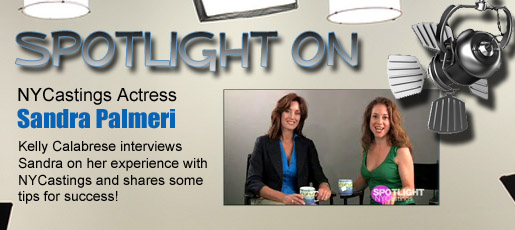
Watch the video interview below where ace reporter Kelly Calabrese interviews actress, Sandra Palmeri on her experience using NYCastings and booking projects such as the feature film “Alone” and several principle roles in commercials like: Jack LaLane Power Juicer, Hana Tea, Dream Lash & Pajama Jeans.

Filming & editing compliments of Angelita Ali @ Reel Services.

You can also check out over 1000 other Success Stories here >

And send us your Success Story Here >

facebookings

Auditioning has a great deal to do with the art of social networking. Everything in an audition sends a message and builds a profile in the mind of the casting director. The more you know, the larger potential you have to grow. So, NYCastings sought the insight of a CD with nearly 20 years of professional experience and a generous nature when it comes to offering top news and recent insight to actors on his company’s Facebook…

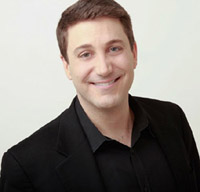
Meet Casting Director Ken Lazer.

Currently the owner of Ken Lazer Casting, Ken has cast hundreds of national, regional and local television commercials, webisodes, infomercials, industrials, print projects and voice-overs. The industry knows him for his attention to detail and actors know Ken for his friendly, welcoming personality and insightful direction, making them feel relaxed and able to enjoy the audition process in a supportive environment.

To get the status on Ken Lazer’s casting knowledge and advice for actors – You’re Invited to this info packed Q & A with him…

Q: You give on-going advice to actors on your Facebook page. Why? (besides for helping to lessen the scary image of CDs, naturally:)

I’ve been doing this for nearly 20 years and have seen too many times the actors that come in feeling nervous and not prepared for an audition. There are a large number of actors in the non-union market who are new to this business and unfortunately do not have any on-camera training. I’ve had actors come in for a casting who don’t know what a slate is. So, I started my Facebook page to give actors some helpful tips and tools that may improve their auditions.

Q: You mention on your Facebook page that an actor should plant their feet and not rock during an audition because the rocking makes them look weak. What are some other tell tale signs of a nervous auditioner?

Right. This happens with actors that are new to this business and/or don’t have proper on-camera training. Sometimes an actor will shift their weight, blink their eyes a bit too much, lick their dry lips.  Those are the most common ones.

Q: I know (From your FB page) that you are a big believer in reels. How long should a reel be? Any tips on what to avoid?

The average attention span of watching these reels is 10 – 15 seconds. So you want to make sure you have a creative way of showing your best work. Always put the most recent commercials first and edit them together in chronological order. I wouldn’t make a reel any longer than 90 – 120 seconds. We don’t have a lot of time to sit through 3 – 5 minute reels.

Q: What level of influence does the CD have?

Usually very little influence. It is the CD’s job to present a casting session of the best talent for whatever characters our client (Production Company/Ad Agency) is looking to hire. After our client reviews the casting session, they make their select choices and present them to their client (the Product Company).  From there, the choices are narrowed down and eventually a final choice is made. It’s very rare when our client will ask us to choose who they should book.

Q: If a job says it shoots on a certain day, how often does that stick?  – I ask because actors can usually tell if they didn’t get a gig by – when the shoot date passes by.

When it comes to commercials and shoot dates, when there is a known shoot date, 99% of the time that date sticks. There are thousands of dollars involved when a studio or location is reserved for a shoot date. Producers will make sure to stick to a schedule so they don’t lose that money.

Q: On your website, you present some sample casting sessions with two takes. Do you send in both?

It depends upon the casting. Sometimes, I only need to do one take. Other times, if I do a second take it’s either because I’ve given the actor some kind of direction to help their performance and it shows my client that the actor can take direction; or even if the first take is good and the framing is 3/4 or waist up, then I like to do a 2nd take a bit tighter/closer up.

Q: How long is the audition clip that the producer / client sees?

Again, this depends upon the casting and how much copy there is (if any) and how many takes are recorded.

Q: How many actors do you typically show to the client, percentage wise, out of those who audition?

When I prep a session, I know who I want to present to my client. I like to bring in the best talent in a particular category. However, I always like to give fresh faces an opportunity to audition. Sometimes those fresh faces turn out to do a great audition, but sometimes they don’t. I don’t like to take actors off of a session—it’s very rare that I do. However, I can’t show my client someone who just isn’t cutting it. So percentage wise, I would say I show 97% of the actors that audition on a casting to my client.

Q: When slating, should an actor show personality or keep it simple?

When slating, it’s always better to keep it real and simple.

Q: On the second slate, how long should an actor hold their focus /body position? It seems as if the tape roles for a while.

Do you mean the end slate when we ask what the actor’s name is one more time? If so, hold it until you know the camera has cut. This could be maybe 2 seconds or more depending upon how many recording devices are being used. Definitely don’t leave your mark until you know for sure all recording devices have been stopped.

Q: Does the camera role in between takes? Catching the actor’s response to the CDs direction?

Great question. I can only speak for myself on this one. When I give direction, I make sure all recording devices are stopped. However, in rare cases on a callback with clients, sometimes the director will want me to keep rolling while he/she is going over direction with an actor. Again, it’s rare.

Q: In those sample sessions (on your site), the camera zooms out to full body, does that always happen?

Again, I can only speak for my sessions. When I’m doing a slate, I like to show my clients a full length shot.

Q: How do CDs keep track of those they liked during the auditions, since you/they often see hundreds?

I have a log sheet that is preprinted ahead of time. This log sheet has the names of all actors that are scheduled to come in to audition. I write some brief notes next to each name that helps me remember at the end of the day who had a good audition.

Q: Why does an audition room sometimes hold up and not let any actors enter for a while? (YES! I want all the secrets of what goes on behind closed doors 😉

This could be any number of reasons. For example, maybe the CD got a message to call the Producer/Director about a possible change in direction or what they are looking for or any other messages that need to be taken care of; or maybe the CD is having a short conversation with an actor; or maybe the CD just needs a 5 minute breather.

Q: Are there seasons where the commercial gigs pick up or wind down?

Yes. Commercial castings slow down during Thanksgiving/Christmas Holiday season and into January.  Also, summertime is a slower time. Otherwise, we’re pretty busy during the rest of the year.

Q: How do you, personally, get the best work out of an actor?

I want actors to do well. It’s important to me that an actor is relaxed during the audition process. If an actor is relaxed and open to the direction I’m giving (if they need it—sometimes they don’t need any tweaking), then I’ll give them direction that will make their audition look better. I’m a strong believer that we are a team. If an actor looks good, then I look good to my client. So, I do my best to make actors feel welcomed to my sessions, to put them at ease. I make sure they have the copy in advance (if there is copy) so they can prepare the best they can before coming into the studio.

Q: As a CD with many years of experience, you know to trust your judgment. What advice do you have for actors about trusting their own judgment and making strong choices?

It’s important that the actor listens to the direction the CD gives before the audition. The first take I always allow the actor freedom to make their own choices. Once an actor knows what the scene involves, he/she should have creative freedom to make whatever choices they feel will work. However, if something doesn’t look right or needs tweaking, that’s when I’ll give direction and a second take.

Q: You run a boutique business built on trust, work ethic and keen judgment, what tips do you have for actors on how to best present themselves as a business?

Make sure you are prepared with copy (if there is any), arrive on time (which means before your call time), make sure your appearance (hair, makeup) looks good (unless the character requires that you look like a mess), be nice to the assistant (they are our eyes and ears) and always have a positive attitude.

Q: Looking forward to the fall and 2011 (geez!) – what message would you like to give actors? And what is your view of the industry?

There’s so much I want to share but here are some basics:
1. Try not to get discouraged if you didn’t get a callback or booking. Even if you feel you did a great job maybe the director didn’t think you had the right look. If you were good, we’ll remember you.
2. Have confidence without being cocky. Don’t go into an audition thinking you know it all.
3. Be as prepared as you possibly can be. If not, the next person that auditions after you will be and your audition won’t look so good.
4.  When you’re in the waiting room, focus on your audition. Practice what you’re going to do in front of the camera. This is a business, not a social hour. Your competition will be playing with your head to keep you from focusing on your audition. When you arrive to the casting, sign in, make sure you have the copy (if there is any), go to a quiet corner away from your competition and start working.
5. If you have questions, don’t be afraid to ask. We’re here to help make your audition look it’s best. If you don’t have questions, that’s fine too.
6. Finally, always try to keep a positive attitude, be appreciative of what you have and enjoy the audition process.

Become a Friend of Ken Lazer Casting on Facebook…

Thank you, Ken Lazer, for being a friend to the entertainment industry.
–  Your insight is greatly appreciated!

juggling babies

I am definitely not the expert on how to juggle everything, says Anna Fishbeyn with a laugh, as we sit down at a Starbucks in New York City to speak about her challenges and triumphs as a mom, artist and woman with a hilariously strong viewpoint.

Anna mentions her lack of guru status because being a mom and a career woman is not an art that can be mastered. One has to, keep trying everything, Anna reveals.

You try everything and you find a way, especially when it’s a passion you long for, that you were born for.

Growing up as a child actress in Russia, Anna Fishbeyn sung as a soloist in a state national choir and she acted in the theatre.

I loved every minute of it, Anna shares. But when we came to America, my parents didn’t have enough money for singing or acting lessons and all of that theatrical life ended. I would long for it, but my parents were like, you should get into statistics.’

A graduate of the University of Chicago, Anna went on to earn an MFA in Fiction from New School University, and Ph.D. from Columbia University, where she wrote a 360 page dissertation, entitled, Evil in the Novel and Its Implications for Moral Education.

Since graduating, Anna began writing her own novel, The Matrimonial Flirtations of Emma Kaulfield, about a gorgeous, free-spirited, feminist artist, who redefines the traditional rules of dating and puts a feminist spin on the word, “harem.”


As a writer, Anna did a lot of juggling to try and get her creative work done while raising her children and giving them a lot of love and attention.

I’d write while they slept, while I cooked dinner or while I changed their diaper; writing in my head and then rushing to write it down on paper, Anna says. I wrote while my children sat on my lap and drew. I would have the computer sideways, writing on it. I even wrote while I breastfed… over the boob… over the kid.

So, when people ask, how did you write a five hundred page novel while having one kid and then the next?’ well…that’s how I did it, Anna says.

I did it by constantly being both mom and in the characters lives.

Anna kept her characters alive but had yet to awaken her childhood love of acting until she saw a show called Birth Stories, featuring prominent writers from places like Comedy Central telling atypical tales about being parents. Inspired, Anna decided to write and perform a show based on her own misadventures.

She performed the raw and honest one woman piece, titled Conversations with my Breasts,’ at The Cornelia Street Café.

I hadn’t been on stage since I was nine, Anna shares. But, being a Mom gave me a strength I never had.

Everyone says, your time for chances is up when you have babies.’ But what happens is you fight for them, you fight for them at pre-school or at the playground. Suddenly you can’t be the, hi please like me,’ type of person anymore. You’ve changed into a tigress and that shift in mentality, especially for me because I was a real pussycat, gave me guts. It was only after my second kid that I decided to get back onstage.

My kids made me tougher and they made me take chances that I never would have, Anna shares.

From Cornelia, Anna placed a taping of her show on YouTube and soon got a break to perform a longer version at The Flea in New York City (Now titled, Sex in Mommyville, Directed by Sande Shurin, from August 18-29, 2010)

The show is edgy. It ain’t your run of the mill mommy talk, Anna says. I rile women up and say, lets stand up and not submit to all the pressures to be a certain way and look a certain way and all the craziness of the wrinkles. You can’t turn on the TV anymore without it saying, let us help you look reborn to the age of a two year old.’

Speaking of two year olds… Anna has a two year old and a six year old. Who both challenge and inspire her.

Here is how Anna secretly absorbs acting tips from her children. By the way – this all happened on the very day she met with NYCastings!

A day in the life of Anna the actress.

9am

Anna learns to develop many different, yet true voices.

The children are each eating yogurt with honey and one had a pretty silver spoon and one had a plain spoon and it was all whining and nagging and crying while I am making them waffles, Anna says. So I try the calm tone. I try the yelling tone. I try the manipulative tone. But my children are very clever. In the end it winds up being a complicated discussion of what’s fair.

10 am

Anna learns how to toughen her skin – against the word, NO.

I ask my daughter to clean up papers. So, she lies on the floor, on top of the papers, and puts her legs under the table, kicking it. Then the little one does the same thing and I have to give them time out – but – my girl says, No. I do not have time out. I will not go to time out.’ Eventually she went very reluctantly, Anna says.

11 am

Anna learns how to deal with other – dramatic actors.

I asked my daughter to play with my son and they were making a puzzle but my daughter wouldn’t share a piece. When I told her she needed to share, she decides to put herself in time out! She puts herself in time out so she doesn’t have to play with her brother.

How could you live like this with these amazing children and not write about it? Anna adds, laughing.

12 noon

Anna learns how to deal with an industry where everyone wants a piece of you.

I had to rush out for a NY Times Podcast and needed to take a shower. Of course, this becomes a process because my children hold onto my legs as I try to go take a shower and they hold onto my legs as I pick out an outfit.

3pm

Anna learns the value of a solid scene partner.

Then, I have to go to rehearsal and thankfully my Mom lives upstairs and she watches them for two hours because they can’t come into this rehearsal with me.

4:30pm

Anna enjoys the love of true fans.

While at rehearsal, my kids call me to make sure I am coming back soon, Anna says, her eyes misting.

At no point during the day – does Anna Fishbeyn find life easy as an actor, artist, woman and mom with an original sense of humor.

But getting on the stage is a great outlet for the guilt. I totally love it and you play aspects of life that are so real and so connected with the things you know, Anna says, grinning again.

Performance is a way to know that there is something going on – FOR ME.

Whatever is going to happen with the show, I have had the best time doing it and being able to say to my kids… I am going to work just like Daddy. For a while, my daughter would say, Mommies don’t work, only Daddy’s work.’ And now, it’s different.

As Anna readily admitted at the beginning of this interview, it takes trying everything’ to be a mom and a working artist/actor…

It’s complicated and you have to juggle a lot. You can not do it alone, Anna says…

But it is worth it.

For more information on Anna Fishbeyn’s one woman show at The Flea, directed by Sande Shurin, visit… http://www.sexinmommyville.com/

http://www.theflea.org/

twelve

As the creator of countless hit movies…

From St Elmo’s Fire, to Lost Boys, A Time to Kill, and Phantom of the Opera – acclaimed director Joel Schumacher knows how to create stories that spark emotion and ignite audiences.

For his latest film, TWELVE (based on the best-selling novel by Nick McDonell), Joel fans the flames of young kids with free flowing money and no fear of danger.

Filmed in New York City, TWELVE, features background talent chosen through NYCastings – hence a must see for all reading this!

Opening August 6th, rising stars include Chase Crawford, Emma Roberts and Emily Meade, as well as music mogul (50cent) – Curtis Jackson.

So, go ahead and reach for your Moviefone/Fandango password… right after these TWELVE insights from director Joel Schumacher…

TWLEVE

Questions & Answers

1. Being from New York originally, what does filming here mean to you?

It was great to be home and see all my friends and shoot here. Although, shooting in Central Park, and Upper East Side, with Chase Crawford, Emma Roberts, Curtis Jackson and the beautiful young cast – caused crowds. It was a challenge. But Manhattan was really great to us.

A lot of the clothes were samples from Ralph Lauren, Diane Von Furstenberg and Gucci. Jennifer Miller loaned us all the jewelry and people gave us their apartments to shoot in, for $1. And that beautiful townhouse (where the party scene filmed on 10th street in NYC), those people who rented it to us were fabulous.

2. You filmed in a short amount of time for a small budget, how did you make it work?

That is one of the exciting parts of making movies. We were very lucky, because of how little time and money we had, that there were so many people on the other side of the camera to help out, because, it does take a village. It takes a lot of people working their butts off.

We did it all in 23 days. I am proud of everyone.

3. When this movie hits the scene, on August 6th, what will surprise audiences about it?

It is always hard to say, when you create entertainment, because audiences have so many different views.

I think the people who have seen Chase Crawford will be surprised that he can play a different character, totally opposite than he has played before. I think they will be surprised by all the young people they’ve never seen before doing amazing performances. And 50cent, Curtis Jackson, is a really serious actor with an onscreen charisma that is overwhelming.

The story has a lot of shocking and interesting and darkly ironic moments at the same time. I don’t think people have seen this movie so I hope they will find it interesting, exciting. And if it disturbs them, annoys them, makes them angry – I hope they will tell their friends because controversy is really good.

4. From scouting the 10th street location, to the set deign and casting – how involved are you in every aspect?

It’s my job, that’s what I do.

My job is to hire people who are more talented than I am so I hire props, makeup, hair, set designers and the actors. Everyone contributes to creating the theatre of what we present. So, even though I am responsible for it all – I am working with many talented people who are putting their creativity into it as well.

5. The cast of TWLEVE was low key and personable. Is this a sign of your personal directing style, the types of actors you seek out, or both?

I like to have a good time, but when we work we work. So I try and create a very comfortable experience for everyone on the set. And, we didn’t have any divas in the movie, so I was not distracted by having to handle someone with bad behavior. We were able to just create together.

6. You seemed to have even more energy than all the high school students on set. What natural drug keeps you revved up to work?

There is a certain adrenalin that happens, when you are directing. And a hyper energy when you have no time and need to focus. But also, I love my job. I wanted to be a director since I was seven and I got my dream, and got it bigger than my dream.

You wake up sometimes and say, this really happened? I wanted to be a director… and I got it?

I also love the idea that you wake up in the morning and go to the set and there’s nothing. Then, by then end of the day, you have created something.

The other thing is, I’ve made a lot of movies with young kids and that gives you a lot of energy. It is exciting.

7. This film speaks about having two lives, two sides. And the entertainment industry certainly has a light and a dark side. What advice do you have for aspiring actors and filmmakers about the dark side of the industry?

I think that there are cautionary tales all around for people who want to get in the business. They can look at headlines and what has happened to successful people. But it is more important to look at the stories they don’t hear about, the people they know onscreen but do not hear about because 99% of the people in the film industry work their buts off and then go home to their families.

That’s one of the themes in the movie. These kids do not have a lot of positive role models and if this party actually happened, the media would be blitzed by it. We would know more about Claude, the character Billy Madison plays, then the people we work with every day. He would be famous.

All light has a dark side. All people have a dark side. All businesses. That is just the way it goes. But it is how people deal with it that changes them. People have to look at the positive role models, at the kids and adults on my movies who got sober and moved on, like Robert Downey.

We have to make our way and find our way.

And, as Chase’s mother says in the film, “We must live the best lives we can.”

8. At the end of shooting the party scene in NYC, you personally thanked all the background. What do they mean to a film like this?

The background artists in most of my films, and certainly this one, are fabulous. Their reactions and partying are very important to the film, especially the end of this movie. So, I tried to thank everyone, but of course you can’t. So please also send my thanks out.

9. What TWELVE words would you use to describe what you look for… when casting actors?

Falling in love. When someone walks in and I’m like, thank god.

10. You work with a lot of rising talent, any advice for NYCastings actors?

I look for very talented people, whether newcomers or experienced like Chase and Emmy and Zoë. My job is to hire talented people and remind them how talented they are and to create a safe space for them to take risks.

If anyone is interested in acting, it is really important that they study. You never loose by studying. Study with a few people, go to classes, get your feet wet. A lot of times you meet actors and they are good looking, but it does not seem to be their passion.

And, actors need to work on their voice. If you notice, Chase Crawford has a gravely voice. Think of the people you like to watch, they have memorable voices. People can be beautiful and talented but they need to have good voices. If people have high voices, they should go to a coach.

11. The tag for TWELVE says…

No one needs anything here. It’s all about want.

After so many successes, what does Joel Schumacher still want?

I want to make the film I start shooting in August. I always want the next film, so I am always working on that.

And, I would like to be a better man, each year. Though it always seems easier to go to work than to be a better man, I am always looking into the future.

The film says you have everything you need but you don’t. We all need love. We all need compassion and we all need our friends in our lives.

12. A question… For NYCastings members:

Want to score an invite to a secret TWELVE party in NYC August 6th….

Log onto http://12-themovie.com/ – for your chance / details.

Thank you Joel Schumacher for this EXCLUSIVE interview

AND… for filming in NYC.

I was lucky enough to work as background on TWELVE (booked through NYCastings) and it earned me my SAG eligibility.

I am inspired by your spirit and very grateful.

Smiles, Kelly Calabrese

know where you belong copy

From Spain, photographer/director Wilhelm Scholz has traveled the world producing imagery for advertising and editorial clients in countries such as New Zealand, Greece, The United Arab Emirates, China, Peru, and more.

His keen eye for capturing the essence of a location, developed while working in New York as a first assistant, producing shots and making sure all was in order on set.
Before long, he took the next step.

“I realized I could do my own thing,” Wilhelm Scholz shares. “I saw what people were doing and felt confident I could do that as well. So, I built a portfolio of what I really like, which is travel with a commercial twist to it.  All location based, very little studio.”

Currently the owner of Wilhelm Scholz Studio, Wilhelm casts for both print and commercial work. So we asked him to share his twist on the print and commercial industry, with NYCastings.com…

As a director and photographer, how do the two intertwine, style wise?
For print, in advertising, the only difference is the thought behind it.  You are always making pictures, not taking pictures. You are making a vision from scratch depending on what the needs are for a client. It is almost like doing a treatment. Things need to be considered like page placement, where a logo may go, the format of a spread or single page. And you shoot based on the parameters required.

In the print shoot you tell the story in just one image. With film you tell the story in segments. Every piece must flow in film. Even if every frame is not as strong as one single image, it must relate to the next and get the point across well.

You have such a unique style, how would you describe your vision?
My projects, what I have to show in my portfolio, is a sense of place. Most images are taken in places that you would want to be in and then I add a commercial value to it. To make it not a product shot, but products within landscapes. Simple. Clean. A lot of people have said my work is quiet. I guess that is the signature my work has.

For print, and films, I leave nothing to chance, everything is choreographed to be what you see.  What you see is meant to be there.

What quality do you look for in actors?
First it depends in the product or shot – what is needed. What character fits the brand? Is it upscale or not? And then, we do a regular casting call. On the go-see you can tell if their demeanor matches the part. They are supposed to be acting, even if it is for print. Print has the same choreography behind it, you re-enact a moment. It has a beginning, an end, and the middle part is where you take the picture.  The challenge is to find the right person for the project because they are a product as well. It’s not the best looking person that makes it. It’s not necessarily the most qualified. It has to be the right person.

For sports, the person has to be good or it looks fake. You can tell that they don’t have the experience. Most actors or models put things on their resumes that say they are experienced runners or tennis players and that is not true.  There are certain techniques that need to be exact.

So, many times, when I cast for sports, I go to sport agencies because a marathon runner knows how the body needs to conduct itself while running versus someone who runs around the block a couple of times a week.  They also have the body structure. It gets very specific with sports talent.

Also, I did a shoot for a German company for a resort and we had to cast the perfect belly button. You would be amazed,  everyone imaginable came by. Everyone, extremely beautiful. But there are so many variables with the shape and the muscles of the belly button. There were thousands of people we ended up using Ms. Greece because her muscles and curvatures were perfect for the ad where the belly would contain water and have sand. That was a challenge.

What advice do you have for print models/actors?
The most important thing is for people to show pictures that are right for the part. A lot of people spend time building a portfolio showing pictures for things they would never be hired for. The guy who flies a plane is not the same as one who would run a hot dog stand. Explore what you have to offer and stick with that because there are so many people to choose from. You need to do what you do best

Everyone has a look. That is, unfortunately, a cliché for the market. Some people have the perfect secretary look, or young mom, chef, athlete, cop, whatever. But a lot of people spend time with pictures as characters that will not pay off. And when casting, the bad fits stand out. You react to the negative pictures and it is something actors should avoid.

Everyone has a good sense of who they are, what they can pull off.  Stick with who you are, it is the safest way to get work.

How can an actor explore who they are?

Go to castings for directors and on go-sees and learn what feels right. It is a trial and error thing. A matter of trying it out and being able to edit out what definitely does not work. I casted something for levis and it said long legged because the jeans had to fit a certain way and people submitted pictures that were 5’2″.  They have to know that they do not fit the bill and it doesn’t help them to be rejected. People probably take it as a failure, not to get the job. But they are not a failure. They are just not right for the project. Better to avoid it.

As an actor, I would figure out what looks best and what I can pull of best. Some have great smiles and some don’t.  Some can show worry and some can’t. It all comes down to acting, even in print.

How do you find your models/actors in NY?
There are certain agencies everyone pulls from; Cunningham (CESD) and Funnyface, the people who have a pool of people one can rely on. The one thing that makes people tentative is when they pull talent that are not serious enough to show up for the casting. So go to places that give you security, whose reputation is something you can count on. Actors should know that if they do not participate in a serious manner, it will affect them and the agency they are behind, especially if it is an internet agency.

I stick with agents, even an internet based place like NYcastings.com, because the people have made an effort to put themselves out there. And there is a fee involved, so you know they are committed. It is one step closer to a serious person in the industry. If you put an ad on Craig’s list the actor may never show up. You don’t do that unless you don’t care.

How important are comp cards for print work?
It is great to see the pictures, but nothing is better than the go-see because you can see the person. With technology, most of the comp cards are re-touched. People make their eyes lighter, or cut hair off an ear, and it looks nice but it is not the person you are meeting.  Plus, when you meet a person you see if the person is workable. There may be situations where that person has to interact with a child or another person and if they are too shy or serious you know that will not happen. The person has to fit what you are trying to accomplish.

Do you ever find new faces on the streets on NYC?
Sometimes. When it is very character based role and the talent pool is limited, say for example an Aborigine. There are not a large pool of that ethnic background so you get a casting director, or a couple of assistants, and do street casting. You present what you are trying to do and if they are interested you take a picture right then and there on the street. Then, if they are close to what you need you contact them and set up a go-see. That is done quite a bit when you want real character types of people.

Do you do open casting calls?
No. It is something I would be open to as long as the people who come do not come with expectations. Things are what they are. There is no promise of anything.

What picture of advice, direction of inspiration, would you give to models/actors?
We all are in the same boat, just in a different part of it. No one is bigger or smaller or better when doing a project. If everyone cooperates, and is as excited  as the next person, that is when a job goes very well. The moment a person thinks that being background doesn’t matter or an assistant thinks what they do doesn’t matter, it gets tricky. It is a team effort. We are all trying to do the best, creative job as possible that accomplishes what the client is looking for.

The hardest part is to get the job. The easiest part is to do it because they hired you. You already know they like the way you are.

And, don’t second guess yourself. If you do… what you do… you will always fit somewhere. There will always be a part for you, as long as you are true to who you are.
– Thank you Wilhelm Scholz for sharing your vision with us!

For more insight on Wilhelm… check out www.wilhelmscholz.com

ucb

52 hours of non-stop improv in New York City!

Once again, improv mania took over New York as The Del Close Marathon celebrated its 12th anniversary this weekend. It kicked off at 6pm on Friday July 30th and went full throttle until Sunday evening. Whoa! That’s a lot of side splitting laughter, game playing and ‘Yes- And’ing – and – founders Matt Besser, Ian Roberts and Matt Walsh shared the reason for it all, with NYCastings… 

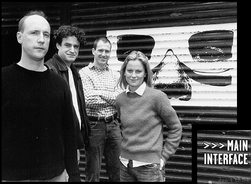
Along with Amy Poehler, the four members produced their own sketch show Upright Citizens Brigade for three seasons on Comedy Central in 1998-2000. During the success of the TV show, UCB opened a comedy theatre and improv school in New York City. In 2005, UCB expanded to the west coast and opened a theatre and improv school in Los Angeles.

The Del Close Marathon, specifically, began to honor the father of long form improv. Del Close was the driving force behind improvisational comedy in Chicago for over 30 years influencing Bill Murray, Tina Fey, Mike Myers, John Belushi, Chris Farley and the Upright Citizens Brigade to name a few. After Del’s passing in 1999, the UCB started the Del Close Marathon to celebrate their mentor and keep alive his name and teachings for future generations.

“I think Del would love to know he is being recognized,” the founders say. “He helped all of these people be great but missed his own boat to fame.  He would love that people are gathering and that he gets talked about. He did not get much credit while alive. And he never got to see improv blow up.”

Amazingly, some improv addicts, “without a life,” actually stay awake for the 52 hour duration and end up “loopy at the end, not able to tell you what happened or how they got there,” according to the orchestrators of the marathon – UCB founders Matt Besser, Ian Roberts and Matt Walsh.

To choose which teams get to perform, the Artistic Director watched 800 submissions (up from 500 last year), trying to get a spread across country with a focus on large groups as opposed to two person shows. This year, the furthest came from Australia. Improvisors travel from near and far for a chance to play and for recognition.

“I don’t know if anyone has been discovered here,” the founders say, “but the cooler agents and managers come here and realize what a great movement it is, where they should be looking. I don’t think anyone has exploded out of here like at Montreal or Aspen, but it puts all the up-and-coming actors on the radar.”

Shows like “Requiem For Drunken Sonic Assault, The Reckoning, To Catch a Predator,” are what that the owners and artistic director most looked forward to watching.
Some other teams, from a splattering of The States, include… The Happy Hoofers (Hollywood), Derelict Toys (Orlando), Antitrust Ice Cream (Raleigh), The Wilhelm (New York), Mrs. Helicopter (Vancouver) – as well as the notorious: ASSSSCAT 3000 and Baby Wants Candy.

Select performances will remain online at www.ucbcomedy.com– for all to watch – so check them out (after this article ;).

Beyond the show, the UCB theatre gives actors many chances to perform, year round, with over 300 people on their stage each week.

What makes UCB, and this Del Close approach, different from other improv houses?

“Belief that the game’ is the heart of all comedy. Breaking the pattern of expected reality and then continuously breaking it in a consistent matter.”

The founders believe, “that is the base of all comedy” and that they can “teach the methods and rules so you can express what you have to share, what you have to say individually, and take your mind of being funny.”

Above all, the founders avoid “half acting,” the cartoon type.

“When you come in here and talk about something just be yourself. Just act,” they say. “Really commit, emotionally, to the thing you are creating and never draw attention to the fact that you are a performer. If you draw attention away from the fiction, that isn’t good. The high water mark of improv is to be accused afterwards of it being scripted.”

On the actual, scripted side, the founders have been hard at work on a book (available asap or when improvisors fly, whatever comes first).

Prepping for this book, the founders focused on defining the “language of improv, so it’s not confusing with different people teaching different things.”

There are certain terms like… Yes And.  “You don’t ‘Yes And’ through the entire scene,” the founders say. “You ‘Yes And’ up to a certain point, until you find that unusual thing.”

“Explore has also been something we are into,” the founders share. “When we say, ‘work at the top of your intelligence’, we mean explore. What is the logic? The philosophy?”

“Heighten means… if this unusual thing is true, what else is true? Explore means… if this unusual thing is true, why is it true? If all you do is heighten, then you run out of steam. It becomes a laundry list.”

Next up on the ‘To Do’ list for UCB founders – a 2nd theatre in NYC. Opening by the beginning of 2011, the new digs, called UCB East, will be on 3rd and Avenue A. It will include all different types of comedy, but more stand-up than improv; giving stand-ups a chance to do what they can’t do in a main stream club.

FYI – the new theatre will also have a bar called, “Hot Chicks.”  When you see it, it is not a trip club.

For more “Hot” info on the Del Close Marathon and the UCB theatre check out www.ucbtheatre.com.

Yes! And… keep your ears open for more news regarding this 2nd UCB location. Rumor has it – “there may be a record broken.” Ooh. Ahh. Ooo…

hugh hefner copy

In a time of discretion, regulations and racial tension, Hugh M. Hefner built an empire without borders or boundaries. Some may call him a genius. Others, a gluttonous instigator. Either way, Hugh Hefner is undoubtedly – a mastermind of self-invention.

Through his strong sense of direction and off kilter perception, Hugh Hefner gained momentum.

Controversy is the way you change things, Hugh Hefner shares in his documentary, Hugh Hefner: Playboy, Activist and Rebel, by Oscar-winningâ„¢ producer/director Brigitte Berman.

The very word, controversy’, makes his choices sound overtly risky. And, certainly, he falls into the rebel category. However, his basic viewpoint lines up with what so many artists strive for… the ability to push boundaries, fully commit to an idea and stand out in a way that’s authentically original.

Who I am is an open book with illustrations, Hefner says, yet how someone interprets those illustrations is very much an ink blot or a Rorschach.
One way to interpret his story, as told in the documentary by Academy Award Winner Brigitte Berman, is to hear beneath and see beyond the obvious Playboy portion of the magazine, media and mansion.

At the center of Hugh Hefner: Playboy Activist, Rebel – the documentary exposes the secrets to success and the costs of creating one’s personal heaven.

To start, Hugh Hefner traveled down the same track as many others. He majored in psychology in order, to understand why we are the way we are. And, escaped into the dreams and fantasies of childhood through the movies.

In that theatre you can escape to anything, anywhere, Hefner shares.

Also, like most day dreamers, Hugh Hefner spent his time at a 9 to 5. He worked as a circulation manager for a children’s magazine until he began to wonder if his life would take the same form as his parents.

There was a moment when I stood on the Michigan Avenue Bridge and looked out on the lake and wondered… is that all there is, Hefner shares. Is this what my life will be?

Days after that, I started making plans for a men’s magazine.

Big thoughts may come easy, yet Hugh Hefner also took action, immediately.
I went to local banks and loan companies and managed to borrow $600, he says. Then, he borrowed more from family, which helped him put together the first issue.

Moving fast made him feel like a one man band. But he stuck with his gumption, discovered that a local calendar company owned the much talked about nude picture of Marilyn Monroe and bought it from them, with the intention of redefining a nation’s take on the girl-next-door.

The result… The first issue was so well received it sold 52,000. By our 5th anniversary we were selling sold over a million, Hugh Hefner says.

I got successful enough to put together a jazz festival and everyone was there. I had turned into a brand. And then I started living the life, turned into a playboy. Promoting the book that way seemed natural to me.

Each success simply meant taking another big step. There were performers who were on blacklists, considered revolutionary, and Hugh Hefner brought them on to his show because he did not agree with silencing talented artists.

I created a show I felt the audience would enjoy, Hefner says.

He acted as a director behind the scenes, making sure he worked on every page of the magazine, saw everything that went into it, got big names and big interviews.

Yet, Hefner didn’t pre-calculate every success. Some began organically, as was the case with his magazine feature called, The Playboy Philosophy. Hefner wrote it for just one issue, because he wanted to make a point about the public’s perception of him.
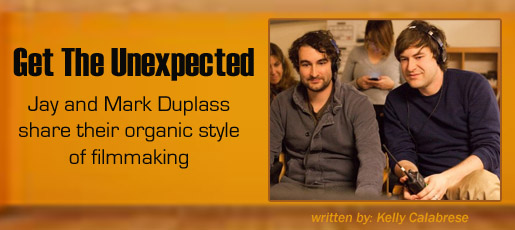
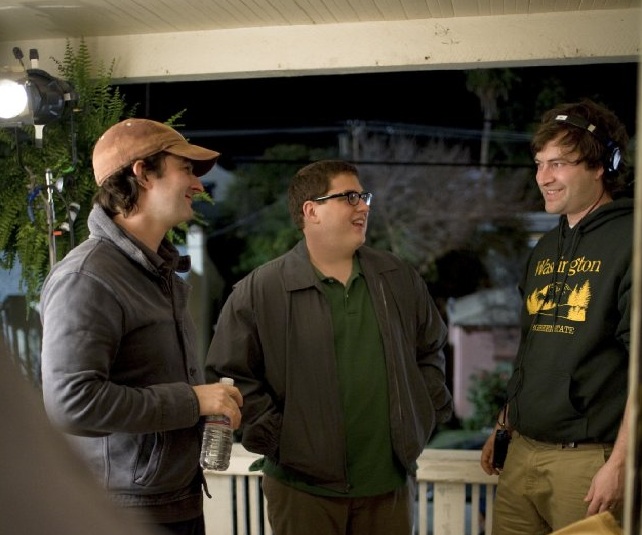
If I was going to be damned for what I believed, I wanted it to be for what I believed, not what they thought I believed, Hefner says.

Readers loved the concept, meant for just one publication, and Hefner continued to write it for the next two to three years as the magazine moved like crazy in circulation form 1 million copies to 7 million a month.

These big rewards came at a big cover price for Hugh Hefner, as working became an obsession.

I would go until I was too tired to work any longer and then would have something to eat and sleep, Hefner says.

Many times he worked three days in a row, striving to keep up with the person everyone expected him to be… Hugh Hefner: Playboy, Activist, Rebel.

Of course, Hefner also has a personal agenda. He stands up for equality, once transported orphans on his private jet full of Playboy bunnies! And he contributes to the preservation of films – a salute to his childhood escapes at the theatre.

Out of all of his tangible achievements, the thing that means the most to me is probably my star on the walk of fame because it is most connected to my childhood and my love of movies, Hefner says.

I thought the latter part of my life would have been looking back on those early days. But suddenly, the here and now is as exciting as it was back then. Who knew? Hugh Hefner shares.

Who knew… that a documentary about a man known for centerfolds could stir up such a straight and narrow(ish) success story? Goes to show that one can learn from anyone, anywhere.

As artists, being open and aware… changes everything.

For the fully exposed picture of Hugh Hefner… with commentary by noted artists: Tony Bennett, Ray Bradbury, James Caan, Reverend Jesse Jackson, George Lucas, Bill Maher, Jenny McCarthy & more…

Check out Hugh Hefner: Playboy, Activist and Rebel – in theatres July 30th.

http://www.hughhefnerplayboyactivistrebel.com/

dup bros

As a writer/director team, Jay and Mark Duplass create smart, witty, relationship driven films for audiences that want to laugh, cry, grimace and applaud – all at the same time. They start by writing a tight script, building a unique,  powerful structure,  and then they do the unexpected. They give their actors complete artistic freedom to evolve each scene into something fresh and inspiring.

“We have a shaggy control,” says the Duplass brothers, Jay & Mark, about their organic approach to filmmaking.

The result… movie magic.

“For us, it is really important to give our actors the freedom to say the lines in a way they want to say them because it gives a natural performance,” says Mark Duplass. “Jay and I believe it is really important to create a structured narrative. But, those tiny, minute nuances that happen between characters are based on a natural chemistry. If you try to control that too much, you can miss out on the magic. And if you over rehearse, it could look fake. “

“The best thing we can get from our actors is to not control them too much. All of our actors are great storytellers. We go with their instincts, in terms of specific, deep rooted things that they want to try or off the wall things they want to try.”

“We want our actors to create the most organic and inspired version of what already exists in the script. What you hope for, in improv, is to find something more fresh, something that inspires people. It is about getting something different than expected.”

The actors evolve the story and then the Duplass brothers “manage the tone more in editing.”


“We want our actors to have an openness, an ability to do several different types of things on a day, so that we have options when editing,” the Duplass brothers say. “We may go more sincere, go in a new direction. Someone who is generous enough to let us go in a different direction, when editing, is important to us.”

For their latest project, Cyrus, the Duplass brothers tell a story about a traditional love triangle, thrown  off kilter a little.

“What inspired us to do this movie was the love triangle, working in a classic genre, but doing it our way.  We look for that perfect mysterious balance between what is funny and tragic, what pulls on the strings of your emotions and keeps people on their toes, because that is what we want to experience when we go to the movies.”

“We are obsessed  with relationships,” the brothers share. “We watch people at airports and film festivals and talk to people about their lives. “

In casting Cyrus, they handpicked their artistic ensemble:  John C. Reilly, Jonah Hill and Marisa Tomei.

“We wrote the movie for John and knew we had to get in the room with him as soon as possible because it started to get more and more specific and he was the perfect guy for the role. We met with him for tacos on the east side of LA and luckily he was into it. At that point, it was about finding a kid who could go head-to-head with John, in a good way, and Jonah was our first choice.”

In casting Jonah, “It was less about his body of work and more about who he is as a person and how he understands us and the kind of movies we make,” says the Duplass brothers. ” We thought he was capable of a lot more and we were both interested in exploring subtler, deeper, darker sides of him that he was capable of and willing to explore.”

“Marisa followed in the same way. We wanted to find people who were strong and passionate and interesting.”

Of course, the Duplass brothers did not begin their filmmaking careers with known actors. Their ground-breaking indie, The Puffy Chair, featured local actors and lower budgets (yet still whipped up that movie magic stardust!)

“The key difference in casting with movie stars is – we wrote Puffy Chair  for our friends and knew we could get them,” the Duplass brothers say. “But we created Cyrus for John Reilly and there was anxiety in whether he would to the movie, if we could get him.”

In looking for actors,  “We want people who are open to, and interested in, the improvisation process. And we want people who are nice. It is very important to keep a healthy environment going and to have people who see the world as we do because we focus on human behavior. We see tragedy and comedy in the same elements and are interested in finding people who want to explore that with us. ”

In this exploration of behavior, relationships and working with major movie stars, the Duplass found it most surprising, “how quickly you slip into a groove.”

“When we first took the meeting with John, Jonah, and Marisa we were intimidated,” the brothers say. “But then we realized they are just normal people, like us, and we were just trying to make art together.”

Though, Mark admits that, “at first, Jay and I were convinced that, creatively, it may never get as good as working with our friends. That working with movie stars wouldn’t reach that same level.”

“But we were pleasantly surprised,” he shares.” Movie stars are movies stars for a reason. We were blown away, not only by their craft, we were blown away from them as people. We just wanted to be around them. Movie stars take a lot of chances and a lot of risks. They are just as scared as everyone else but they put themselves on the line. It was a good collaborative process.”

Once Jay and Mark Duplass capture their organic story, “the nuancing of the comedy / drama blend comes in editorial.”

“We have lots of options, ways to make a scene look comedic or dramatic by what we put before or after it. We have a nine month editorial process minimum.  We test the movie on audiences to see what is working. It is a pretty painstaking process but worth it.”

Also worth it, their unique style of camera work.

“The nature of our camera work is a functional thing for us,” the brothers say. “We do not use specific blocking. We want to give our actors the freedom to move where they want to without having to direct them to a specific  spot.  Our philosophy is, ‘don’t tell an actor to come to the camera’ because we won’t get the spontaneous response  we are looking for. We bring the camera to the actors, it creates that sense of electricity that we like.”

Audiences agree, they also like this sense of electricity, evident by the continuous spark in Jay and Mark’s careers.   Let’s hope this organic brilliance, this dynamic duo, continue to surprise us for many years!

CYRUS premiered in select markets on Friday, June 18.

Jay and Mark Duplass will next direct their original script “Jeff, Who Lives At Home” produced by Jason Reitman.

Also in development right now at the script stage is Table 19 with Sean Levy’s 21 Laps.
www.foxsearchlight.com/cyrus/
www.notmileycyrus.com

getfunnyfast


If you want to succeed in the comedy biz you need to “get as funny as you can as fast as you can,” says Andy Engel, New Talent Director Comix. 

Andy Engel has over eighteen years of experience producing New Talent shows in NYC. He helped countless talent, including: Jim Gaffigan, Ed Helms, Lisa Lampanelli, Greg Giraldo, Demetri Martin, Jessica Kirson, Tom Shillue and many others. He knows how to spot an original comedian and what it takes to make serious tracks in this industry. 

To help NYCastings actors learn more about the Stand-Up biz, Andy shared his years of knowledge and inspirational laugh lines with us… 

Q&A with Andy Engel
Q:  How do you audition new acts/ comedians / what is the process?


The point of the New Talent show is to give anyone who wants an opportunity to perform.  Sometimes people who have never performed do extremely well on our shows, for several reasons. One the crowd is always very supportive and we have positive MC’s who create a supportive environment. Anyone who wants to perform can contact me at the Comix new talent page

However, the absolute best way for me to get to know an aspiring comic, and for an aspiring comic to become all that they’re capable of becoming, is to consider taking my class at the Manhattan Comedy School

www.manhattancomedyschool.com/

The class teaches you the basics of stand – up, performance, and everything you need to become a strong comic.  The class literally shaves years off of making beginner mistakes.  It is a great way to network – we encourage people of all levels to perform, and build a relationship with us, then they can become regulars on our shows. 

Q:  Do you ever scout outside of the club?

Since I have been producing for almost 20 years I have a large network of industry friends who often contact me when they want to showcase someone.

Eddie Brill who books David Letterman, Brian Baldinger who scouts for the Montreal Comedy festival are just some of the people I talk to often who tell me when they see someone who is about to break.  Also, I always have my eyes and ears on the lookout for New Talent, so yes, I do scout outside of the club.
 
Q:  Do they always perform in an amateur hour?

I prefer the term New Talent.  The New Talent shows, while I will give any one the chance to perform, are great shows, for people who care about comedy and having a good time.  To answer your question though, yes when they are starting out on my shows they begin on New Talent Night.

But my shows are the fastest and most direct route to getting paid and guest spots at the club.  When I see someone I like I will tell Kim Hannawhacker and Harlan Halper the owner and booker, that they should watch someone. They don’t have to be one of the 2000 comics submitting DVDs and hope that someone gets around to watching them.  I can ensure they get seen.

Q:  What are you looking for from a comedian – great energy? Consistency? Pure hilarity?

An original, unique, voice, persona, attitude speech pattern that no one else has. Also someone who has good ear for characters, voices, etc. 

Q:  Is it always a straight forward stand up or do you book eccentric, Andy Kauffman style acts as well?

I produce a straight stand-up show so alternative acts wouldn’t work as well on my shows. I have produced a large number of alternative shows with Andy Kauffman type acts which I enjoyed producing because it was a nice change of pace for me and my hosts as well.

Q:  How long of a routine should comedians have on hand and how short should they prepare to cut it down, if needed?

Comics do a 6 minute set on my New Talent shows. Pros do more of course.

Q: How can a comedian in NYC grow a strong career / what does it take?

This will sound very simplistic or almost trite but the answer is get as funny as you can as fast as you can, without stealing, pandering, or doing hack, derivative bits. Comics who get funny fast are hard to ignore.

Q:  I know you recruit for a particular place, but how do the comedy clubs and the opportunities they offer differ from place to place?

The reason I work for the place I work, is we simply offer the best opportunities for New Talent. We offer comics a free Two camera shoot DVD that is unmatched by any other club in NYC. These DVD’s get people development deals and careers. In addition I do auditions for Letterman, Fallon, Kimmel and Comedy Central. I have also just started giving comics free feedback which I think gives our show and edge over every other New talent shows. To answer your question the quality of the DVD’s varies tremendously some clubs literally use security cameras to give to the comics. Our club was designed by a TV and film studio so our acoustics are state of the art. Some clubs were bars that were converted to clubs so that they can’t compete with us. The DVD’s, The feedback the quality of the sound system are a few very distinct differences.


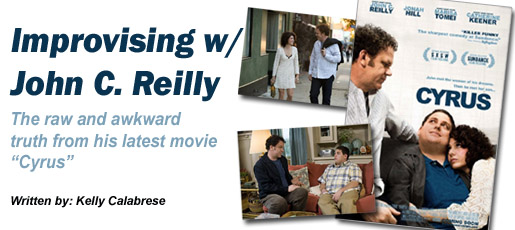
Q:  How can an aspiring comedian sharpen their stand up skills in NYC / hence increase their chances of making it on a main comedy stage?

I go back to get as funny as you can as fast as you can and then people will want to help you. Get stage time.

Q:  How does an emerging (or successful) comedian best network in this business?

Intern for a major comic. Work at the club.

Q:  What is the most serious side of the funny business that aspiring comedians should realize?

You need a mentor, coach someone who can give you honest answers that your fellow comics just don’t have. If someone does my new talent night they can ask me questions and ask for referrals introductions etc. Find a comic you like and offer to intern for them, that can be invaluable.

Thank you Andy for giving us a front row seat to the comedy scene!
For those NYCastings members interested in learning more about the Comix new Talent show, please visit…  http://www.comixny.com/academy.aspx
 

pete-coe

You’ve got to know “when to put your hand on the table and when to discard it,” says Talent Agent Peter Coe, about the entertainment industry.” Know when to say what you are feeling and thinking, how to recognize body language and when to soak everything in.”

Peter Coe has a great deal of experience in this business. He started out as an actor but found sales to be his strong suit so he opened up Peter Coe Talent Agency out of NYC, and the greater Philly area, over eight years ago.

“I am listed as an agent but I really like to act as a manager and take care of my people,” Peter says. “I like when people call me up and ask me questions. If I can help them understand the business better, they’ll have more success at booking jobs and knowing what a casting director or producer wants.”

Since Peter Coe enjoys helping actors play their cards right, NYCastings asked for his strategic advice…

Q&A with Peter Coe

Q:  When it comes to auditions, what is the best way to deal with them?

Be professional, think of this as a business and say yes more often than you say no. If you are in a casting office and waiting for an hour, don’t complain that it is taking too long because you don’t know who is listening and say, “thank you,” when you leave.

If it was a good opportunity, send a thank you note for the audition or an email with something in the header that says, “thanks for the audition, please keep me in mind.” That doesn’t take long to look at.

And, try not to engage in conversations before the audition because you are there to get a job. If someone tries to distract you, say you will speak to them later but right now you need to focus on the sides.

Q:  Unlike many agents, you shuffle through all types of casting notices – from commercials to hosting and print ads – Why?

Two reasons. If a performer is talented enough, there is what I call, “the adjustment factor” – they know how to adjust what they are doing. And, since I am medium range agent on the totem pole of agencies, I have to branch out and find more opportunities for the talent’s sake.  If I only limit myself to one area, which would cut down on the amount of time it takes for me to submit people, then I would miss out and the talent would miss out. There are a lot of commercial jobs but they are mainly non union, so you have to branch out to episodics, commercials and hosting just to sustain yourself and give yourself ways to book jobs.

When the bigger agencies limit a really solid performer to commercials,  instead of branching them out to legit as well, then they do not have fill coverage. When one area might be slower with auditions, sending an actor out for another type can keep their instrument polished.

Q: When it comes to calling, should actors keep in touch with their agents?

Actors should have no fear of calling their agent as long as they are not obnoxious. You are a team and that entitles you to do that. Once a week check in, say hi and have a pleasant conversation so you keep up to date with what is going on. If you have a rep or manager who says, “why are you calling me?” go with someone else.

Q: How can an actor trump the competition?

Actors should get themselves known so when a place has opportunities, and we submit them, the CDs say “oh yeah that person was in last week at Actors Connection and I liked what they did. Let me give them a shot.”

Q: What cards do you hold, that actors don’t see?

What you don’t see is that we have break downs with very specific roles and maybe five out of twenty-five roles actually get an audition because the rest are being offered out.  For legit, they might only look at five or six people per role. Commercially they will look at 300 or 500 people and bring in new faces for the call back. That’s tough for the actor and that’s what they have to understand.

Once the audition is done, besides for actors sending a thank you postcard, we reach out and say, “hope all went well. Let me know if anything is going on.” With some people I keep in touch once a week to see what is coming up. For other places, I am on the phone with them a couple times a day.

Q:  What are some of the best bets, in terms of networking?

I often say, “if you want to take a class with someone, talk to me first” because there are strategic ways of getting in front of people. You don’t want to take a class with someone if they are not doing any work. They could be the nicest people alive but you want to do smart business and not just hard business.

It happened recently. One of my guys just wrote to me that he saw a CD who has not done anything in the last 6 months to a year and I was like, “why did you see them?”

Do not see anyone when they are coming off a season because they are not going to remember you in three months. Go to them when they are starting a new season. Now, taking a class is different because you are there, in their face, for a certain amount of time and they’ll remember you.

Also, you should get on email blasts because there are many people out there and you have to find a way to keep track of as much as possible.  Go to parties. As much as that might seem odd, you will get connections from other actors that can be productive for you.

Q: How do your Ace connections, in both New York and Philly, play out differently?

A lot of times the producers out of Philly will also do casting out of NY, so it allows us to blend in talent or have our talent seen in two cities.

And, in Philly, they typically don’t have a call back. They don’t want to spend as much because it is a secondary session. But there are thousands of talent to pull from in New York so CDs might feel like they did not see everyone in the first audition and bring in new faces for the call back.

Q:  Do producers flush out actors directly or always go straight to a casting director?

Producers typically work through CDs – who work through agents or managers. They go through a casting director because they have pools of talent, multiple places they go through. There is a certain route that this business takes and you don’t want to cut anyone out of that loop because it’s someone’s job. There are times when a producer may not have the greatest budget and choose to do the auditions. Sometimes an producer calls me straight, when they know they like a certain actor I work with.  But the majority of the time, they work with the CD, directly.

Q: When it comes to stacking the deck for success, what ultimate advice do you have for actors at NYCastings?

Think about how you want your hand to play out – you want it to play out where you make money and be successful.

Also, have a second way to make money because it is too small of an environment. The average Philly actor will make 6k. The average New Yorker might make between 12-20k. Get a side job because it allows you to stay in the business longer.

Thank you Peter Coe for sharing your winning strategies with NYCastings!

john reily

Comfort Zone Alert!

On set of his latest movie, Cyrus, John C. Reilly found that a lot of days were very uncomfortable.

Whoa! That sounds like an atypical admission from an actor, yet John has a very good reason to feel like those dreams where you just show up with your underwear on.

You see, the brilliant Duplass brothers (Jay and Mark Duplass) wrote and directed Cyrus and that means a smart script, which actors use mainly as a blueprint – because the Duplass brothers encourage their actors to fully improvise and make each scene totally real to the moment.

They put it in our hands, says John C. Reilly, We all have the script and that was the blueprint to what we were doing. The story did not change that much from the script, but, they left it up to us to find out how the script was going to happen.

In Cyrus, John C. Reilly plays a man, named John, who has no luck on the social scene until he meets the woman of his dreams… a gal named Molly played by NY’s own Marisa Tomei.

John finds his dream gal but with one BIG twist… Molly’s son, Cyrus (played by Jonah Hill), happens to be his Mom’s best friend and he isn’t jiving with this new love thing.

With this unconventional love triangle set up as the movie’s diving board, it makes sense that John C. Reilly found himself belly flopping into an uncomfortable zone, as he improvised each day and put his heart on the line.

Of course, NYCastings wanted to find out more about the awkward moments!
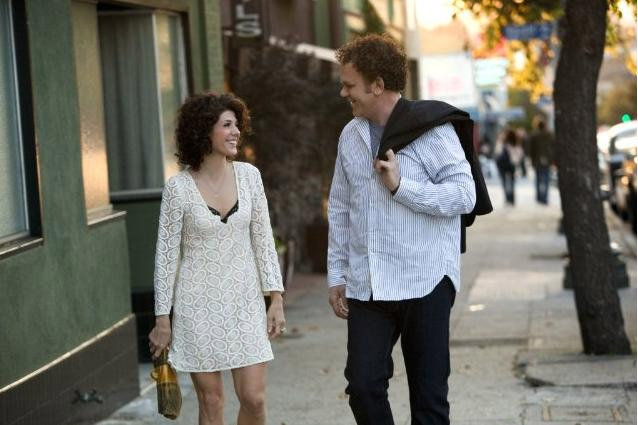
Here’s what else John C. Reilly had to say about the honest flick, when NYCastings got personal with him…

Q&A with John C. Reilly

Q: What drew you to the movie?

I heard about these guys, (Jay Duplass and Mark Duplass), through film festivals and my wife saw Puffy Chair. She brought me a copy of the movie and you can tell from watching Puffy Chair that they like to work with a loose style.

I wanted to work with Mark and Jay and they were fans of mine so they went off and wrote something with me in mind and it fell in place. When I read the script, it was a cool, funny, charming story.

Q: How did you prepare for this improvised script?

Working with these filmmakers, on this movie, the only way to be prepared was to be unprepared; to think it was alright if you didn’t know what you were going to do. It can be unsettling if you just show up to work and some days it felt like those dreams where you just show up with your underwear on.

Q: How did you create your character?

The truth is that every actor prepares in a different way, finds their own way to a character, and how to be connected to a character. If there is something about the character that I don’t know, a special skill or an aspect of their life I am not familiar with, I will study up. But in this case I did not have to do that. I have been in a lot of editing rooms over the years so I know what an editor’s life is like and the guy was close to my age.

Q: Did you rehearse the improv?

No, we didn’t rehearse at all on this movie. For some of the scenes we usually did a blocking rehearsal but even in those situations the Duplass Brothers were like, let’s just shoot the rehearsal because those first moments of honesty, when you are reacting to something you are first seeing or hearing, is the most honest and that is what they were after. They wanted to see what happed when the cameras came on.

Q: As an actor, do you find improvising challenging or liberating?

Both. Definitely both. It is a challenge because you don’t have anything to hide behind. You have to be honest and in the moment. I do not know if I prefer it. I am happy to do it when asked. But I also like to have a well written script. These guys had a well written script yet were interested in the quality that they get when we put it in our own words. We didn’t have to make someone else’s words work. We were able to re-style and it sounds like dialogue written for you, because it is.

Q: When John meets Molly, their chemistry is immediate – how does chemistry play a role for you as an actor / how important is it?
It is really important. The way I work on it (creating chemistry) is to know people a little without talking about the script or gong over the lines. Especially when your characters are supposed to know each other well, it is important to have a comfort zone. Luckily for me, Catherine Keener and I have a long friendship together so that came across in the movie. And Marisa Tomei and I met two days before we stared shooting, briefly. But that worked, too, because we got to know each other better and you see that happen on camera. We didn’t have to fake the awkward moments on camera, it was really just us getting to know each other.

Q: How did you like improvising with Jonah?

Jonah and I worked together on another movie and we basically improvised it, so we knew each other and were pretty friendly. We were both having fun improvising and messing with each other.

I think Jonah is brilliant, really smart and just a great actor. Even more then Will and Jack. Those guys comfort zone is in comedy but I think Jonah is also comfortable doing dramatic things and he is really suited to it. He is smart and he takes ownership on his business in a way that will really serve him well.

Q: Anything that surprised you about Marisa?

I knew she was a great actress and she is really down to earth. But she surprised me in how easily she hung with all the improv. She didn’t have that much experience in the past, but she hung in there with Jonah and me.

Q: What inspired you the most about working with Duplass Brothers

How brave they were about not knowing what they were doing everyday. They wrote a great script and put a lot of care into the location. But when we filmed, they were like, let’s just find it. The plot of the movie could change even, because we shot it in order.

And, I’ve worked with duos before and usually one does the directing and one does everything else. But they were both very involved in every aspect of the movie.

Q: Your character deals with conflict in a specific way, how do you deal with conflict in your real life?

I escape conflict by being really upfront, honest and I try to negotiate with someone. Whenever you get into a situation where you are pulling dirty tricks, it just makes you paranoid and unable to be genuine to yourself. If you have a problem with someone, just call it out.

Q: Why should audiences go see Cyrus?

This movie is for people looking for something a little closer to their own lives, people looking for a more truthful story. There are a lot of bigger than life stories and I love a good popcorn movie, but there is a place for really honest story telling. It has an emotional honesty.

Q: What have you learned from this film experience?

Being totally honest on camera, not knowing what was going on, and trying to write the dialogue on your feet – there were days I was disparaging whether or not we got a good movie in the can. And I learned… that just because you are uncomfortable, does not mean it is not going well. Just do your best.

Thanks to John C. Reilly for getting out of your comfort zone with us!

reel experience

Actor Joanne Baron shares her first hand knowledge of video auditioning

Like a shooting star, Joanne Baron often finds herself traveling a great distance for acting gigs. Yet no matter where she lands, Joanne has to keep up with the casting process… which means auditioning via video.

Just a few weeks ago, when Joanne came to New York City to be a guest star on the final episode of Law & Order, she also received several audition opportunities back at home, in LA, with no physical way to get there.


When I was in New York and knew I had three auditions, I called many places and no one tapes auditions besides Reel Services, Joanne says. I was so relieved when I found them. 


And, I was extremely enthusiastic as an actor, Joanne shares. I had such a fun, creative, positive experience in every way with Reel Services. The videos looked great and the work was responded to well.


When it comes to video auditioning, Joanne feels that they are no different then doing a play, commercial audition, film or soap opera.


There are certain elements of technical reality, Joanne says. If you are trained to live under imaginary circumstances and know how to make choices based on the truth of the material, or the writer’s intention, then looking into a camera, or actually speaking with someone, will modulate the issues but not change them.


Joanne Baron speaks from a lifetime of experience. She appeared in countless projects including, Introducing Dorothy Dandridge, alongside Halle Berry, Frankie and Alice, Superman-2, Mad Men and ER.


Yet, the real power behind Joanne’s star comes from her extensive training.


I was originally a William Esper student, taught with him in NYC and studied under Meisner in private classes in his famed Neighborhood Playhouse, Joanne shares.


Today, Joanne continues the legacy of Meisner and Esper, with her school the Joanne Baron/D.W. Brown Studio in Santa Monica, California; teaching the same specific, sequential training program designed to create an emotionally alive actor of depth, imagination, and truth.


We hand down the biblical tradition of the Meisner work, Joanne says, which we feel is the most practical technique for acting, directing, lighting and producing. The training program illuminates all aspects of story telling.


Speaking of story telling – NYCastings asked Joanne to share some of her stellar insight on the right way to create video auditions…


What do you like about video auditioning?


If you know how to act, it can only be educational and encouraging. I have taped things in life and gotten jobs from it. Someone to Watch Over Me, with Lorraine Bracco (Ridley Scott, Director) was from an audition tape. I have gotten many first jobs in my life from taping something.


I find it creative and encouraging, not only when I get the job, which is the goal, but when someone who would not normally see me takes a look for a few minutes at a tape. That could get you an actual audition.


Also, if you look at your work, and have some ability, it can be very encouraging because you don’t always get feedback at a live audition. Casting directors are very busy and you night not even know that you did a good job. But when you tape it, you can see for yourself.


Why is it so important to already know how to act when it comes to creating a video audition?


Training teaches you the skill, whether it be in dance, piano or acting, and that skill is something within you that you modulate to a degree when you find yourself in different technical situations.


If you don’t have the training, then taping an audition is as useless as asking someone to perform a medical procedure who never went to medical school. Once you have the skill, and the confidence, then there is the potential for a career. A lot of people get lost in this world by wanting to have immediate success.


You can’t have illusions about what you are going to achieve and think you are going to become discovered without any training. There are many people at my school who say they want to audition when they admit to not knowing how to act yet. They just hope that if they can tape something, they can get a job. That is where the modernization of Flip cameras and YouTube is a detriment to society. It makes things accessible and gives the illusion of star potential without the craft and training.


How should you set up the camera shot for a video audition?


The shots vary. People want me to shoot me from the waist up or standing. It happens a few different ways.


Should you edit a video audition?


It is protocol not to cut anything. When you send in a video audition you have to choose a take from start to finish. But you can choose a take, unlike in live theatre where it is what it is.


Are there certain specific techniques for auditioning via video tape?


There are certain tips, like you can’t move a lot or blink a lot. But the basic point I am making is you can either play the piano or not. Then someone can tell you if the camera will be closer to your fingers as you play.


What about those classes that teach video auditioning or on-camera techniques?


I am not going to say there isn’t any value. I would only say that in my experience, as an actor, the specialty in acting should be in adjustments and not education of techniques that impede the potential of an artist to perform.


Every day of the week, someone from my school gets a job. Mariska Hargitay, my student, is 7 years in Law & Order. Sherri Shepherd goes from comedic show to comedic show; from Everyone Loves Raymond to 30 Rock. I am not aware of them needing any specialty technique training.


What happens to all your video auditions?


There is a library of the tapes incase my agent wants to use it as a point of reference for another role. If you have really good video auditions, it might be useful for another part that is similar. Yet, an agent or manager is critical for this. The agent or manager can send your tape to a casting director who might think you are too proper and prim and say, she was so good at this audition. Do you want to take a 30 second peek? Not everyone may have an agent, and not every casting director may be willing to look at it, but it is another tool.


How do you get in the door when casting directors are being bombarded by so many wonderful people? This is one more opportunity. It is a fantastic way to give yourself a shot when a casting director may not give you the time for an audition or think you are the right type. It may open the door for an actual audition or a future audition.


What are the risks of creating a video audition without the right training?


Some people get confused between access and quality. You only get one chance to make a first impression and it does not matter if you have access if you do not have quality to showcase. That is the only downside of video auditioning. You can’t gear these wonderful resources as a replacement for good old fashioned learning and competitive edge training that would make you a candidate to appropriately be taping things.


Can you make a poor impression if the quality of the tape is not strong?


Yes. If it does not seem and look professional, that is the 2nd way to undermine yourself.


1. The talent itself must be strong


2. The manner in which you are taping must be clear and professional.


It doesn’t have to be a set, or some ridiculous attempt at substituting for an actual performance, but it does have to be filmed in a good clean way where the actor is appropriately dressed and the lighting is good.


Why is there an increase in video auditions lately?


People are overwhelmed with the choices and don’t have enough time to meet everyone. Also, people can not always pay to travel across country for auditioning and production may not have enough money to interview people on camera so it saves time and money.


It is part of this new amazing online life, so amazing that I could tape an audition for Entourage at Reel Services and then they can have it in LA ten minutes later.


Any inspirational advice you share with actors?


Everything related to this dream, as it is perused, has to be perseveringly committed to with sacrificial elements. Commit completely to being the best, which means serious training and then persevere once you have that training in a way that you do not allow yourself to consider defeat.


There are so many ways to do what you love. You can do play after play and be in the LA Times and NY times and not make a living at it. That is not failure. Failure is not committing to the leaning and pursuing it with excellence. It always goes back to being good at what you do.


Thanks Joanne Baron for sharing your Reel Experience!


For more information on the Joanne Baron/D.W. Brown Studio in Santa Monica, California visit: www.baronbrown.com


essentialactingelements

Casting Director Tony Pichette speaks scientifically about the casting process

How often do you meet a casting director who majored in Theatre and minored in Chemistry? Not too frequently! That is why I had to ask Casting Director Tony Pichette about his view on the periodic elements… of the acting business. Luckily, for NYCastings, Tony agreed to lend his sense of humor along with his insight about this ever changing, reactive industry.

It all began with a molecule of passion. Tony Pichette decided to learn more about the world of acting by getting to the core of it all… in the mailing room at mega agency Paradigm in NYC. A couple of equations later, he ended up assisting with the casting of voiceovers before moving his skill set over to Kipperman Casting where he still casts national and regional commercials (both on-camera and V/O) for major clients such as: Arm & Hammer, STAPLES, Boston Market and MTV.

Along the way, Tony came up with his own set of life equations. Instead of doing what was expected of him, he did a little bit of everything as he learned to build from the ground up, assist himself, be open to suggestions, get to know what works for him and understand the randomness of it all while blowing a thing up or two for the fun of it. (That part goes back to the Chemistry lab in college, of course!)

For some major advice, here is how Tony Pichette equates the elements learned in life to the casting process:

BUILDING FROM THE GROUND UP

= {N} Networking + {We} Work ethic + {Bn} Being Nice

Actors need to know the people who book jobs. They need to network and have a strong work ethic. When I talk to actors, they think they’ve done everything but we can always do something different to change our course. There is always something to do and people to meet, even the guy in the mailroom..

Also, there is always going to be other actors out there, no matter who you are. So you shouldn’t give someone a reason to not like you, a reason to not bring you in.

ASSIST YOURSELF

= {P} Preparation

Always have some way for another person to get a hold of you and see your work, whether that be a card or headshot. Nowadays headshots are almost old school but you should always have one on you, as well as a card with your website.

You must have a website because if people are interested they will look you up.

And have a reel. People always ask me “should I have a reel?” And I always say, “yes, why not.” Every answer is yes. All options are yes because you never know what is going to stick.

DON’T DO WHAT YOU ARE SUPPSOED TO DO, DO A LITTLE OF ALL YOU KNOW.

= {B} Balls

Actors always wonder, “should I do this?”

Yes, you should.

Sometimes a casting director will not care what you do on the first take or the second take but it has to be something different. There has to be some sort of separation between the two. It’s not about getting the script right. No one cares about getting the script right. No one ever gets the script right. You have to try things. Some of the best actors seem a little wacky because they do not have that thing that stops them.

Also, pay attention to when the casting directors gives you clues about what they want to get from you. If someone says, “be happy” and you were smiling a little, pay attention to the casting director’s body language and words. If they say they want you to smile “way more,” then you need to adjust accordingly.

BLOW THINGS UP

= {Bb} Big balls

Let the director see something in you that they wouldn’t unless you tried something. Actors often say, “I wish I had done this or that.” Your whole job, your whole thing, is about that room. You can meet a million people and create opportunities but it all goes back to that room.

Everything is the same in that room until BOOM you just blow things up.

BEING OPEN TO SUGGESTIONS

= {H} Humble + {Ab} Assume the best

Be modest, humble and receptive to what people are telling you. Don’t think they all hate you. Don’t expect the negativity in people. Assume that other people have their own issues. Assume that they have their own things going on and assume the best of intentions from them. Then you will be able to work with them and say, “ok, I wasn’t smiling enough. Let me try that.”

GETTING TO KNOW WHAT WORKS FOR YOU

= {Sa} Self awareness + {Td} Translating direction

Understand that if you are an energetic person, naturally full of life, then your scale might be a little off because of who you are. Everyone has a scale. Your scale of happiness may be a 4 to 10 with four as your nothing. So when someone says, “be happy,” you have to move your scale over and adjust. Know if you have to hold it back.

Sometimes actors get frustrated because they are doing what is natural for them but they have to understand their instrument.

Many times, when I meet with someone, I just talk with them for a while as I tape them. Then we watch it back and see how they twitch, so many things come out of them. This is something you can correct on your own. You can tape yourself and watch it. But if you aren’t aware, how can you correct it? You have to be self-aware and then move on to trying things. Once you get that down, you can move on to call backs and get bookings.

People think it is such a big mystery – what separates one person from another. Yes, it is hard work. But there are some minor things that you can control. Sometimes, with auditions, you just need to get out of your own way.

UNDERSTANDING THE RANDOMNESS

= {Wh} Work hard + {Tw} Treat people well

I truly believe that if you work hard and treat people well that it will pay off. Understand that working hard does not mean doing something minor. It means working hard. Also understand that 1 plus 2 does not = 3. It is not a sure thing.

When I teach people I say, “This will only be true 80% of the time.” You can know what works for most people. You can know what will improve the chances. But you can not know what will work 100% of the time.

Your goal for commercials, over anything else, is to keep getting seen. The goal is not to be booked. As long as you keep getting seen by the casting director, you can consistently improve. Making those steps is something definite. It is finite feedback because many times you do not get any feedback.

Also, you have to let someone find you. Let someone work with you. So many times, I offer advice to someone in class and they are only thinking, “Are you going to bring me in?” That is not the end goal. The end goal is to learn.

To learn more about Tony Pichette visit his website www.ActorsU.com.

Tony works with college students. He visits schools and shares information about getting started in commercials and the acting business.

get real-515

Strickman-Ripps, Inc. Casting + Research shares how to get REAL acting gigs

Countless companies rely on testimonials, market research, and man-on-the-street interviews to help sell their products and services. This demand for engaging people means another opportunity for actors to make $$$ – IF – they know how to best represent themselves.

When it comes to finding genuine people, Jill Strickman-Ripps rules in casting and research. Jill founded Strickman-Ripps, Inc. Casting & Research in 1992. Prior to starting the company, Jill was producer of Still Photography and Special Projects for Photographer/Director Neal Slavin where they focused on finding authentic people.

“That’s how I got started,” Jill Strickman-Ripps shares. “Then I got involved in market research, getting people’s opinions, and ended up starting a casting company. Now we are a one stop shop, whether you need actors, real people, or a combination.”

At Strickman-Ripps, their team gets all kinds of requests from people with diabetes, to flight attendants who sweat a lot, or even brides-to-be with corns on their feet. For some of these gigs, you need to be something very specific. But overall, you just need to be… yourself.

To help more NYCastings members find a place in this real market, we asked Jill to share her expert opinions.

(Q&A with Jill Strickman-Ripps)

Part One:  What actors need to find within themselves.

Q: How does an actor, be real?
A: When actors come in to be themselves, and this happens in many situations, the most important thing is for the actor to not push their acting. What we are interested in is who you are as a person.  For Select Comfort, we had people come in who had trouble sleeping in the same bed. What happened was that the actors started saying, “I am an actor and this is what I’ve done.” It is not about acting. It’s about you and your spouse and sleeping problems. You need to be aware what they are looking for. Most of the time, especially in the commercial world, they don’t care about your experience. For a short commercial, they want a look and a personality. Be yourself and don’t focus on your acting career.

Q: Are there any mistakes to avoid when auditioning for a “real” person spot?
A:   Actors tend to go over the top. You want to show range but take your cues from the casting director. A good casting director will let you know what they want and they will bring you back in if you get lost. Be in tune with what the casting director asks for and the direction they give you.  Sometimes casting directors will say, Take it in your own direction, but just really try to pay attention to what they are saying.

Q: Physically, are there ways to seem more natural?
A: Many times people say, “I do not want to see anyone too slick, too groomed, too tan, or with too white of teeth.” You have to look great and natural but don’t overdo it. Usually, they want someone to look how they do on the street, how you would look in everyday life.

Q: Is there a manner of speech that comes across more believable?
A:  With real people, the style is usually an interview as opposed to a script. Be engaged and conversational. The good thing about working with an actor is you don’t have to pull them out, they will already be out, but really listen and engage with the person.

Q: What happens if you don’t like the company’s product?
A: Testimonials legally have to be done in a research environment so unless an actor was recruited through a research setting, legally, they would not be asked to do a testimonial. Infomercials are something different but I say, in general, being truthful is really important.  Whatever you do in life you want to have integrity.  If you don’t want to bash something, that’s ok, don’t say anything. However, if they ask you if you like something, I would say to be honest. For my part, people come to me because I do find those who are authentic. For our style, one who is a liar is not going to work. We will detect it.

Part Two: What actors need to know.

Q: On the research side, what should actors do to be more prepared and aware?
A: If you are going in to speak about a product, which is what we do here, then research the product. Google the product and see what is going on, what the trend has been, and what the news says. If you are going in for a doctor, read what it is like to be one. That will give you a feeling, strategically. Things will make more sense when you go in for the audition.

Q: How long should answers be in the interview?
A:  In that situation, you can ask the casting director upfront if they want the short or long answer and they will tell you what they want. In general, a short answer is better. If they are interested, they will ask for more.

Q: What should actors know about testimonial work versus regular commercials?
A: Going in and reading copy, reading a script, is a completely different talent than being able to have a conversation. It is like apples and oranges. That’s why when people ask us to bring in real people to do tons of copy we are like “forget it.” It takes training and skill to be able to do that well.

Q: What more can an actor do to become right for “real” casting?
A: Everyone wants people who are interesting and have passions. Passions in life like cooking, skydiving, hiking, biking are the kind of things that interest people on the creative side. Be able to talk about your love for them. Casting directors want people who are alive and passionate. Some actors can come across as self-absorbed and then people on the other side of the camera start to roll their eyes. Those actors behave as if it is all about them, they are not listening, and it’s not a reciprocal feeling in the way they communicate.

Q: Is there a trend in “real people” casting that actors should know about?
A: Any kind of multi-racial thing is appealing and mixed families. We get many requests for actors and their entire families. We also get calls for actors and five of their closest friends. It is good to have your friends organized incase the call comes. We use actors to find these requests because it is a quicker way to do it.  Actors could prep their family a little before the opportunity comes up. They could get the idea in their head so when it does come up, they are ready.

Q: Are three any tools or skill sets that come in handy?
A: Being able to do video chats, being able to put you on camera and submit it, is important. Have a set up that is ready and looks decent because many times there are submissions with things like “tell us your biggest hair problem.” For this, the best background is simple, well lit and without too much clutter.

Q:  Is there anything that actors should be more aware of?
A: Social media checks. A company hired an actor and then discovered something pornographic about them on the web. Everything you do on the internet can be found. If clients are looking at someone on a tape, they may Google the actor. Be aware of your image and be careful about what you put out there.

Another thing is that actors should not spend a lot of money sending out their headshots by UPS or FedEx. It makes us feel bad because they are spending money they should not be spending. The truth is that we are so saturated with people and if you don’t fit what we are looking for, at a certain time, then you are not in our vision.

Also, do not send too many blanket emails about what you have been up to. Unless a casting director is asking for it, you will be deleted. Sometimes the squeaky wheel gets the grease but you can’t overwhelm. You have to be strategic. Be thoughtful.

To get jobs, I do think the casting sights are very important because that is what we use. Just don’t be loose about what you submit for. Sometimes, people are so far off the spec it creates a bad rep for them.  Be strategic about what you submit for but do use these sites because we do all the time.
In general, if you are going to come in to Strickman-Ripps, you have to be authentic and honest about who you are and what you like. Don’t lie, because the people who hire us expect the people we use to be genuine and we can detect it right away.

Thanks Jill for sharing the real deal with us!!

For more information of Strickman-Ripps, Inc. Casting + Research, visit: www.strickman-ripps.com

just ducky-2

Commercial Agent Carole Ingber shares her upbeat view on the industry.

Feeling swell…

Our conversation with Commercial Agent Carole Ingber went so swimmingly that we just kept on chatting away with her.

Hence… we present Part 2 of our interview!

Please check out Part 1, if you haven’t already, because Carole Ingber shares many truths about the industry; including how things are NOT always what they seem and why actors should simply believe.

For Part 2 or our conversation, NYCastings waded deeper into Carole’s company and what it’s like to work with Ingber and Associates.

But first! NYCastings has breaking news to reveal… we learned that Carole Ingber has her own line of cookies!!!

These yummy treats, called Monchips, come in six different flavors with a top secret liquor ingredient in each of them.

NYCastings snacked on these delicious cookies as we kicked back and asked more personal questions…

Q: What is the difference between working with Ingber and Associates versus some of the more corporate agencies?

When I first started in the business I was at Michael Bloom. I am used to working big but I am a very hands-on person. I don’t like assistants because I want to talk to my clients. You can’t do that at a big office. I am like everyone’s Jewish mother. I can not work in a structured environment. I am very down-to-earth and relaxed. I’ll stay working as late as I need to stay and do whatever I need to do. It’s about getting work for my clients.

Q: You have a very unique set up here with the cookies, snacks and comfortable chairs. Why is that?

I think the most important thing about an agent’s office is to have a comfortable atmosphere. If you are not comfortable when you come in, you are not going to be yourself. You shouldn’t have airs in an office.

Q: Should an actor touch base with you after an audition or does that take up too much time?

Some of my clients do call me up after an audition. They can if they want to. I never say don’t call. I don’t have a problem with it.

Q: Do you get feedback from casting directors after auditions?

The only feedback I get is if someone is really bad and that has only happened once in my life. The person was really nervous and I said you have to see this person again’ and they did and that person ended up getting a call back. So, commercially you don’t get feedback.

My feedback is… if I keep submitting you and you keep getting a time from the same office then you are doing everything you are supposed to be doing. And it is not even about call backs. To me, if you keep getting a time at the same office, after you have been there once, that is feedback.

Q: What do you consider a success rate of auditions versus bookings?

I don’t even think about it. It’s not who I am.

When you are a small business, it’s just me and my clients. I don’t think oh this person has made so much money.’ I don’t really care how much money they make, I just try to help everyone make as much as they can.

I tell people to go out and have fun. If you book something now, great. If you book something later, great. I had a client who took six years to book her first commercial. If an agent believes in their clients, it should not be about how much money they make. It is about who they are.

Q: Will you freelance with someone who has other commercial agents freelancing with them as well?

Absolutely. There are people I have worked with for trillions of years who just want to be freelance. I am fine with that. Sometimes the older generations think they might be better off to keep freelancing. If someone wants to freelance, and I like working with them, I will continue working with them.

Q: How can an actor help YOU out with getting them auditions?

Good Question.

(Points to Justin Lang hanging out on a wicker chair in her office)

Do like Justin does. He likes to schmooze all the right people. It is teamwork. If my clients happen to be someplace and they meet directors or producers it helps if they say I work with Carole Ingber.’

Do what you are supposed to do as an actor. Study, do your improv classes and have a good time. And just keep in touch. That is very important.

Q: Do you have any words of advice for actors?

If you are not available, if you are going out of town, do not wait until the last moment to tell me. I keep a schedule and if you are not available, I write it down. I like to know where everyone is because if I push to submit you on something and then you say oh, I am not going to be here tomorrow’ then another actor has lost out on a time. Not only is it bad for me because I am losing a time, another actor is not getting a time because of you also. Be kind to your fellow actors.

Q: Why do you stay in this business?

I love it. I love my clients. I was never an actor. I am amazed by actors and I sit in an audience mesmerized by them. I love this business.

Speaking of loves, Carole Inbger’s 2nd love – her Monchips – will be available soon. Keep an eye out for them! Yum!


hit_a_high_note copy

Casting over 30 projects a year, Jamibeth Margolis knows what it takes to build a note worthy career.

I love working with actors and knowing actors, says Jamibeth. I love the creative process of working with writes, directors, producers and seeing that negotiation of what goes on at the table and who ends up getting the job.

Jamibeth Margolis casts countless actors, working mainly in theatre, straight plays and musicals. She heads up her own company, Jamibeth Margolis Casting, and directs theatrical shows as well!

Recent credits include Do I Hear a Waltz?, Jekyll and Hyde at the Arvada Center Theater in Denver, and Warsaw (which is currently on track for a Broadway production in the next two years).

Since Jamibeth has so much passion, information and insight, NYCastings asked her to sing out loud about it…

What key differences do you see between theatre and film/TV?

I’ve done a lot of TV over the years and it’s a lot different. First of all, theatre works at a different pace than TV and film. Shows could take months or years to cast, years to get up, and years to raise the money. So, it’s a lot different than film where you call an actor and say come in tomorrow. We want to put you on tape.

The job of a casting director is also different in theatre because we are the people who narrow down the talent, we are supposed to know everyone out there and show the writer, director, producer the best ten or twenty people for a role. But we don’t decide who gets cast. In television and film, the casting directors often do choose who gets casted.

Must an actor be highly trained for theatre?

It really depends on the show, the role, and who we are looking for. Certainly, training is important to the extent that strong colleges attract the agents. I try and go to college showcases every year to see who’s new, who’s great, who might be right for things I am working on. But for the last few shows, I did cast a wider net to agents and casting sites. I think that theatre always has a luck aspect attached to it.

Do you need to be a triple threat, these days?

If you are willing to do shows other than Broadway then you can work a lot as a straight actor. I know people who only do straight plays, they don’t sing at all, and they work all the time. There is Off Broadway, regional theatre, Lincoln Center, and the festivals. There is plenty of work if you don’t sing. However, if you want to sing and do musical theatre the days of having a separate dancing chorus are over so you really need to be able to do everything.

If you didn’t come out of a strong college, can festivals be a way to get noticed?

Absolutely. One of the reasons I work on festival projects is because they then become larger projects. As a performer, you get to work with writers and directors and make a stamp on the show. I have so many actors who love to work on festival shows because you can really help develop a piece. Your input is a lot different than when you do a rented show and, many times, getting in on that level actors stay with the show. I have had actors who have stayed with a show for over four years. If you don’t have an agent you could end up getting as far as someone with an agent. It could be a great stepping stone.

Does getting press from a festival help an actor’s career?

All of the festivals have press reps and some of the shows hire press, themselves. So you get a mention online, on theatre mania and backstage. Plus, I think investors are programmed to check out the festival scene now. I have had producers call me when casting a show and say they saw an actor at a reading and they want me to call them in. You never know. Producers are out there scouting for shows and for actors.

Should an actor strategically choose which theatres they work with?

My philosophy is… It is better to work than to not work. You never know which show is going to move forward, which choreographer is going to call you in again. There are so many theatres with great relationships. It is hard to determine, as a performer, what will get you seen. If you are really interested in getting producers or agents to see you, then I would recommend shows in midtown and theatre row.

How important is Equity?

A lot of shows are sending out their tours as non-equity, now. So I tell my younger students not to join until they are ready, until they are ready to compete with a person who has five Broadway credits. I think it is better, if you are a younger person, to stay non-union because you can audition for the same tour as a union person. You may get the principle role as a twenty-four year old and work with the same production teams as union actors. Personally, I would rather get the experience as a lead in non-equity tour than join and wait around for work.

So many NY based TV shows have recently ended. How is the health of NY theatre, today?

It’s coming back. There was a time when shows were closing and losing money but now it’s better. I also think that producers are more willing to try a show and to try a show without a big star.

Film and TV trends toward ethnically ambiguous actors, right now. Is there a trend in theatre? A type of voice in high demand?

Actually, yes. A trend I am seeing is a going away from the big loud belty sound. A lot more is placed on storytelling and the lyrics. People want to hear less volume. There used to be a time when every show was the big, loud, high singing but now the trend is to forgo that for something that you connect with, that shows who you are.

Should singers take acting classes?

Absolutely. I have seen people audition with glorious voices and then get called back to do sides and have a lot of trouble. You have to stay on top of the acting. You have to. A lot of shows aren’t sung anymore the way they were in the 80s and 90s. You can’t let the sides stand in the way of what gets you a role.

As people get older, is it harder to break into theatre or TV/film?

My vote is film and TV because being an older character actor is really in. There are many shows with older characters. And, many times, as actors get older they realize that they are funny. They really come into their own. Film and TV is harder because it’s more about look and type. Theatre is about characters, voice, and interpretation of what you bring to a role.

Can a person make a living off doing theatre in NY?

I think you can, but it’s definitely difficult. That’s why I really do encourage actors to go out and do TV, under fives, extra work, commercials. You have to be able to work in all of these mediums to make a living. There are people who make a solid living in theatre alone, but not many. I know people on Broadway who are everything from accountants to historians.

Is it possible to go from unknown to landing a Tony nominatable role?

It’s usually at least a minor climb. Many times people will come out of a conservatory and get a job in an ensemble show. The next year they will get a feature and then the third year they may get a Tony nominatable role. So it happens. But it’s rare.

Can you spot those who will make it?

I think so. There are times when I see someone and say, they are going to book a lot of work and I am right. It comes down to confidence in your ability and knowing your material. Sometimes people come out and they are dressed perfectly for themselves and their songs are perfect for their voice and type. They don’t have any misconceptions about who they are and so they do really well. I can always tell when someone comes in and they are doing a song that a teacher told them to do because they don’t connect with it.

Does having an agent matter for landing theatre gigs?

No. It’s much more important for on-camera. Over my fifteen years of casting, and eight or nine Broadway shows, I would say fifty percent were represented. You do not need an agent for theatre. It helps in getting appointments and not having to wait in line. But if you don’t mind waiting in line then it doesn’t matter that much.

What must an actor do in terms of taking classes, ongoing?

You always need to classes consistently. The training doesn’t stop after college. You always need another dance class, voice class, a session with your acting coach before an audition, or an hour in the Drama Book Shop looking for a new monologue. And it’s important to go to the various places around town where you can meet casting directors and agents so they know who you are.

Does working backstage help an actor get a foot in the door at theatres?

I think that gets confusing. I would suggest doing a showcase that’s unpaid, where you are onstage, as opposed to volunteering backstage. The more you can be onstage, the better.

You travel around looking for actors. Do you cast them for NY or elsewhere?

It depends on the show. Many times I go out for national shows, touring shows, regional theatre or Broadway. And sometimes a producer will fly someone here to be seen again.

Any tips for keeping a healthy voice?

You have to be aware of your technique at all times, don’t smoke because you can hear that over time, have a good voice coach that you can go back to, and know your voice. I have actors who would rather wait for something that’s right for them than hurt their voice by trying to hit that high B-flat.

How many shows do you cast in a year?

I cast around thirty or forty a year and sometimes they are all compacted, twelve of them into two months during festival season.

How do you meet actors?

I meet people at the classes I teach and the classes I do for other places. I keep really good files from them. I also got to college showcases. What doesn’t help me, because of the volume of shows I cast, is sending in general submissions. That does not help me as much as saying I saw your post for Family Dinner and I think I am really right for the role. I am much more willing to take a chance on a new person then.

Do you have any special advice for actors?

Yes! When you go into an audition and the director asks you to make an adjustment, you need to make that adjustment. I have seen so many people loose jobs because they get so set into this is how I do the scene. Then, when the director wants to work with them, it’s the same the second time around. You want to show a director that you can change, that you can take direction, are fun to be with, are willing to play and make choices. Being able to make adjustments and coming in with choices is important. If you come in and say, I am going to make this broad and see what they think, that will not work for you. Come in and make big, bold choices and then be willing to change them. I tell people coming out of school that your job, until you get a job, is to go out and auditioning. Learn from your mistakes.

What’s up next?

Next up I am doing a play on Theatre Row called Family Dinner. I cast it and I am also directing it. And next week we have the first big round of auditions for the Midtown International Theatre. I always run the big open call for them. And I just directed a piece that is moving on called Warsaw. Plus a bunch of other stuff for the fall, including two musicals.